
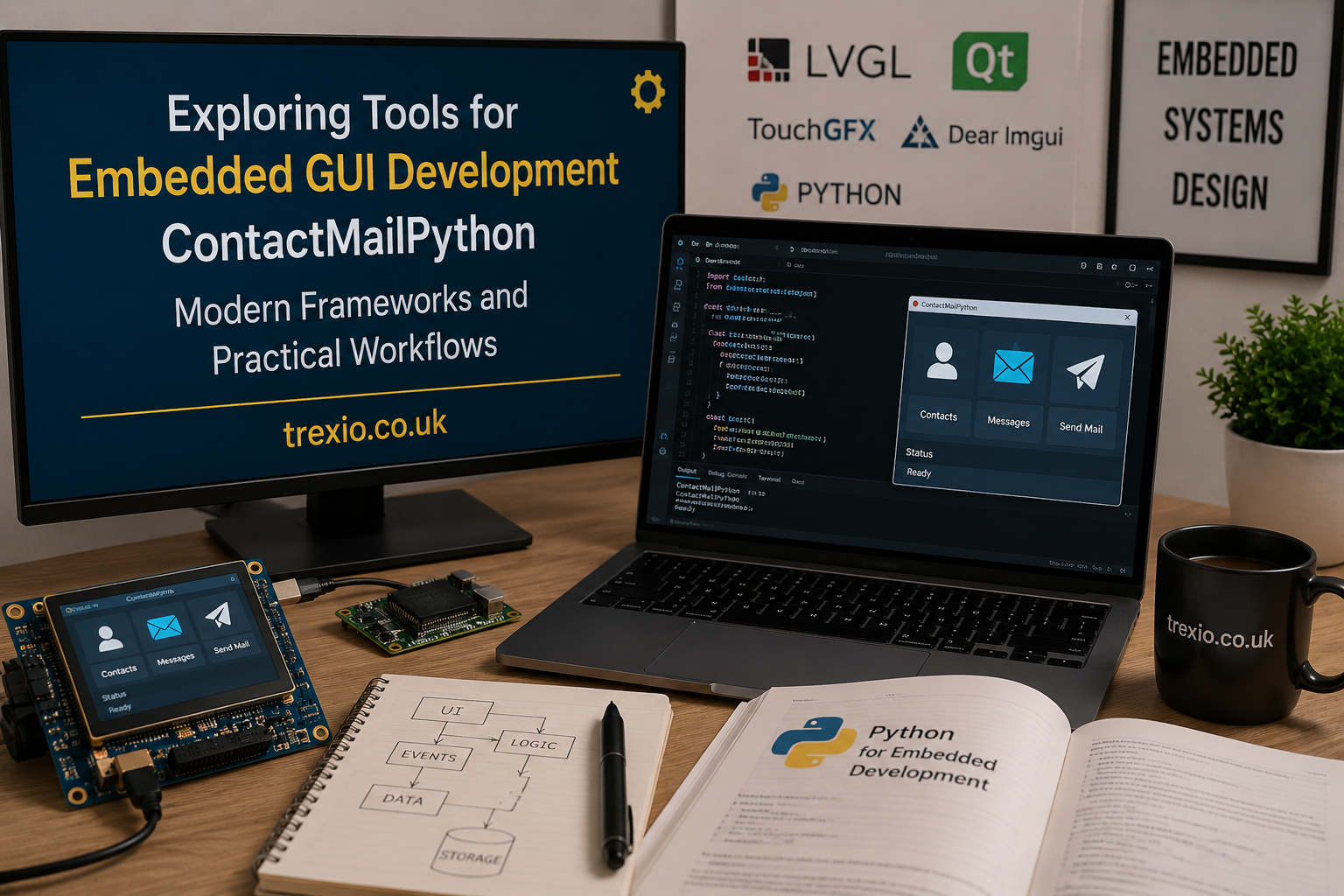
The demand for intelligent embedded devices has increased rapidly across industries, making graphical user interfaces more important than ever. Whether you’re designing industrial control panels, automotive dashboards, medical equipment, or IoT devices, choosing the right embedded GUI development tools can dramatically improve performance, usability, and development speed. Many developers researching exploring tools for embedded gui development contactmailpython are looking for practical ways to combine modern GUI frameworks with Python-powered workflows to build efficient applications. Today’s embedded environments require more than attractive interfaces—they must also be responsive, lightweight, secure, and hardware-aware. Selecting suitable development tools helps reduce maintenance costs while improving long-term scalability. Modern frameworks also simplify deployment across different processors and operating systems. As embedded systems continue to evolve, understanding the available development ecosystem becomes increasingly valuable. This guide explores the essential concepts, technologies, and workflows that professionals use when exploring tools for embedded gui development contactmailpython.
Quick Answer
Exploring tools for embedded gui development contactmailpython involves selecting software frameworks, programming languages, design environments, and testing utilities that simplify creating graphical interfaces for embedded hardware. Popular options include Qt for Embedded, LVGL, TouchGFX, Embedded Wizard, GTK, Python GUI libraries, and hardware simulation platforms. The right combination depends on available system resources, display requirements, operating system support, and project complexity.
Understanding Exploring Tools for Embedded GUI Development ContactMailPython
Embedded graphical interfaces have evolved from simple monochrome displays into highly interactive touch-based experiences. When developers begin exploring tools for embedded gui development contactmailpython, they quickly discover that success depends on balancing performance, usability, and hardware limitations. Unlike desktop software, embedded applications often operate with limited memory, processor power, and storage capacity. Developers must therefore select frameworks optimized for constrained environments while maintaining an excellent user experience. Python frequently plays an important role during automation, testing, scripting, and rapid prototyping stages, making it a valuable companion technology. Many engineering teams also integrate Python utilities into build systems to automate repetitive development tasks. Modern embedded GUI solutions additionally support scalable graphics, animations, touchscreen gestures, multilingual interfaces, and responsive layouts. Understanding how these components work together creates a stronger foundation for successful embedded software projects.
Why Embedded GUI Development Matters
Embedded systems are becoming increasingly visual because users expect intuitive interfaces similar to smartphones and tablets. Engineers exploring tools for embedded gui development contactmailpython recognize that attractive interfaces significantly improve product adoption and customer satisfaction. A carefully designed GUI reduces operator errors by presenting information clearly and simplifying navigation. Modern industrial environments also demand real-time visualization of sensors, alarms, production metrics, and equipment status. Well-designed interfaces shorten training periods and improve operational efficiency across manufacturing, healthcare, automotive, and consumer electronics. Companies that invest in quality embedded GUI design often reduce long-term support costs because users experience fewer usability problems. As devices become smarter, graphical interfaces continue replacing traditional button-driven systems. This evolution makes selecting suitable GUI development tools increasingly important.
Core Components of Embedded GUI Development
Creating embedded graphical interfaces requires several technologies working together seamlessly. Engineers researching exploring tools for embedded gui development contactmailpython should understand these building blocks before choosing a development framework.
Display Engine
The display engine manages screen rendering, animations, colors, fonts, and graphics acceleration. Efficient rendering ensures smooth user interaction while minimizing processor usage.
Graphics Library
Graphics libraries provide reusable UI components including buttons, sliders, charts, icons, menus, and progress indicators. They eliminate the need to build every visual element from scratch.
Hardware Drivers
Hardware drivers connect the graphical framework with display controllers, touchscreens, memory modules, and processors. Proper driver optimization improves responsiveness and overall stability.
Event Management
Modern GUI frameworks include event systems that process touch gestures, keyboard inputs, rotary encoders, timers, and sensor events efficiently.
Key Features to Look for in Embedded GUI Development Tools
Developers exploring tools for embedded gui development contactmailpython often compare software based on features rather than marketing claims. Understanding these capabilities helps identify solutions suitable for long-term projects. Cross-platform compatibility allows interfaces to run across multiple processors with minimal code modifications. Efficient memory management becomes essential for microcontrollers with limited RAM and flash storage. Hardware acceleration support improves animation performance while reducing CPU utilization. Visual design tools enable designers and developers to collaborate more effectively without manually coding every screen. Responsive layouts allow interfaces to adapt to different screen resolutions and orientations. Integrated debugging utilities simplify troubleshooting during development and testing. Long-term vendor support also provides confidence for commercial embedded products. These features collectively contribute to more reliable and maintainable embedded applications.
Performance Optimization Features
Performance remains one of the highest priorities when exploring tools for embedded gui development contactmailpython. Lightweight rendering engines minimize memory consumption while maintaining responsive interfaces. Incremental screen updates reduce unnecessary redraw operations and conserve processing resources. Double buffering eliminates display flickering and creates smoother visual transitions. Efficient image compression reduces storage requirements without sacrificing image quality. GPU acceleration improves rendering speed for animation-heavy interfaces. Hardware abstraction layers simplify migration between different embedded processors. Optimized font rendering enhances readability while minimizing memory usage. These optimization capabilities significantly improve both developer productivity and end-user experience.
Popular Framework Categories Used in Embedded GUI Development
Rather than focusing on a single solution, developers typically evaluate several framework categories while exploring tools for embedded gui development contactmailpython. Each category addresses different hardware capabilities, licensing requirements, and application complexity. Understanding these categories simplifies selecting an appropriate technology stack. Some frameworks prioritize lightweight performance for microcontrollers, while others emphasize rich graphical experiences on embedded Linux platforms. Development teams should also consider documentation quality, community support, and long-term maintenance. Framework flexibility becomes increasingly valuable as products evolve over multiple generations. Selecting the correct category early reduces future migration challenges and development costs. A thoughtful evaluation process leads to more sustainable embedded software architectures.
Open-Source Frameworks
Open-source frameworks provide flexibility, active communities, and lower licensing costs. Many developers appreciate the ability to customize source code for specialized hardware requirements.
Commercial Frameworks
Commercial solutions often include professional technical support, integrated design tools, optimized rendering engines, certification assistance, and enterprise-level documentation.
Hybrid Development Platforms
Hybrid platforms combine visual interface design with traditional programming environments, enabling rapid interface development while maintaining code customization flexibility.
Python’s Role in Embedded GUI Development
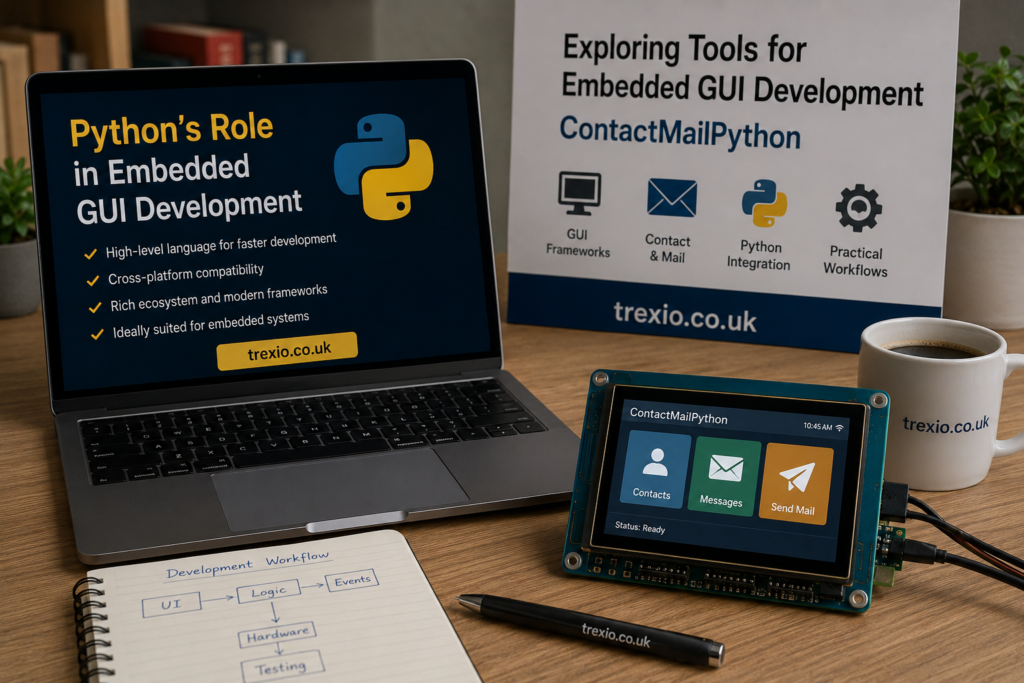
Although Python is not always the primary language used for embedded firmware, it has become increasingly valuable when exploring tools for embedded gui development contactmailpython. Developers frequently use Python to automate testing, generate interface assets, validate configuration files, communicate with embedded hardware, and create simulation environments. Python scripts simplify repetitive development processes that would otherwise consume significant engineering time. Many hardware manufacturers provide Python libraries for interacting with evaluation boards and development kits. Python also supports automated GUI testing through scripting frameworks that simulate user interactions. During early development phases, Python prototypes help validate interface concepts before implementing production firmware. Continuous integration pipelines commonly rely on Python automation for building, testing, packaging, and deployment. These capabilities make Python an essential productivity tool within modern embedded GUI development workflows.
Python Integration Benefits
Python improves development efficiency by reducing manual effort across multiple project stages. Automated asset conversion simplifies managing icons, fonts, localization files, and graphical resources. Testing frameworks verify interface behavior before deployment onto physical hardware. Communication libraries allow engineers to monitor serial ports, network interfaces, USB devices, and debugging outputs. Python’s readability also makes maintenance easier for multidisciplinary engineering teams. Integration with machine learning, analytics, and data visualization further expands embedded development possibilities. As embedded software ecosystems become more sophisticated, Python continues supporting innovation beyond traditional firmware programming. Its versatility explains why many professionals value Python when exploring tools for embedded gui development contactmailpython.
Common Industries Using Embedded GUI Development
The applications of exploring tools for embedded gui development contactmailpython extend across nearly every technology sector. Medical devices depend on reliable graphical interfaces for patient monitoring, diagnostics, and equipment control. Automotive manufacturers develop digital dashboards, infotainment systems, and advanced driver assistance interfaces using embedded GUI technologies. Industrial automation systems display production metrics, equipment status, and maintenance alerts through responsive graphical displays. Consumer electronics manufacturers create intuitive interfaces for smart appliances, wearable devices, and entertainment systems. Retail organizations deploy embedded kiosks for self-service transactions and customer engagement. Aerospace applications require dependable graphical systems that operate under strict reliability standards. Agricultural equipment increasingly incorporates intelligent touchscreen displays for monitoring machinery and environmental conditions. These diverse industries demonstrate the growing importance of embedded graphical development tools.
Industry Requirements Comparison
| Industry | Primary GUI Focus | Performance Priority | Reliability Level |
|---|---|---|---|
| Healthcare | Accuracy and usability | High | Very High |
| Automotive | Real-time interaction | Very High | Very High |
| Industrial Automation | Monitoring and control | High | High |
| Consumer Electronics | User experience | Medium to High | High |
| Aerospace | Safety and reliability | Very High | Extremely High |
| Agriculture | Equipment monitoring | Medium | High |
Choosing the Right Embedded GUI Development Tool
Selecting the right platform is one of the most important decisions when exploring tools for embedded gui development contactmailpython because every embedded project has unique technical requirements. A solution that performs exceptionally well on a Linux-powered industrial computer may not be suitable for a low-power microcontroller with limited RAM and storage. Developers should begin by identifying hardware specifications, display resolution, memory limitations, processor architecture, and expected application complexity before comparing available frameworks. It is equally important to evaluate long-term maintenance, documentation quality, licensing costs, and community support. Projects intended for commercial deployment often benefit from frameworks that receive frequent updates and security improvements. Compatibility with existing development environments and continuous integration pipelines can also reduce implementation time. Teams should additionally consider future scalability because products frequently receive new features after deployment. Taking a structured evaluation approach helps organizations make confident technology decisions while exploring tools for embedded gui development contactmailpython.
Evaluation Criteria Comparison
| Evaluation Factor | Why It Matters | Priority |
|---|---|---|
| Memory Usage | Determines suitability for embedded hardware | Very High |
| CPU Performance | Affects interface responsiveness | Very High |
| Graphics Quality | Improves user experience | High |
| Documentation | Reduces learning curve | High |
| Community Support | Faster troubleshooting | High |
| Licensing | Impacts project budget | Medium |
| Cross-Platform Support | Simplifies future migration | High |
| Security Updates | Improves long-term reliability | Very High |
Hardware Considerations During Development
When exploring tools for embedded gui development contactmailpython, hardware capabilities directly influence software architecture. Embedded developers must understand processor speed, available RAM, flash memory, display controller compatibility, and GPU support before selecting graphical libraries. Larger displays typically require more memory for buffering and rendering operations, while higher animation rates increase processor utilization. Battery-powered devices introduce additional constraints because graphics processing affects energy consumption. Engineers should also verify touchscreen controller compatibility, communication interfaces, and display refresh performance during hardware selection. Storage capacity becomes increasingly important as graphical assets, fonts, localization files, and multimedia content grow in size. Careful benchmarking helps identify performance bottlenecks before production begins. Proper hardware planning ensures that the selected GUI framework performs efficiently throughout the product lifecycle while supporting exploring tools for embedded gui development contactmailpython.
Memory Optimization Strategies
Minimize Image Resources
Large image collections consume valuable flash storage and memory. Compressing graphics and using scalable vector assets where appropriate reduces resource consumption.
Reuse UI Components
Reusable interface elements reduce code duplication and simplify maintenance while lowering overall memory requirements.
Load Resources Dynamically
Dynamic resource loading prevents unnecessary memory allocation by loading graphical assets only when needed.
Optimize Font Libraries
Including only required character sets significantly decreases application size, especially for multilingual interfaces.
Development Workflow for Embedded GUI Projects
A structured workflow greatly improves project efficiency when exploring tools for embedded gui development contactmailpython. Successful teams typically begin with requirement gathering and interface planning before designing wireframes and visual prototypes. Once layouts are validated, developers integrate graphical components with application logic and hardware drivers. Unit testing verifies individual modules before complete system integration. Automated testing tools ensure that interface changes do not introduce unexpected behavior during future releases. Performance profiling identifies rendering bottlenecks and excessive memory usage before deployment. User acceptance testing provides valuable feedback regarding usability, accessibility, and navigation efficiency. Finally, deployment and long-term monitoring allow continuous improvements as customer needs evolve. Following a disciplined workflow reduces project risks while supporting scalable embedded GUI development.
Security Considerations for Embedded GUI Applications
Security is becoming increasingly important while exploring tools for embedded gui development contactmailpython, particularly for connected devices operating in industrial, healthcare, and automotive environments. Graphical interfaces frequently interact with sensitive operational data, making secure communication essential. Developers should implement encrypted communication channels to protect transmitted information from unauthorized access. Authentication mechanisms prevent unauthorized users from accessing configuration menus or administrative controls. Secure boot technologies help ensure firmware integrity during device startup. Regular software updates address newly discovered vulnerabilities throughout the product lifecycle. Logging and monitoring capabilities assist engineers in identifying suspicious activity before it affects system reliability. Building security into every development stage creates more resilient embedded products that maintain user trust.
Future Trends in Embedded GUI Development
The future of exploring tools for embedded gui development contactmailpython continues evolving alongside advances in hardware and software technologies. Artificial intelligence is enabling smarter graphical interfaces capable of adapting to user behavior and environmental conditions. Voice interaction is becoming increasingly common in automotive, healthcare, and industrial systems where touch interaction may be inconvenient. High-resolution displays continue improving visual quality without dramatically increasing power consumption. Cross-platform development environments are simplifying deployment across diverse hardware architectures. Cloud connectivity enables embedded interfaces to receive remote updates, analytics, and configuration changes more efficiently. Edge computing allows complex processing to occur directly on embedded hardware while reducing network latency. Improved graphics acceleration is making sophisticated animations feasible even on resource-constrained devices. These innovations ensure that exploring tools for embedded gui development contactmailpython remains an exciting and rapidly developing field.
Best Practices for Embedded GUI Development
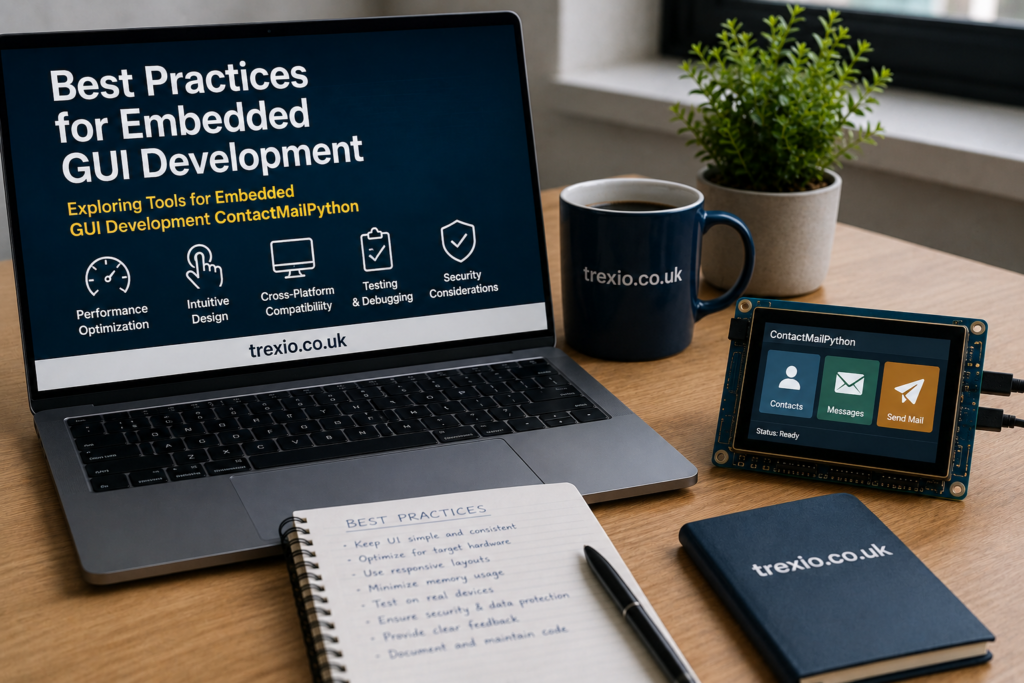
Developers working on exploring tools for embedded gui development contactmailpython should follow proven best practices to improve software quality and long-term maintainability. Begin interface design with user needs rather than technical preferences to create intuitive navigation. Keep layouts simple and avoid unnecessary visual complexity that can reduce performance on embedded hardware. Optimize images, icons, and fonts to minimize memory consumption without compromising readability. Test interfaces on actual hardware instead of relying solely on simulations because real devices often reveal performance differences. Build reusable interface components that simplify future maintenance and feature expansion. Document architecture decisions and coding standards to support collaboration across development teams. Perform regular performance profiling throughout development rather than waiting until deployment. Finally, plan for future software updates by designing modular architectures that accommodate changing requirements while exploring tools for embedded gui development contactmailpython.
Common Mistakes to Avoid
Many development teams encounter avoidable challenges while exploring tools for embedded gui development contactmailpython. Selecting frameworks based solely on popularity instead of hardware compatibility often results in performance problems. Ignoring memory limitations during early design stages can require expensive architectural changes later. Excessive animations may reduce responsiveness on lower-powered processors. Developers sometimes underestimate the importance of usability testing, leading to interfaces that confuse end users despite functioning correctly. Poor documentation makes future maintenance significantly more difficult as projects grow. Inadequate automated testing increases the risk of regressions after software updates. Neglecting accessibility considerations can limit product usability for diverse audiences. Avoiding these common mistakes contributes to more reliable, efficient, and maintainable embedded GUI applications.
Pro Tips for Professional Developers
Profile Performance Frequently
Measure rendering speed, processor utilization, and memory consumption throughout development instead of waiting until final testing.
Design for Scalability
Build modular interfaces that allow new screens and features to be added without major architectural changes.
Use Automated Testing
Python automation scripts can validate interface behavior quickly after every software update, reducing manual testing effort.
Maintain Consistent UI Standards
Consistent colors, typography, spacing, icons, and navigation improve usability while simplifying future interface expansion.
Test Under Real Conditions
Evaluate the interface using production hardware, realistic workloads, varying temperatures, and extended operating periods to identify issues before release.
Comparison of Development Priorities
| Development Goal | Recommended Focus | Expected Benefit |
| Faster Development | Visual design tools | Reduced implementation time |
| Better Performance | Lightweight rendering | Improved responsiveness |
| Lower Memory Usage | Resource optimization | Smaller firmware size |
| Easier Maintenance | Modular architecture | Simplified updates |
| Higher Reliability | Automated testing | Fewer production defects |
| Better User Experience | Responsive UI design | Greater customer satisfaction |
Conclusion
The process of exploring tools for embedded gui development contactmailpython extends far beyond selecting a graphics library or programming language. Successful embedded GUI projects combine thoughtful hardware planning, efficient software architecture, optimized graphical performance, and user-centered interface design. Modern development frameworks provide powerful capabilities, but choosing the right solution requires careful evaluation of memory constraints, processor capabilities, scalability, documentation, and long-term support. Python continues to enhance embedded development through automation, testing, scripting, and workflow optimization, making it a valuable addition to many engineering environments. Organizations that follow structured development practices, prioritize usability, and invest in continuous testing are better positioned to build reliable and maintainable embedded applications. As embedded devices become increasingly connected and intelligent, graphical interfaces will continue serving as the primary interaction layer between users and technology. Staying informed about emerging frameworks and development techniques enables teams to create high-quality products that remain competitive for years. With a strategic approach, exploring tools for embedded gui development contactmailpython becomes a practical pathway toward building responsive, secure, and future-ready embedded systems.
Frequently Asked Questions
1. What does exploring tools for embedded gui development contactmailpython mean?
It refers to evaluating software frameworks, Python-based automation, graphical libraries, and development workflows used to build graphical interfaces for embedded devices.
2. Is Python used directly for embedded GUI applications?
Python is commonly used for automation, testing, scripting, simulation, and rapid prototyping, while production firmware may use C or C++ depending on hardware requirements.
3. Why is an embedded GUI important?
A graphical interface improves usability, simplifies device operation, reduces user errors, and enhances the overall customer experience.
4. Which industries commonly use embedded GUI technology?
Healthcare, automotive, industrial automation, consumer electronics, aerospace, agriculture, retail, and smart home technology all rely heavily on embedded graphical interfaces.
5. What factors should be considered when choosing a GUI framework?
Developers should evaluate memory usage, processor compatibility, rendering performance, documentation, licensing, scalability, community support, and security updates.
6. How does Python improve embedded development?
Python automates testing, manages build processes, generates graphical resources, communicates with hardware, and supports continuous integration workflows.
7. Can embedded GUI applications run on low-memory devices?
Yes. Lightweight frameworks and optimized graphics engines are specifically designed to operate efficiently on memory-constrained microcontrollers.
8. What are the biggest challenges in embedded GUI development?
Common challenges include hardware limitations, memory optimization, responsive rendering, cross-platform compatibility, usability testing, and long-term maintenance.
9. How can developers improve GUI performance?
Optimizing images, reducing unnecessary animations, profiling resource usage, reusing interface components, and selecting efficient rendering libraries all improve performance.
10. What is the future of embedded GUI development?
Future developments include AI-assisted interfaces, edge computing, advanced graphics acceleration, voice interaction, cloud connectivity, and increasingly efficient cross-platform development environments.
Author Bio
Author: Technology Research & Embedded Systems Writer
The author specializes in embedded software engineering, graphical user interface technologies, software development tools, and Python-based automation. With extensive experience researching modern development frameworks and embedded computing trends, the author creates practical, EEAT-focused technical content that helps developers, engineers, and businesses make informed technology decisions while staying current with industry best practices.