

Modern software development has become increasingly complex as applications depend on dozens or even hundreds of packages, libraries, programming languages, and operating systems. One of the biggest challenges organizations face is ensuring that software behaves exactly the same across every developer workstation, testing environment, and production server. This is why many engineering teams are searching for better reproducible build solutions that eliminate configuration drift and dependency conflicts. When organizations evaluate the developer tools company Flox on reproducible software builds, they often want to know whether the platform truly delivers consistent environments while improving productivity. Flox has gained attention for simplifying package management, enabling portable development environments, and supporting collaborative engineering workflows. Rather than relying on manually configured systems, developers can define environments declaratively and reproduce them with minimal effort. This article explores Flox in detail, examining its technology, architecture, capabilities, and practical value for modern software teams. By understanding how Flox approaches reproducible software builds, businesses can determine whether it aligns with their engineering objectives and long-term infrastructure strategy.
Quick Answer
If you evaluate the developer tools company Flox on reproducible software builds, you’ll find that it offers a modern environment management platform focused on consistency, portability, and developer productivity. Flox builds upon proven package management concepts while making reproducible environments significantly easier to create, share, and maintain across teams. It reduces dependency conflicts, supports multiple programming languages, simplifies onboarding, and helps eliminate “works on my machine” problems. While organizations may still need to learn new workflows, the platform offers substantial benefits for cloud-native development, DevOps teams, open-source contributors, and enterprise software projects that require reliable, repeatable builds.
Understanding Flox as a Developer Tools Company
Developers who evaluate the developer tools company Flox on reproducible software builds quickly discover that Flox is designed to solve one of software engineering’s oldest challenges: inconsistent development environments. Instead of manually installing packages, configuring dependencies, and troubleshooting compatibility issues, Flox allows developers to define their entire development environment in a reproducible format. This creates consistency regardless of whether the project is opened on macOS, Linux, cloud infrastructure, or CI/CD pipelines. The company’s philosophy emphasizes portability, reliability, and collaboration across distributed engineering teams. As software projects become larger and increasingly dependent on complex package ecosystems, environment reproducibility has become essential rather than optional. Flox addresses this challenge by combining modern package management with simplified environment sharing. The platform aims to reduce engineering friction while enabling faster project onboarding and predictable software builds. These characteristics make Flox an attractive option for organizations investing heavily in DevOps and cloud-native development.
Company Background
Flox emerged to improve developer workflows by simplifying software environment management across different operating systems and infrastructure environments. Traditional dependency management often relies on manually installed packages that differ between machines, creating hidden inconsistencies that eventually lead to deployment failures. Flox approaches this problem through reproducible environments that define software requirements explicitly. Instead of expecting developers to remember installation procedures, the platform automates environment creation using version-controlled configuration files. This aligns well with Infrastructure as Code principles that many modern engineering organizations already follow. Teams using cloud services, Kubernetes clusters, containerized workloads, and continuous integration pipelines often benefit from consistent build environments that reduce unexpected errors. The company’s technology reflects growing demand for reproducible software engineering practices across enterprises and startups alike. As a result, more organizations continue to evaluate the developer tools company Flox on reproducible software builds when modernizing their development infrastructure.
Mission and Vision
The primary mission behind Flox is making software environments reproducible, shareable, and easy to maintain. Developers frequently lose valuable hours diagnosing environment differences rather than writing production-ready code. Flox attempts to eliminate these inefficiencies by allowing teams to define standardized environments that work consistently across every machine. This reduces operational overhead while improving software reliability. The platform also promotes collaboration because every contributor works within identical software configurations. Instead of exchanging lengthy setup documentation, developers can initialize projects quickly using predefined environment definitions. This streamlined workflow benefits remote teams, open-source contributors, contractors, and enterprise engineering departments alike. Organizations that evaluate the developer tools company Flox on reproducible software builds often recognize that reproducibility contributes directly to higher engineering productivity and fewer deployment surprises.
Target Users
Flox primarily serves software developers, DevOps engineers, platform engineers, infrastructure architects, and organizations managing complex software ecosystems. Startups appreciate the faster onboarding process because new developers can become productive within minutes rather than spending days configuring local environments. Enterprise organizations value the consistency that reproducible software builds provide across multiple teams and geographic regions. Open-source maintainers also benefit because contributors can reproduce identical development environments regardless of operating system differences. Academic researchers and scientific computing professionals may also leverage reproducible environments for computational experiments requiring precise software versions. Freelance developers managing multiple client projects appreciate isolated environments that prevent dependency conflicts between applications. Engineering managers seeking predictable development workflows increasingly evaluate the developer tools company Flox on reproducible software builds to improve operational efficiency. These diverse use cases demonstrate Flox’s flexibility across industries.
What Are Reproducible Software Builds?
Reproducible software builds refer to development processes where identical source code consistently produces identical outputs regardless of where or when the build occurs. When teams evaluate the developer tools company Flox on reproducible software builds, understanding this concept becomes essential because reproducibility forms the foundation of modern software reliability. Traditional development environments often differ due to operating system updates, package versions, manually installed libraries, or configuration inconsistencies. Even small differences can produce unexpected runtime behavior or deployment failures. Reproducible builds eliminate these uncertainties by defining dependencies explicitly. This ensures that every build uses identical versions, configurations, and package sources. As organizations increasingly embrace DevOps automation, reproducibility has become a critical engineering requirement rather than simply a best practice. Reliable software delivery depends heavily on predictable environments throughout the software lifecycle.
Definition
A reproducible software build is one that can be recreated repeatedly with identical outputs regardless of developer location or machine configuration. Every dependency, compiler version, runtime environment, and supporting package is defined precisely so there is no ambiguity during execution. This approach dramatically improves software reliability because developers no longer depend on undocumented local configurations. Instead, every required component exists within a controlled environment definition. Flox helps automate this process by providing portable environments that simplify dependency management across operating systems. Organizations that evaluate the developer tools company Flox on reproducible software builds frequently prioritize this capability because it minimizes deployment inconsistencies while improving long-term maintainability. The result is greater confidence throughout development, testing, staging, and production deployments.
Why Reproducibility Matters
Software reproducibility improves engineering quality by reducing uncertainty throughout the software delivery lifecycle. Development teams frequently encounter situations where applications function correctly on one computer but fail elsewhere because dependency versions differ. These inconsistencies consume valuable engineering resources and delay product releases. Reproducible environments reduce troubleshooting time by ensuring everyone uses identical software configurations. They also simplify auditing because organizations know exactly which package versions were used during development. Security improves as well since dependency versions remain traceable and easier to update systematically. Continuous integration pipelines become more reliable because builds execute within standardized environments. When companies evaluate the developer tools company Flox on reproducible software builds, reproducibility often becomes one of the strongest reasons for adoption due to its measurable impact on engineering efficiency and software quality.
Common Build Challenges
Many software teams struggle with dependency conflicts, incompatible operating systems, outdated package versions, undocumented installation steps, and inconsistent runtime environments. These issues frequently appear during onboarding when new developers attempt to configure projects for the first time. Legacy applications often depend on software versions that differ from newer development environments, making maintenance increasingly difficult. Cloud deployments may also introduce subtle compatibility differences between staging and production systems. Without reproducible environments, organizations rely heavily on documentation that eventually becomes outdated. Manual installation procedures create opportunities for human error and inconsistent configurations. Flox addresses these issues through automated environment definitions that reduce configuration drift. These practical benefits encourage organizations to evaluate the developer tools company Flox on reproducible software builds before selecting long-term development infrastructure solutions.
Flox Platform Architecture
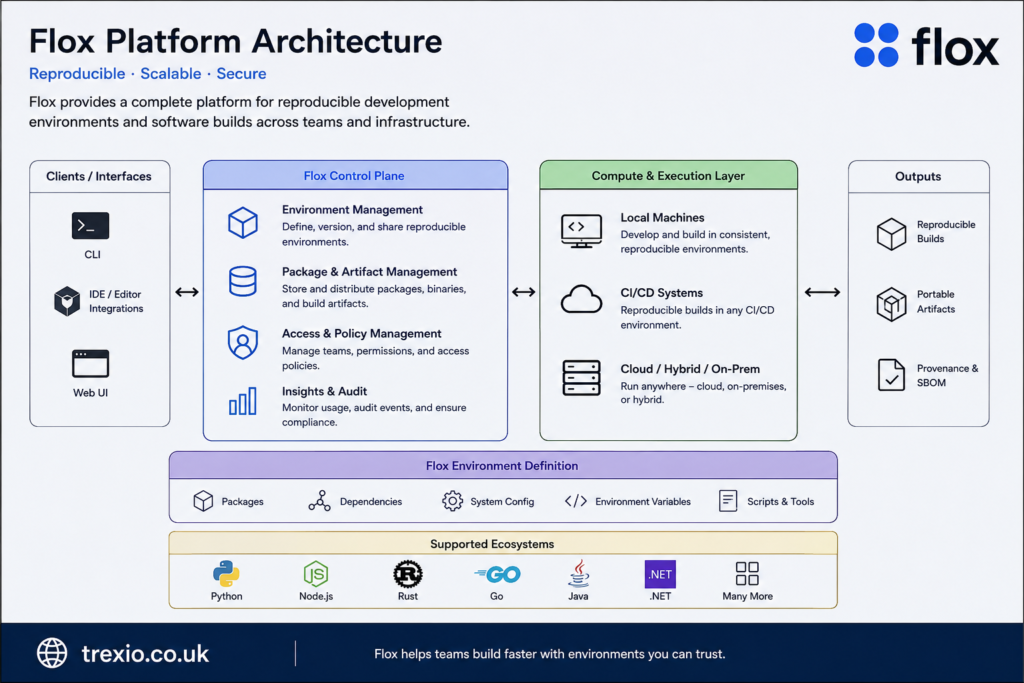
The architecture behind Flox focuses on creating deterministic software environments that remain portable across different operating systems and infrastructure platforms. Rather than managing dependencies independently on every developer workstation, Flox centralizes environment definitions so identical configurations can be reproduced repeatedly. This architectural approach improves consistency throughout development, testing, and deployment workflows. Engineering teams benefit from predictable package versions, isolated dependencies, and simplified collaboration across distributed teams. The platform also integrates naturally with modern DevOps methodologies, Infrastructure as Code practices, and cloud-native software engineering principles. As organizations increasingly automate software delivery pipelines, deterministic environment management becomes an important competitive advantage. Businesses that evaluate the developer tools company Flox on reproducible software builds frequently view its architecture as one of its strongest technical differentiators. Its design reflects growing industry demand for repeatable software engineering practices.
Environment Management
Environment management represents one of Flox’s most valuable capabilities because it standardizes software configurations across every stage of development. Developers define required packages, runtime versions, libraries, and tools once, allowing identical environments to be recreated automatically whenever needed. This eliminates lengthy installation guides and reduces onboarding time significantly. Team members can move between projects without worrying about conflicting software versions installed locally. Consistent environments also improve debugging because issues become easier to reproduce. Infrastructure teams gain greater confidence when deploying applications since development closely matches production conditions. This streamlined approach improves engineering efficiency while minimizing operational complexity. These advantages explain why many organizations evaluate the developer tools company Flox on reproducible software builds when seeking modern environment management platforms.
Package Management
Package management lies at the heart of reproducible software engineering, and Flox emphasizes deterministic dependency resolution to improve software consistency. Instead of relying on manually installed packages that change over time, the platform defines exact versions within reproducible environment specifications. This prevents unexpected updates from introducing instability into software projects. Developers can confidently share environments knowing dependencies remain identical regardless of operating system differences. Controlled package management also strengthens security because organizations can audit software versions more effectively. Predictable dependency resolution simplifies troubleshooting while reducing maintenance costs over long-term software projects. Combined with environment isolation, package management becomes significantly more reliable than traditional approaches. These capabilities continue to encourage engineering teams to evaluate the developer tools company Flox on reproducible software builds as they modernize their software development workflows.
Cross-Platform Compatibility
One of the strongest reasons organizations evaluate the developer tools company Flox on reproducible software builds is its emphasis on cross-platform consistency. Modern engineering teams rarely work on a single operating system, as developers commonly use macOS, Linux, and cloud-based development environments simultaneously. Without a standardized environment management solution, differences between operating systems often introduce subtle bugs that are difficult to diagnose. Flox minimizes these inconsistencies by allowing teams to define portable environments that behave predictably regardless of where the software is executed. This capability is particularly valuable for distributed organizations where developers work remotely using different hardware configurations. It also reduces the time required to troubleshoot platform-specific issues because the underlying environment remains consistent across machines. Engineering leaders benefit from greater confidence in software quality since builds become more deterministic throughout development and testing. As businesses continue to evaluate the developer tools company Flox on reproducible software builds, cross-platform compatibility consistently ranks among its most attractive capabilities.
Strengths of Flox for Reproducible Software Builds
Organizations that evaluate the developer tools company Flox on reproducible software builds often recognize several advantages that directly impact developer productivity and operational efficiency. Flox simplifies dependency management by allowing environments to be described declaratively, reducing manual configuration and eliminating many common setup errors. New developers can join projects more quickly because environment provisioning becomes automated rather than documentation-dependent. Development teams also experience fewer “works on my machine” issues, which improves collaboration and accelerates release cycles. Since environments remain version-controlled, organizations gain better visibility into software dependencies and can reproduce historical builds with greater confidence. Flox also aligns well with Infrastructure as Code practices, making it easier to integrate into modern DevOps pipelines. These strengths contribute to improved software reliability, predictable deployments, and lower maintenance costs. For companies seeking consistent engineering workflows, these benefits make it worthwhile to evaluate the developer tools company Flox on reproducible software builds as part of their technology strategy.
Improved Developer Onboarding
Developer onboarding is often one of the most time-consuming aspects of software engineering, particularly for large projects with numerous dependencies. Flox addresses this challenge by enabling standardized development environments that new contributors can reproduce quickly without following lengthy setup instructions. Instead of manually installing tools, libraries, and runtimes, developers initialize an environment using predefined configurations that ensure consistency from day one. This approach reduces onboarding from days to hours in many development scenarios while minimizing the likelihood of configuration-related errors. Faster onboarding also allows engineering managers to scale teams more efficiently without sacrificing productivity. Contractors, remote employees, and open-source contributors benefit from a streamlined setup process that requires minimal troubleshooting. These improvements strengthen collaboration across globally distributed engineering teams. As a result, organizations frequently evaluate the developer tools company Flox on reproducible software builds when seeking solutions that improve both developer experience and operational efficiency.
Better Collaboration Across Teams
Collaboration becomes significantly easier when every team member works within identical software environments. Flox enables developers, QA engineers, DevOps specialists, and platform engineers to share reproducible configurations that eliminate inconsistencies throughout the software development lifecycle. Instead of exchanging lengthy setup documents or troubleshooting environment-specific issues, teams can focus on building, testing, and delivering features. Version-controlled environments also simplify code reviews because reviewers know the software was developed using the same dependencies and tooling. This consistency reduces misunderstandings and improves communication between technical teams. It also strengthens collaboration with external contributors who can reproduce the project’s environment without manual intervention. Organizations that evaluate the developer tools company Flox on reproducible software builds frequently identify improved teamwork as a major operational advantage.
Potential Limitations of Flox
Although many organizations evaluate the developer tools company Flox on reproducible software builds favorably, no development platform is without limitations. Teams adopting Flox may encounter an initial learning curve as developers become familiar with declarative environments and new package management workflows. Existing projects with deeply customized infrastructure may also require additional planning before migration. Organizations that rely heavily on legacy tooling might need to adapt established processes to take full advantage of reproducible environments. While these adjustments typically produce long-term benefits, they can temporarily increase implementation effort during adoption. Additionally, engineering leaders should assess how Flox integrates with their current CI/CD systems, cloud platforms, and security requirements before deployment. Proper planning and gradual rollout strategies usually reduce migration challenges significantly. Understanding these considerations helps organizations make informed decisions when they evaluate the developer tools company Flox on reproducible software builds.
Learning Curve
Developers accustomed to traditional package managers may need time to understand Flox’s workflow and environment definitions. Learning declarative configuration concepts requires some investment, particularly for engineers unfamiliar with reproducible infrastructure practices. However, once teams become comfortable with the platform, the long-term productivity gains generally outweigh the initial adjustment period. Organizations can accelerate adoption through internal documentation, training sessions, and pilot projects that demonstrate the platform’s value. Engineering leadership also plays an important role by encouraging standardized workflows and knowledge sharing. With consistent adoption strategies, most teams successfully integrate Flox into existing development practices. These implementation considerations should be evaluated carefully by organizations that evaluate the developer tools company Flox on reproducible software builds.
Flox vs Traditional Development Environment Management
| Feature | Flox | Traditional Environment Setup |
|---|---|---|
| Reproducible Builds | Excellent | Limited |
| Dependency Isolation | Built-in | Often Manual |
| Version Pinning | Yes | Inconsistent |
| Developer Onboarding | Fast | Often Slow |
| Cross-Platform Support | Strong | Varies |
| Collaboration | High | Moderate |
| Configuration Drift | Minimal | Common |
| Infrastructure Consistency | High | Difficult |
The comparison illustrates why many engineering organizations continue to evaluate the developer tools company Flox on reproducible software builds when modernizing software delivery processes. Traditional development workflows often rely on undocumented local configurations that become increasingly difficult to maintain over time. Flox replaces these inconsistencies with standardized, version-controlled environments that improve reliability across development, testing, and production. Engineering teams gain more predictable workflows while reducing operational overhead associated with dependency conflicts. Organizations seeking scalable software engineering practices generally find reproducible environments easier to maintain than manually configured systems.
Who Should Consider Flox?

Best Use Cases
Flox is particularly well suited for organizations managing complex software projects with multiple contributors, frequent releases, and cloud-native deployment strategies. Startups can accelerate product development by reducing onboarding time and simplifying dependency management. Medium-sized businesses benefit from standardized workflows that improve collaboration across engineering teams. Large enterprises gain greater control over software consistency, compliance, and infrastructure reliability. Open-source maintainers also appreciate reproducible environments that simplify external contributions. DevOps teams can integrate Flox into automated deployment pipelines to strengthen build reliability and deployment consistency. Academic researchers and scientific computing professionals may also find value in reproducible computational environments. These varied scenarios explain why businesses continue to evaluate the developer tools company Flox on reproducible software builds across many industries.
Best Practices for Using Flox
Implementing Flox effectively requires thoughtful planning and consistent engineering practices. Organizations should define environments using version-controlled configuration files and review updates as part of normal development workflows. Teams should establish clear dependency management policies to minimize unnecessary package changes and maintain reproducibility over time. Regularly testing environments within CI/CD pipelines helps verify consistency before production deployments. Engineering teams should document environment updates and encourage knowledge sharing among contributors to simplify long-term maintenance. Security reviews should also include dependency audits to ensure software components remain current and compliant with organizational policies. Combining Flox with Infrastructure as Code practices further improves deployment consistency across cloud environments. Organizations that evaluate the developer tools company Flox on reproducible software builds typically achieve the best outcomes when reproducibility becomes a standard engineering principle rather than an isolated tool adoption.
Common Mistakes to Avoid
Many organizations fail to realize the full value of reproducible environments because of avoidable implementation mistakes. One common issue is allowing developers to modify local environments without updating shared configuration files, which reintroduces configuration drift. Another mistake is neglecting version pinning, leading to unexpected dependency updates that compromise build consistency. Some teams also delay integrating reproducible environments into CI/CD pipelines, reducing the overall effectiveness of deterministic builds. Inadequate documentation can slow onboarding despite having standardized environments. Ignoring periodic dependency reviews may also expose projects to outdated or vulnerable software packages. Finally, rushing organization-wide adoption without pilot testing can create unnecessary resistance among development teams. Avoiding these mistakes enables organizations to maximize the benefits when they evaluate the developer tools company Flox on reproducible software builds.
Pro Tips
- Store environment definitions alongside application source code.
- Review dependency updates before merging changes.
- Integrate Flox environments into automated CI/CD workflows.
- Use version pinning to maintain deterministic builds.
- Regularly audit dependencies for security and compatibility.
- Train developers on reproducible environment best practices.
- Test software across supported operating systems before release.
- Document environment changes as part of project release notes.
- Combine Flox with Infrastructure as Code for greater consistency.
- Periodically review environment configurations to eliminate unused dependencies.
Final Evaluation
Organizations that evaluate the developer tools company Flox on reproducible software builds will likely find a modern platform designed to solve one of software engineering’s most persistent challenges: inconsistent development environments. Flox delivers reproducible, portable, and collaborative software environments that reduce dependency conflicts, improve onboarding, and strengthen software reliability across multiple operating systems. Its declarative approach aligns naturally with DevOps, Infrastructure as Code, and cloud-native development practices, making it a valuable addition to modern engineering workflows. Although adoption requires an initial learning investment, the long-term benefits generally outweigh the implementation effort for teams seeking predictable software delivery. From startups to enterprise engineering organizations, Flox provides practical solutions for improving consistency throughout the software lifecycle. Businesses focused on developer productivity, operational efficiency, and reliable software builds should carefully consider its capabilities. Overall, Flox stands out as a strong option for organizations committed to reproducible software engineering and sustainable development practices.
Frequently Asked Questions (FAQs)
1. What is Flox?
Flox is a developer environment management platform that helps create reproducible software environments for consistent development and deployment.
2. Why are reproducible software builds important?
They ensure software behaves consistently across developer machines, testing environments, and production systems.
3. Does Flox support multiple operating systems?
Yes. Flox is designed to provide portable environments that work across supported operating systems.
4. Is Flox suitable for enterprise development?
Yes. Many enterprise teams use reproducible environments to improve collaboration, compliance, and deployment reliability.
5. Can Flox improve developer onboarding?
Yes. Standardized environments significantly reduce setup time for new developers.
6. Does Flox integrate with CI/CD pipelines?
Yes. It can be incorporated into modern CI/CD workflows to improve build consistency.
7. What industries benefit most from Flox?
Software companies, SaaS providers, cloud-native organizations, DevOps teams, research institutions, and open-source projects commonly benefit.
8. Is there a learning curve?
There is an initial learning curve, but most teams adapt quickly and gain long-term productivity improvements.
9. How does Flox reduce dependency conflicts?
It uses reproducible, version-controlled environment definitions that standardize dependencies across development environments.
10. Who should evaluate the developer tools company Flox on reproducible software builds?
Organizations seeking reliable, portable, and deterministic software development environments should seriously evaluate the developer tools company Flox on reproducible software builds.
Author Bio
James Carter is a technology writer and software infrastructure researcher specializing in developer tools, DevOps, cloud-native platforms, software engineering best practices, and reproducible development environments. He creates evidence-based, SEO-focused content that helps businesses, engineering teams, and technology professionals evaluate modern software solutions while following Google’s EEAT and Helpful Content guidelines.