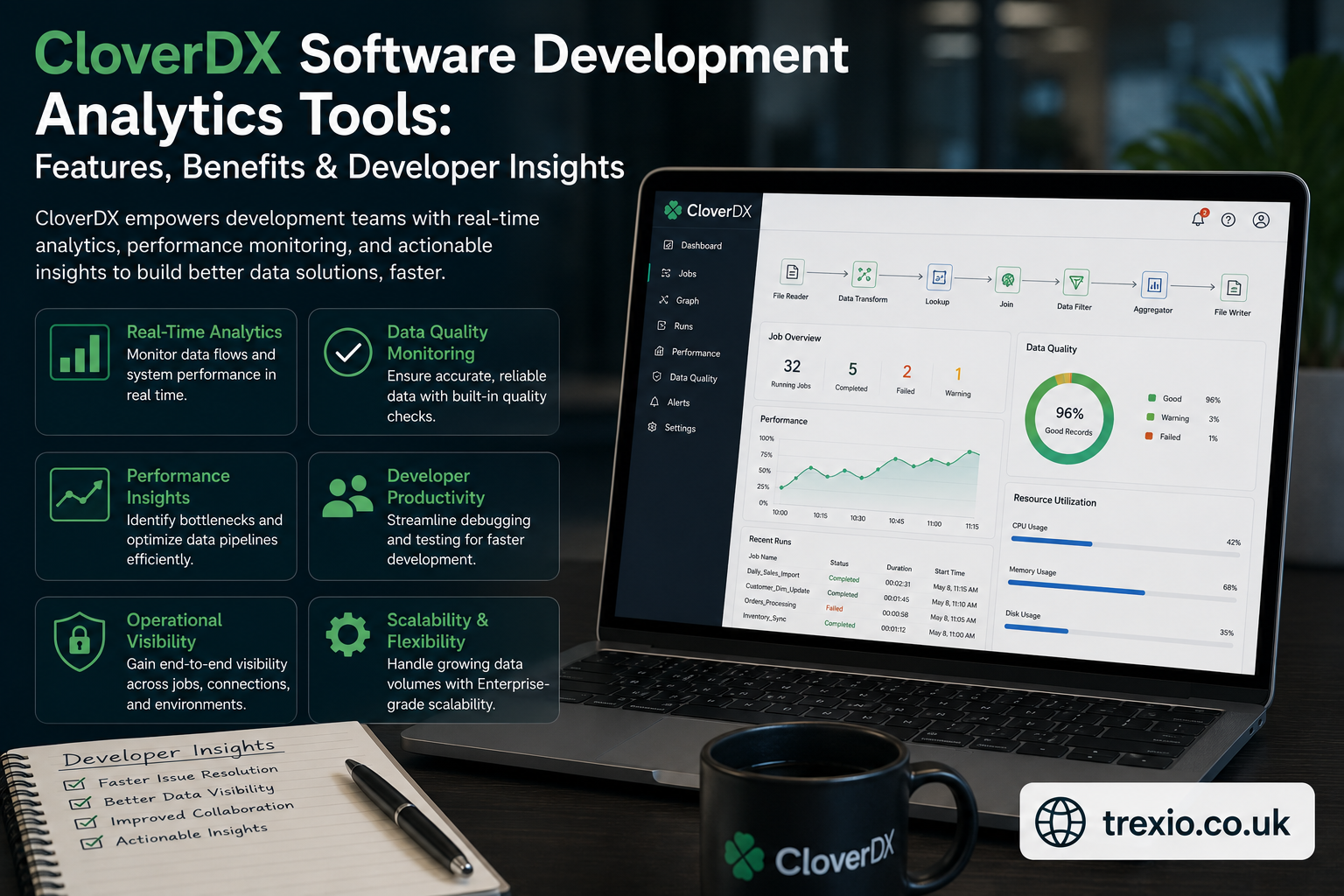
Modern software teams generate enormous amounts of development, operational, and business data every day. Transforming this information into meaningful insights requires more than spreadsheets or manual reporting. This is where cloverdx software development analytics tools become valuable for organizations seeking better visibility into software projects, data integration, and performance optimization. Rather than simply moving data from one system to another, CloverDX helps businesses design scalable workflows that automate complex data processes while producing reliable analytics. Development teams can monitor project health, improve collaboration, and make data-driven decisions without unnecessary manual effort. As software systems become increasingly interconnected, analytics platforms like CloverDX simplify data engineering tasks while improving accuracy and compliance. Companies across finance, healthcare, manufacturing, retail, and logistics rely on these capabilities to support critical business operations. Understanding how cloverdx software development analytics tools work can help developers, architects, and decision-makers build more efficient, scalable, and intelligent software ecosystems.
Quick Answer
CloverDX software development analytics tools provide an enterprise-grade platform for data integration, workflow automation, analytics, and data engineering. They enable organizations to collect, transform, validate, monitor, and analyze data from multiple systems while supporting software development teams with automation, reporting, governance, and operational insights. Businesses use CloverDX to improve development efficiency, reduce manual processing, increase data quality, and accelerate digital transformation initiatives.
What Are CloverDX Software Development Analytics Tools?
Understanding the Purpose of CloverDX
CloverDX software development analytics tools combine enterprise data integration with workflow automation and advanced analytics to help organizations manage large-scale data operations efficiently. Instead of relying on disconnected systems or manual imports, developers can create reusable workflows that automate data movement between applications, databases, APIs, cloud services, and enterprise software. These tools allow teams to monitor data quality while generating meaningful insights that improve operational performance. Software engineers benefit from centralized pipelines that simplify maintenance and reduce repetitive coding tasks. Business analysts also gain access to cleaner, validated datasets for reporting and decision-making. Because modern applications depend on multiple data sources, CloverDX helps maintain consistency throughout the software lifecycle. Organizations adopting cloud infrastructure, hybrid environments, or digital transformation strategies often consider these capabilities essential. Ultimately, cloverdx software development analytics tools serve as both an integration platform and an analytics solution that supports smarter software development.
How Analytics Fits into Software Development
Software development increasingly depends on measurable insights rather than assumptions. Analytics platforms help identify bottlenecks, monitor workflows, measure application performance, and improve collaboration across technical teams. CloverDX software development analytics tools transform raw operational data into dashboards and reports that reveal trends affecting development quality. Teams can analyze processing times, identify failed workflows, optimize integrations, and predict potential issues before they become production problems. Analytics also supports continuous improvement by measuring deployment success, automation efficiency, and resource utilization. Managers gain greater visibility into project health while engineers receive actionable information for optimizing workflows. As organizations scale, analytics becomes essential for maintaining reliability and ensuring consistent software delivery. CloverDX integrates these analytical capabilities directly into enterprise data pipelines.
Why Development Teams Need Analytics Tools
Solving Modern Development Challenges
Software development environments have become increasingly complex due to cloud computing, distributed applications, microservices, APIs, and multiple programming frameworks. Managing data across these systems manually introduces delays, inconsistencies, and unnecessary risk. CloverDX software development analytics tools simplify these challenges by centralizing data workflows while providing visibility into every stage of processing. Teams no longer need to troubleshoot isolated systems independently because analytics reveal the complete operational picture. Automation reduces repetitive tasks that consume valuable engineering time. Standardized workflows improve collaboration between developers, analysts, operations teams, and business stakeholders. Organizations also reduce operational costs by minimizing manual intervention and data correction. These advantages make analytics tools an important component of modern software engineering.
Benefits for Technical and Business Teams
Analytics platforms are valuable not only for developers but also for business users who depend on accurate information. Technical teams gain workflow transparency, easier debugging, automated validation, and faster deployment cycles. Meanwhile, executives receive trustworthy reports that support strategic planning and performance evaluation. CloverDX software development analytics tools bridge the communication gap between technical implementation and business objectives. Better data quality leads to more confident decisions, while automation increases operational efficiency. Organizations also benefit from improved compliance through consistent validation rules and audit capabilities. Teams can identify trends earlier, respond quickly to changing business requirements, and continuously optimize software processes. These combined benefits strengthen both technical operations and organizational performance.
Understanding the CloverDX Platform
Enterprise Data Engineering Solution
At its core, CloverDX is an enterprise data engineering platform designed to manage complex data operations across multiple environments. CloverDX software development analytics tools enable organizations to create visual workflows for extracting, transforming, validating, enriching, and loading information between systems. Rather than writing extensive custom scripts for every integration, developers can build reusable workflows that simplify long-term maintenance. The platform supports enterprise-scale processing while maintaining flexibility for changing business requirements. Built-in automation features reduce repetitive development tasks and improve operational consistency. Organizations also gain centralized monitoring that provides visibility into workflow execution and system performance. This combination of automation and analytics supports faster software delivery while improving overall data governance. As enterprise ecosystems grow, CloverDX provides scalable infrastructure capable of handling increasingly complex integration demands.
Supporting Digital Transformation
Digital transformation initiatives require organizations to integrate legacy applications with modern cloud services, APIs, and SaaS platforms. CloverDX software development analytics tools simplify this transition by providing flexible connectors and scalable workflow automation. Businesses avoid expensive custom development projects because integrations can be designed visually while remaining highly configurable. Automated analytics provide continuous insight into system performance and operational efficiency. Teams can modernize infrastructure without sacrificing data quality or governance. Centralized workflow management also simplifies ongoing maintenance as systems evolve. These capabilities help organizations accelerate innovation while reducing integration complexity. Consequently, CloverDX has become a valuable platform for enterprises pursuing long-term digital modernization strategies.
Core Components of CloverDX Analytics
Data Processing Engine
The data processing engine forms the foundation of cloverdx software development analytics tools by executing workflows that extract, transform, validate, and distribute information across enterprise systems. This engine efficiently processes structured, semi-structured, and unstructured data while maintaining high performance. Developers can design workflows that scale according to business requirements without constantly rewriting integration logic. Advanced scheduling enables automated execution at predefined intervals or event-driven triggers. Built-in error handling reduces operational downtime while simplifying troubleshooting. Organizations can monitor workflow performance using detailed execution statistics and operational metrics. These capabilities improve processing reliability while supporting continuous software operations. The processing engine ultimately serves as the backbone of enterprise analytics and integration.
Visual Workflow Designer
One of the platform’s distinguishing features is its visual workflow designer, which enables developers to build sophisticated integrations without excessive manual coding. CloverDX software development analytics tools provide drag-and-drop components that simplify complex transformations while maintaining enterprise-level flexibility. Developers can configure data pipelines visually, making projects easier to understand, maintain, and document. Reusable components accelerate development while reducing implementation errors. Visual representations also improve collaboration because technical and business stakeholders can better understand workflow logic. Version control and testing features further strengthen development quality. These design capabilities reduce project complexity while supporting rapid software delivery across organizations.
Key Features of CloverDX Software Development Analytics Tools
Comprehensive Enterprise Features
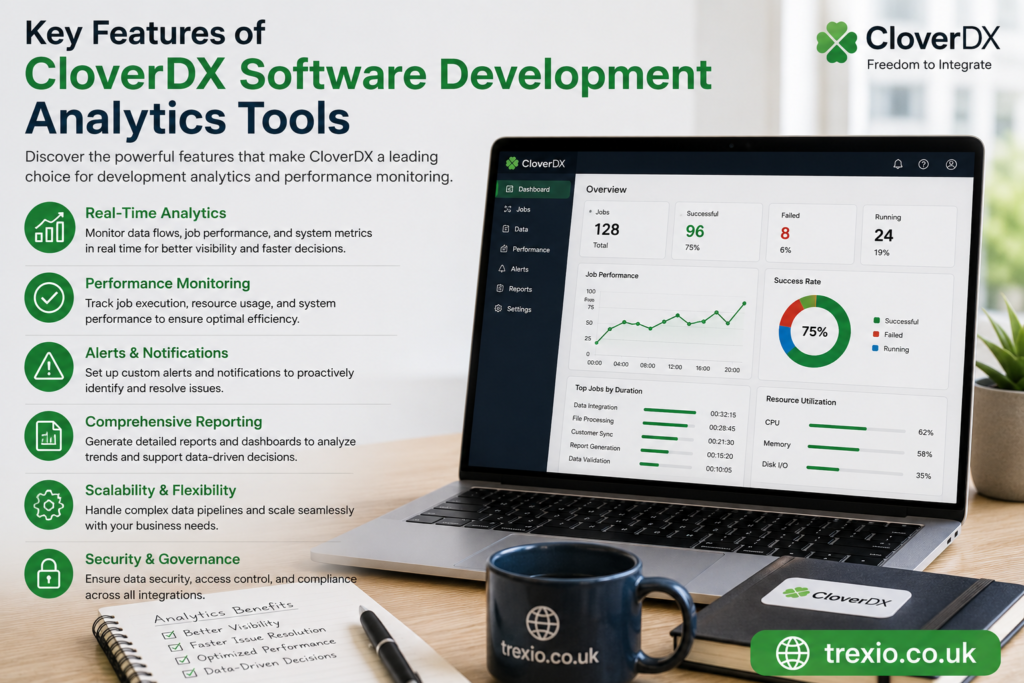
Organizations choose cloverdx software development analytics tools because they combine multiple enterprise capabilities within a unified platform. Data integration, workflow automation, analytics, monitoring, governance, scheduling, validation, reporting, and transformation operate together instead of requiring separate applications. This integrated architecture simplifies deployment while reducing software licensing costs. Development teams can manage integrations from a centralized environment while monitoring performance through real-time analytics. Automated notifications alert administrators when workflows require attention, reducing operational risks. Flexible deployment options support on-premises, cloud, and hybrid infrastructures. Security controls help organizations protect sensitive information while meeting regulatory requirements. Together, these features make CloverDX suitable for enterprise-scale software development and analytics projects.
Major Platform Capabilities
Data Pipeline Automation
Automates repetitive data movement across enterprise systems while reducing manual intervention.
Advanced Data Transformation
Converts raw information into structured, standardized formats suitable for analytics and reporting.
Workflow Scheduling
Supports automated execution based on schedules, events, or business triggers.
Error Management
Detects failures early and provides detailed diagnostic information for rapid issue resolution.
Real-Time Monitoring
Offers operational visibility into workflow execution, processing performance, and system health.
Data Integration Capabilities
Connecting Multiple Business Systems
One of the strongest advantages of cloverdx software development analytics tools is their ability to integrate numerous enterprise systems into a unified data environment. Organizations often operate databases, CRM platforms, ERP systems, APIs, cloud applications, flat files, warehouses, and external services simultaneously. CloverDX connects these sources through configurable workflows that automate data exchange while preserving quality and consistency. Developers avoid writing separate integrations for each application because reusable components simplify implementation. Data synchronization becomes faster, more reliable, and easier to monitor. Businesses also gain improved reporting because information flows consistently between operational systems. These integration capabilities reduce development complexity while enabling enterprise-wide analytics. As data ecosystems expand, centralized integration becomes increasingly valuable.
Workflow Automation
Reducing Manual Development Effort
Automation represents another critical capability within cloverdx software development analytics tools. Rather than manually executing repetitive integration tasks, development teams can configure workflows that run automatically according to business schedules or system events. Automation improves consistency while reducing operational errors caused by human intervention. Developers spend less time maintaining repetitive scripts and more time creating valuable software features. Organizations benefit from faster processing, improved scalability, and more predictable operations. Automated notifications help administrators respond quickly to workflow failures before they affect downstream systems. These efficiencies contribute to higher productivity while supporting continuous software delivery. Intelligent workflow automation has become essential for organizations managing growing volumes of enterprise data.
Data Quality and Validation
Ensuring Reliable Data for Software Development
High-quality data is the foundation of every successful analytics initiative, and this is where cloverdx software development analytics tools demonstrate significant value. Even the most advanced dashboards and reporting systems become unreliable when the underlying information contains duplicates, formatting inconsistencies, missing values, or inaccurate records. CloverDX enables organizations to build validation rules directly into data pipelines, ensuring that every dataset is checked before reaching downstream systems. Developers can define business rules, standardize formats, detect anomalies, and automatically reject or quarantine problematic records for review. This proactive approach minimizes the risk of inaccurate reporting and reduces costly manual corrections later in the software development lifecycle. Data validation also strengthens customer trust because business decisions are based on verified information rather than assumptions. Organizations operating in regulated industries particularly benefit from these capabilities, as consistent validation helps maintain compliance with industry standards and internal governance policies. By making quality assurance an integrated part of every workflow, cloverdx software development analytics tools support dependable software development analytics and enterprise reporting.
Common Data Validation Techniques
Validation processes within CloverDX extend beyond simple error detection and support comprehensive quality management throughout the development workflow. Teams can verify data types, mandatory fields, reference values, duplicate entries, and business-specific rules before information is processed further. Automated cleansing routines improve consistency by correcting formatting issues and normalizing values across multiple sources. Developers can also create conditional logic that adapts validation procedures based on the origin or destination of each dataset. These flexible capabilities simplify complex enterprise integrations while maintaining accuracy at scale. Built-in monitoring allows administrators to identify recurring quality issues and implement long-term improvements. Continuous validation ensures that software development analytics remain trustworthy even as systems evolve and new data sources are introduced. As organizations increase their reliance on data-driven decision-making, these validation capabilities become essential components of cloverdx software development analytics tools.
Monitoring and Performance Analytics
Gaining Real-Time Operational Visibility
Monitoring is one of the most valuable capabilities offered by cloverdx software development analytics tools because it provides continuous insight into workflow execution and system performance. Instead of waiting until users report issues, development teams can observe processing activities in real time and identify bottlenecks before they affect business operations. Dashboards display workflow status, execution times, throughput, and resource utilization, allowing administrators to make informed operational decisions. Historical metrics help identify long-term performance trends while supporting capacity planning for future growth. Automated alerts notify teams whenever failures, delays, or unusual processing patterns occur, reducing downtime and improving service reliability. This visibility allows developers to optimize workflows proactively rather than reacting to unexpected production incidents. Comprehensive monitoring also simplifies troubleshooting by providing detailed execution logs and diagnostic information. Together, these capabilities make cloverdx software development analytics tools an effective solution for maintaining stable and efficient enterprise software environments.
Performance Optimization Through Analytics
Performance analytics help organizations understand how efficiently their data pipelines operate under varying workloads. CloverDX captures operational metrics that reveal processing speed, resource consumption, execution frequency, and workflow dependencies. These insights enable development teams to optimize inefficient processes, allocate infrastructure more effectively, and reduce unnecessary computational overhead. Analytics also support strategic planning by highlighting opportunities for automation and workflow redesign. Organizations processing large volumes of transactional or operational data can scale confidently because performance trends are continuously monitored. Decision-makers benefit from measurable indicators that demonstrate return on investment and operational improvements over time. Continuous performance evaluation strengthens software quality while reducing infrastructure costs. These advantages reinforce why cloverdx software development analytics tools are widely adopted for enterprise analytics initiatives.
ETL Processes in CloverDX
Simplifying Extract, Transform, and Load Operations
Extract, Transform, and Load (ETL) processes remain central to enterprise data engineering, and cloverdx software development analytics tools provide a powerful environment for managing these operations. Data is extracted from multiple internal and external sources before being transformed into standardized formats that support reporting, analytics, and application development. Transformation includes cleansing, enrichment, aggregation, filtering, and restructuring information according to business requirements. Once validated, data is loaded into target systems such as warehouses, cloud platforms, business intelligence solutions, or operational applications. CloverDX simplifies these complex processes through reusable workflow components and visual pipeline design. Automation minimizes manual intervention while reducing development time and improving consistency across projects. Organizations gain faster access to trusted information while supporting scalable analytics initiatives. These ETL capabilities position cloverdx software development analytics tools as an effective platform for enterprise software development and data integration.
ETL Benefits for Modern Enterprises
Modern organizations often integrate hundreds of applications that continuously exchange information. Efficient ETL processes ensure that data remains synchronized, accurate, and readily available for operational and analytical purposes. CloverDX enables businesses to automate recurring ETL jobs while handling exceptions intelligently through configurable workflows. Teams spend less time maintaining custom integration scripts because reusable components simplify long-term management. Improved data consistency enhances reporting accuracy and supports better business intelligence initiatives. ETL automation also reduces operational costs by eliminating repetitive manual tasks and decreasing error rates. As organizations continue expanding cloud infrastructure and hybrid architectures, scalable ETL capabilities become increasingly important. These benefits further strengthen the role of cloverdx software development analytics tools in enterprise software ecosystems.
Supported Integrations and Data Sources
Extensive Connectivity Across Enterprise Systems
One of the reasons organizations adopt cloverdx software development analytics tools is the platform’s ability to connect with a broad range of technologies and enterprise applications. Modern businesses rarely rely on a single data source, making integration flexibility essential for successful software development analytics. CloverDX supports relational databases, cloud storage platforms, REST APIs, SOAP services, CSV files, XML documents, JSON datasets, enterprise applications, message queues, and numerous additional data formats. This versatility enables development teams to consolidate information from multiple environments without extensive custom coding. Organizations can integrate legacy systems alongside modern cloud services while preserving workflow consistency and governance. Centralized connectivity also simplifies maintenance because reusable integration components reduce duplication across projects. As enterprise technology stacks continue to evolve, flexible integration capabilities remain one of the strongest advantages of cloverdx software development analytics tools. These broad compatibility features support scalable digital transformation across diverse industries.
Common Integration Sources
| Data Source | Typical Use Case | Business Benefit |
|---|---|---|
| SQL Databases | Operational data | Centralized reporting |
| REST APIs | Cloud integrations | Real-time connectivity |
| CSV Files | Batch imports | Easy migration |
| XML & JSON | Application exchange | Standardized communication |
| Cloud Storage | Data archiving | Scalable infrastructure |
| ERP Systems | Business operations | Enterprise integration |
| CRM Platforms | Customer management | Improved customer insights |
| Data Warehouses | Analytics | Business intelligence |
CloverDX Compared with Traditional Data Integration Approaches
Feature Comparison
| Feature | CloverDX | Traditional Manual Integration |
|---|---|---|
| Workflow Automation | Excellent | Limited |
| Visual Pipeline Design | Yes | Usually No |
| Data Validation | Built-in | Manual |
| Monitoring Dashboard | Comprehensive | Basic |
| Scalability | High | Moderate |
| Error Handling | Automated | Mostly Manual |
| Enterprise Analytics | Integrated | Requires Additional Tools |
| Reusable Components | Yes | Minimal |
| Cloud Support | Extensive | Depends on Implementation |
| Development Speed | Faster | Slower |
The comparison illustrates why many enterprises transition from manually developed integration scripts to platforms like CloverDX. While traditional approaches can meet basic integration needs, they often require substantial maintenance and become increasingly difficult to scale as systems grow. CloverDX software development analytics tools reduce this complexity through automation, standardized workflows, and integrated monitoring. Organizations benefit from faster development cycles, improved reliability, and greater operational visibility. The ability to reuse workflow components also lowers long-term maintenance costs while improving consistency across projects. Businesses seeking scalable software development analytics often find that integrated platforms provide significantly greater value than isolated custom solutions.
Best Practices for Using CloverDX Software Development Analytics Tools
Follow Proven Implementation Strategies
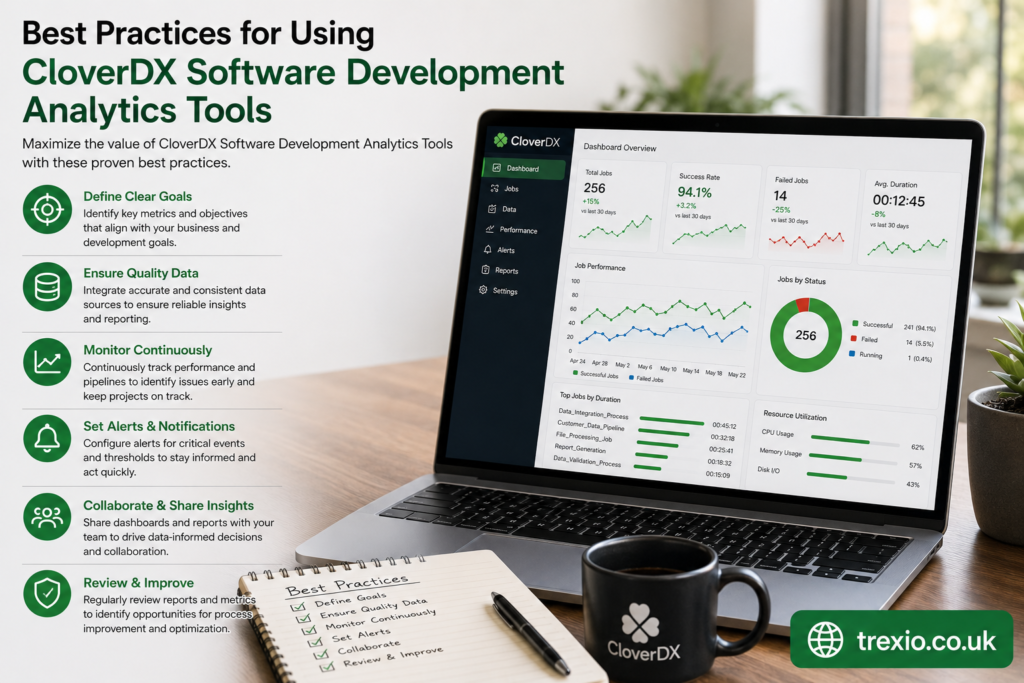
Implementing cloverdx software development analytics tools successfully requires thoughtful planning and ongoing optimization. Organizations that establish standardized workflows, governance policies, and monitoring procedures typically achieve better long-term results than those relying on ad hoc integrations. Teams should design reusable components whenever possible to reduce duplication and simplify future maintenance. Regular validation of incoming data ensures that analytics remain accurate and trustworthy throughout the software lifecycle. Monitoring dashboards should be reviewed consistently to identify performance trends before they become operational issues. Documentation is equally important because clearly defined workflows improve collaboration among developers, analysts, and administrators. Organizations should also implement role-based security to protect sensitive information while maintaining compliance. Following these best practices allows businesses to maximize the value of cloverdx software development analytics tools while supporting scalable software development.
Best Practices Checklist
- Standardize workflow design across projects.
- Validate all incoming and outgoing data.
- Monitor pipeline performance regularly.
- Build reusable integration components.
- Document every workflow thoroughly.
- Implement role-based access controls.
- Schedule periodic workflow optimization.
- Test changes before production deployment.
- Automate repetitive operational processes.
- Review analytics to support continuous improvement.
Common Mistakes to Avoid
Preventing Costly Implementation Errors
Although cloverdx software development analytics tools simplify enterprise integration, organizations sometimes encounter avoidable challenges during implementation. One common mistake is ignoring data quality before creating analytics workflows, resulting in inaccurate reports and unreliable business decisions. Another issue is designing overly complex pipelines that become difficult to maintain as projects expand. Some teams neglect workflow documentation, making future troubleshooting unnecessarily complicated. Insufficient monitoring may allow small processing issues to develop into larger operational failures. Businesses also underestimate the importance of governance and access controls when managing sensitive enterprise data. Failing to reuse existing workflow components increases development costs and maintenance effort. Finally, inadequate testing before deployment can introduce unexpected production errors that disrupt business operations. Avoiding these mistakes helps organizations realize the full benefits of cloverdx software development analytics tools.
Pro Tips
Expert Recommendations for Better Results
Experienced data engineers recommend treating analytics workflows as long-term software assets rather than one-time integration projects. Build modular pipelines that can evolve alongside changing business requirements instead of creating isolated workflows for each application. Continuously monitor execution metrics to identify optimization opportunities before performance declines. Automate validation whenever possible to minimize manual quality assurance activities. Maintain version control for every workflow to simplify collaboration and rollback procedures. Encourage cross-functional communication between developers, analysts, and business stakeholders during workflow design. Schedule regular performance reviews to ensure infrastructure scales efficiently with increasing data volumes. Most importantly, leverage the complete capabilities of cloverdx software development analytics tools rather than limiting implementation to basic ETL processes, as the platform offers significantly broader enterprise value.
Conclusion
Cloverdx software development analytics tools provide organizations with a comprehensive platform for enterprise data integration, workflow automation, monitoring, validation, and analytics. By combining scalable ETL capabilities with powerful operational visibility, CloverDX enables development teams to build reliable software ecosystems that support informed business decision-making. The platform reduces manual effort through automation while improving data quality, governance, and overall development efficiency. Flexible integration options allow businesses to connect cloud services, databases, APIs, enterprise applications, and legacy systems within a unified architecture. Real-time monitoring and performance analytics help organizations optimize workflows before issues affect production environments. As businesses continue adopting data-driven strategies, reliable analytics platforms become increasingly important for maintaining competitive advantage. Whether supporting digital transformation, software modernization, or enterprise reporting, cloverdx software development analytics tools deliver measurable value across industries. Organizations that implement best practices and continuously optimize their workflows can maximize productivity, strengthen data quality, and accelerate long-term innovation.
Frequently Asked Questions
1. What are CloverDX software development analytics tools used for?
They are used for enterprise data integration, ETL processing, workflow automation, monitoring, analytics, and data quality management across multiple business systems.
2. Is CloverDX suitable for enterprise software development?
Yes. It is designed for enterprise environments that require scalable integration, automation, governance, and operational analytics.
3. Does CloverDX support cloud platforms?
Yes. CloverDX integrates with cloud services, APIs, databases, and hybrid infrastructures.
4. Can CloverDX automate ETL workflows?
Absolutely. Automated ETL workflows are one of the platform’s core strengths, reducing manual effort and improving consistency.
5. How does CloverDX improve data quality?
It provides validation rules, cleansing capabilities, error detection, monitoring, and standardized transformation processes.
6. Is programming knowledge required to use CloverDX?
Basic technical knowledge is beneficial, but the visual workflow designer significantly reduces the amount of manual coding required.
7. Which industries commonly use CloverDX?
Finance, healthcare, manufacturing, retail, telecommunications, logistics, insurance, and government organizations frequently use CloverDX.
8. Can CloverDX integrate legacy systems?
Yes. It supports both legacy enterprise applications and modern cloud-based services within the same workflows.
9. Does CloverDX include monitoring features?
Yes. It offers dashboards, execution logs, performance metrics, alerts, and operational analytics for workflow monitoring.
10. Why are CloverDX software development analytics tools important?
They improve developer productivity, automate data integration, strengthen data quality, enhance reporting accuracy, and support scalable enterprise software development.
Author Bio
Daniel Carter is an enterprise software and data engineering writer with extensive experience researching analytics platforms, ETL technologies, workflow automation, and software development tools. He specializes in creating EEAT-focused, SEO-optimized technical content that helps developers, IT leaders, and business professionals understand complex enterprise technologies through practical, well-researched guidance.