
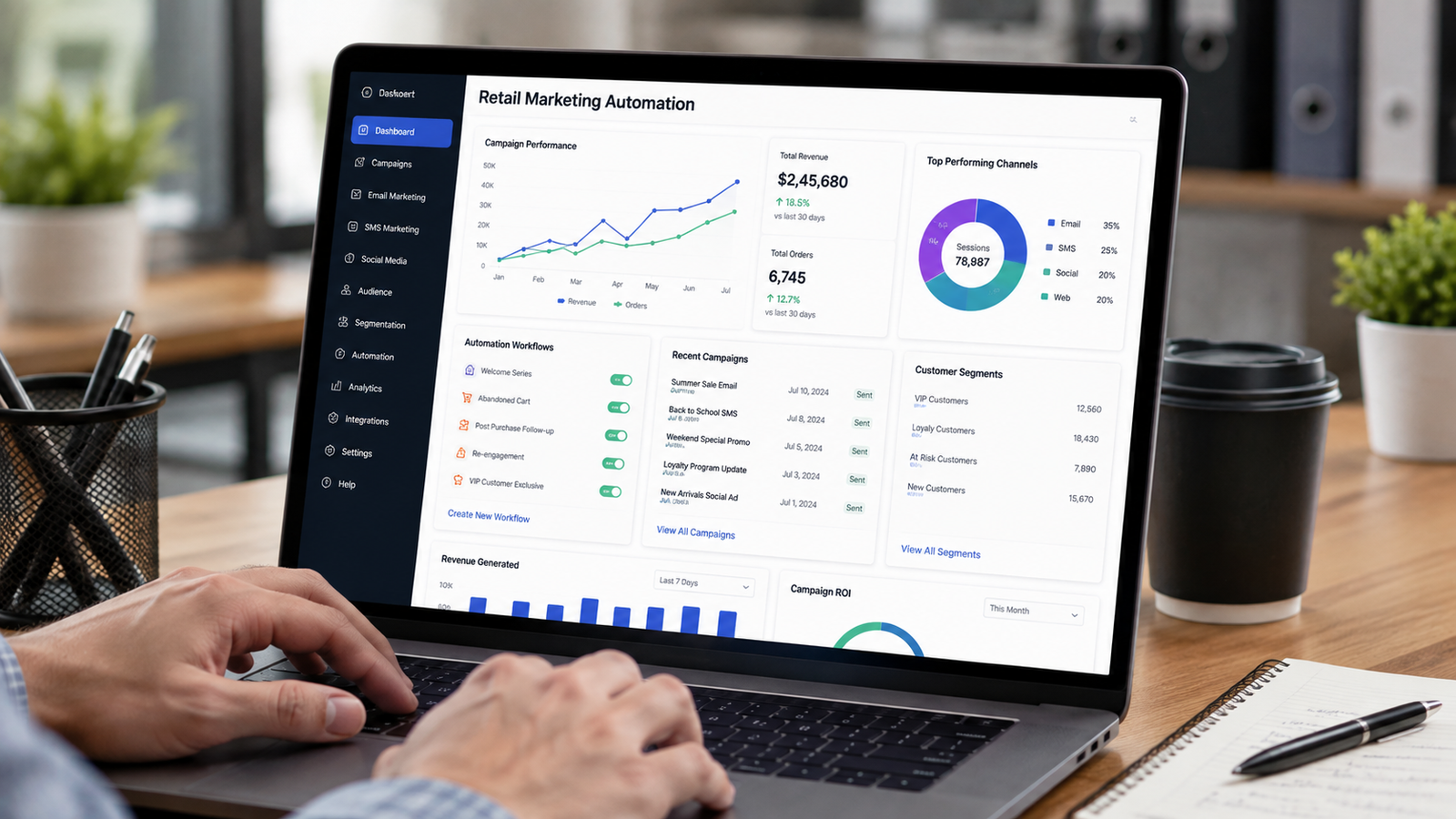
Retail marketing no longer waits for a Monday meeting before responding to customers. A shopper browses a product, abandons a cart, completes a purchase, earns loyalty points or stops engaging—and increasingly, software can respond within minutes. That shift has made marketing automation one of the most important technology categories for modern retailers.
Yet choosing the right platform is becoming harder. Retailers now face dozens of tools promising AI personalization, customer segmentation, omnichannel campaigns, predictive analytics and automated journeys. The challenge is not finding software with impressive features. It is finding a system that connects customer data, commerce activity and marketing execution without creating another disconnected technology layer.
Why Retail Marketing Automation Has Become Essential
Retail customers interact with brands across websites, mobile applications, stores, social networks, marketplaces, email and messaging platforms. Each interaction creates a signal about customer intent. A shopper repeatedly viewing running shoes, for example, has a different marketing need from someone who purchased shoes yesterday or has not interacted with a retailer for six months.
Marketing automation turns those signals into predefined or intelligent actions. Instead of manually creating every campaign, marketers can build journeys that respond to events such as purchases, browsing behavior, cart abandonment, loyalty milestones and changes in engagement. This approach allows smaller teams to manage sophisticated customer journeys while giving larger organizations a way to coordinate activity across millions of customer records.
The technology also addresses a growing operational problem. Modern retailers often have more marketing data than their teams can realistically analyze. Automation provides a layer between data collection and campaign execution, helping marketers translate customer behavior into timely communications. The strongest systems increasingly combine automation with segmentation, analytics, artificial intelligence and real-time decision-making.
What Makes the Top Software for Automating Retail Marketing Efforts
The best platforms share several capabilities, but their priorities differ. A useful retail marketing system should collect customer signals, create meaningful segments, automate campaigns, support multiple communication channels and provide reliable reporting. It should also integrate with the retailer’s ecommerce platform, CRM, point-of-sale system, loyalty program and analytics environment where appropriate.
Another important consideration is usability. Sophisticated software can become a liability if marketers need technical assistance for every campaign change. Retail teams should look for visual journey builders, flexible segmentation, reusable workflows and clear analytics. At the same time, enterprise retailers may require stronger governance, permissions, data architecture and integration capabilities than smaller businesses.
Klaviyo for Ecommerce-Focused Retailers
Klaviyo has become a prominent choice for ecommerce and direct-to-consumer brands because it centers heavily on customer behavior and lifecycle marketing. Retailers can use customer events such as browsing, purchases and campaign engagement to build automated journeys and personalized communications.
Its ecosystem supports email and other messaging channels, while ecommerce integrations help connect store activity with customer profiles. That makes Klaviyo particularly useful for welcome sequences, abandoned-cart campaigns, post-purchase communications, replenishment reminders and win-back programs. For retailers whose marketing strategy revolves around digital commerce and customer lifecycle engagement, this specialization can be a major advantage.
Salesforce Marketing Cloud for Enterprise Retail
Salesforce Marketing Cloud is positioned differently. It targets organizations that need broad customer-data capabilities, complex journeys and omnichannel marketing at enterprise scale.
For large retailers, the ability to connect CRM information with marketing activity can be particularly valuable. Customer data may come from physical stores, ecommerce operations, service interactions, loyalty programs and other systems. Salesforce’s broader ecosystem can help organizations coordinate these sources and create more connected customer experiences. However, its greater sophistication can also mean more complicated implementation, governance and ongoing administration.
HubSpot for CRM-Centered Retail Marketing
HubSpot is often attractive to retailers that want marketing automation closely connected to CRM and broader customer-management processes. Rather than operating purely as an ecommerce marketing engine, HubSpot combines marketing, CRM, sales and customer-service capabilities within its platform ecosystem.
That approach can suit retailers that need a broader customer relationship strategy. Teams can build segmentation and automated workflows around customer interactions while keeping marketing activity connected to CRM records. However, retailers with extremely sophisticated ecommerce event requirements may find specialized B2C platforms more closely aligned with their needs.
Omnisend for Email and SMS Automation
Omnisend focuses strongly on ecommerce marketing automation, particularly email and SMS campaigns. Its positioning makes it relevant to growing online retailers that want automated lifecycle communications without adopting a highly complex enterprise marketing stack.
Common applications include welcome campaigns, abandoned-cart recovery, post-purchase journeys and reactivation. The platform’s ecommerce orientation can make it easier for smaller marketing teams to connect store events with campaign triggers. For retailers that primarily need practical automation rather than an extensive enterprise customer-data architecture, this can be an important consideration.
Braze for Sophisticated Customer Engagement
Braze is designed for brands that need sophisticated customer engagement across multiple digital channels. Its relevance to retail grows as brands move beyond email-centric marketing toward coordinated messaging across apps, websites, push notifications and other touchpoints.
Braze is particularly interesting for retailers with large customer bases and mature lifecycle marketing operations. Instead of treating campaigns as isolated broadcasts, organizations can construct journeys around customer behavior and lifecycle stages. This approach supports more dynamic engagement, although it generally requires a stronger marketing-technology operation than a simpler ecommerce automation platform.
Emarsys for Retail Personalization
Emarsys has long focused on customer engagement and marketing automation, making it another option for retailers looking to coordinate lifecycle campaigns and personalization.
Its relevance comes from the growing demand for automated customer journeys that extend beyond acquisition. Retailers want software that can help identify high-value customers, encourage repeat purchases, reactivate inactive shoppers and personalize product-related communications. Emarsys can be particularly relevant for organizations seeking a broader retail marketing environment rather than a narrowly focused email platform.
Shopify for Retailers Already Using Its Commerce Ecosystem
Shopify is an important option for merchants already operating their stores within its ecosystem. Its advantage is proximity to commerce data. Retailers can connect customer activity, orders, products and store operations with marketing workflows without necessarily building a completely separate technology environment.
Shopify’s ecosystem also provides access to additional marketing applications and automation capabilities. For smaller and mid-sized retailers, reducing integration complexity can be as important as gaining advanced functionality. A retailer should therefore consider whether its existing commerce platform already provides enough automation before adding another major marketing system.
Mailchimp for Simpler Retail Marketing Programs
Mailchimp remains relevant for retailers that prioritize straightforward email marketing and accessible automation. It can be a practical starting point for businesses that do not need advanced customer-data orchestration.
The important distinction is complexity. A smaller retailer may gain more from a platform its team can operate confidently than from an enterprise suite containing hundreds of features. If the marketing program primarily involves newsletters, basic segmentation and automated customer communications, simplicity can become a competitive advantage.
Behavioral Segmentation Is the Engine Behind Automation
Automation becomes considerably more useful when campaigns respond to customer behavior rather than merely calendar dates. Behavioral segmentation allows marketers to group customers according to actions such as purchases, website visits, email engagement, product views and frequency of interaction.
Consider two customers who subscribed to the same retailer’s newsletter. One has visited the same product category five times during the past week, while the other has not opened an email in four months. Treating them identically wastes the available data. Automation can instead place them into different journeys, with one receiving product-focused messaging and the other entering a re-engagement sequence.
Abandoned Cart Automation Still Matters
Cart recovery remains one of the clearest examples of retail marketing automation. A customer adds products to a cart but leaves without completing checkout. A properly configured system can recognize that event and initiate a sequence without requiring manual intervention.
However, retailers should avoid assuming that every abandoned cart requires a discount. The first message might simply remind the shopper about the products. Later communication could provide additional product information, availability updates or carefully controlled incentives. Testing different sequences helps retailers determine what actually improves incremental conversion without unnecessarily reducing margins.
Post-Purchase Automation Can Increase Customer Lifetime Value
The customer journey should not end when payment is completed. Post-purchase automation can help retailers build relationships after the initial transaction through order information, product education, review requests and relevant recommendations.
For example, a skincare retailer might send product-use guidance after an order and later recommend complementary products. A fashion brand might introduce related items after a purchase. A grocery company could use purchase patterns to identify likely replenishment windows. These workflows transform transactional data into opportunities for retention and repeat revenue.
Loyalty Programs Create Valuable Automation Signals
Retail loyalty programs produce some of the richest customer data available to marketers. Purchase frequency, reward activity, point balances and redemption behavior can all help determine the next appropriate communication.
Automation can recognize loyalty milestones, remind customers about unused rewards or identify shoppers whose purchasing frequency is declining. Retailers can then create targeted retention campaigns rather than sending identical promotions to the entire customer base.
The most sophisticated programs can connect loyalty behavior with product preferences and customer value. That creates opportunities to differentiate communication according to both what a customer buys and how important the relationship is to the business.
AI Is Changing How Retail Marketing Automation Works
Artificial intelligence is gradually shifting marketing automation from fixed rules toward predictive and adaptive systems. Traditional automation might say, “If a customer purchases product A, send email B after seven days.” AI-powered systems can potentially evaluate larger sets of signals and determine which customer, message, product or timing is most likely to produce a desired outcome.
This does not mean retailers should automatically trust every AI feature. Marketing teams should evaluate whether AI produces measurable improvements in conversion, retention, customer value or efficiency. Human oversight remains important, particularly when automated systems influence customer communications, pricing, recommendations or sensitive customer decisions.
Omnichannel Automation Is Becoming More Important
Customers rarely follow a perfectly linear path. Someone may discover a product on social media, research it on a phone, visit a physical store and purchase later through an ecommerce site. A fragmented marketing stack can treat those actions as unrelated events.
Omnichannel marketing automation attempts to connect those experiences. The goal is not simply to communicate through more channels. It is to make each interaction part of a coherent customer journey. For example, a customer who has already completed a purchase should not continue receiving acquisition messaging for that same product.
First-Party Data Is Increasingly Valuable
Retailers are placing greater emphasis on first-party data because it comes directly from customer interactions with the business. Purchase records, loyalty activity, website behavior and voluntarily provided preferences can provide valuable signals for personalization.
The quality of that data matters just as much as its volume. Duplicate customer records, incomplete profiles and disconnected systems can undermine automation. Before investing heavily in advanced personalization, retailers should examine whether their customer data is accurate, accessible and consistently structured.
Privacy Must Be Built Into Automation
More automation means more responsibility around customer data. Retailers need to understand what information they collect, why they collect it and how it is used in marketing.
Consent management, data security, communication preferences and appropriate retention policies should be part of the platform evaluation process. A technically sophisticated marketing system cannot compensate for weak data governance. In fact, automation can amplify mistakes when poor-quality or improperly collected data is distributed across thousands of campaigns.
How to Choose the Right Platform
Retailers should begin with business requirements rather than software features. Map the customer lifecycle from acquisition through purchase, repeat purchase, loyalty and reactivation. Identify which stages currently require the most manual work and which customer signals should trigger communications.
Next, evaluate integrations. Ecommerce, POS, CRM, loyalty, customer service and analytics systems may all need to exchange information. A platform that looks impressive in a product demonstration but requires extensive custom development to connect to the existing stack may ultimately deliver less value than a simpler system with strong native integrations.
Pricing Is Only One Part of the Cost
Software subscription fees rarely represent the entire investment. Retailers should consider implementation, integration development, data migration, training, customer support, message volume and potential agency or consulting costs.
A platform with a lower monthly price may become more expensive if the business needs several additional tools to replicate important functions. Conversely, an enterprise platform can create unnecessary costs if the retailer uses only a fraction of its capabilities. The right calculation should focus on total cost of ownership and measurable business impact.
Implementation Can Determine the Outcome
Even powerful software can fail if the organization does not establish clear ownership. Someone needs to maintain segments, review workflows, monitor deliverability, analyze performance and update campaigns as customer behavior changes.
Retailers should therefore define responsibilities before implementation. Marketing may own campaign strategy, ecommerce may manage product data, IT may oversee integrations and analytics teams may validate reporting. Clear governance reduces the risk of automation becoming another isolated system.
Measuring Retail Marketing Automation ROI
Retailers should connect automated campaigns to business metrics rather than simply measuring message volume. Important indicators include conversion rate, repeat purchase rate, average order value, customer lifetime value, revenue per recipient, retention and unsubscribe rates.
Incrementality is especially important. If an automated campaign reports revenue, marketers should ask whether those customers would have purchased anyway. Holdout groups and controlled experiments can help estimate the actual contribution of automation.
What the Future Holds for Retail Marketing Automation
The next stage of retail marketing automation is likely to combine real-time customer data, predictive analytics, AI-generated content and increasingly autonomous journey optimization. Instead of marketers manually designing every possible customer path, software may increasingly recommend which journey, message or product should be presented to each customer.
Yet the technology landscape will not necessarily reward retailers for owning the most platforms. The bigger opportunity lies in reducing fragmentation. Connected customer data, reliable integrations and disciplined experimentation are likely to matter more than accumulating features.
Key Takeaways
- Klaviyo is particularly strong for ecommerce lifecycle marketing and behavioral campaigns.
- Salesforce Marketing Cloud is better suited to complex enterprise and omnichannel environments.
- HubSpot works well for retailers prioritizing CRM and marketing alignment.
- Omnisend is a practical option for ecommerce-focused email and SMS automation.
- Braze is designed for sophisticated multi-channel customer engagement.
- Emarsys is relevant for retail lifecycle marketing and personalization.
- Shopify is compelling for merchants already operating within its commerce ecosystem.
- Mailchimp can suit smaller retailers with simpler marketing requirements.
- Behavioral segmentation is central to effective automation.
- Integration, data quality, privacy and measurement are as important as features.
- AI is moving automation toward more predictive and adaptive customer journeys.
- The best system is the one that produces measurable incremental business value.
Frequently Asked Questions
What is retail marketing automation software?
Retail marketing automation software allows businesses to automate customer communications and marketing workflows using customer data, behavioral signals and predefined or intelligent rules. Common applications include abandoned-cart recovery, welcome campaigns, post-purchase journeys, loyalty communications and customer reactivation.
What is the best software for automating retail marketing efforts?
There is no single best platform for every retailer. Klaviyo is particularly strong for ecommerce lifecycle marketing, Salesforce Marketing Cloud suits complex enterprise operations, Omnisend emphasizes ecommerce messaging, HubSpot connects marketing closely with CRM, and Shopify can be effective for merchants already using its commerce ecosystem.
Can retail marketing software automate email and SMS?
Yes. Many modern platforms support multiple channels, including email and SMS. Some also support push notifications, WhatsApp, in-app messaging and advertising-related workflows. Channel requirements should therefore be considered when comparing platforms.
How does behavioral segmentation improve retail marketing?
Behavioral segmentation divides customers according to actions such as purchases, product views, website visits, email engagement and loyalty activity. This allows retailers to send different communications based on actual customer intent instead of treating every subscriber identically.
Is AI necessary for retail marketing automation?
No. Traditional rule-based automation can still deliver substantial value. However, AI can add capabilities such as predictive segmentation, personalization, recommendations and optimization. Retailers should adopt AI where it produces measurable benefits rather than simply because it is available.
What integrations should retailers prioritize?
The most important integrations usually involve ecommerce, POS, CRM, loyalty, customer service, analytics and customer-data systems. The appropriate combination depends on the retailer’s operating model and customer journey.
How should retailers measure automation success?
Retailers should measure business outcomes such as incremental revenue, conversion, repeat purchases, retention, customer lifetime value and average order value. They should also monitor unsubscribe rates and other customer-experience metrics to ensure automation does not create unwanted communication.
Conclusion
The strongest retail marketing platforms are no longer simply tools for scheduling campaigns. They are becoming decision-making and customer-engagement systems that connect behavioral data with automated action.
For ecommerce-focused brands, Klaviyo and Omnisend can provide strong lifecycle automation. Enterprise retailers may need the broader capabilities of Salesforce Marketing Cloud or Braze, while HubSpot can be valuable where CRM integration is central. Shopify remains a natural choice for merchants already invested in its commerce ecosystem.
Ultimately, the top software for automating retail marketing efforts is the platform that fits the retailer’s data architecture, customer journey, team capabilities and growth strategy. The winning approach is not to automate everything. It is to automate the right interactions, measure their incremental impact and continuously improve the customer experience.
Retail marketing is moving toward a future where customer signals can trigger increasingly intelligent actions in real time. Retailers that build a reliable foundation of first-party data, connected systems and disciplined experimentation today will be better prepared for that next generation of marketing automation.