
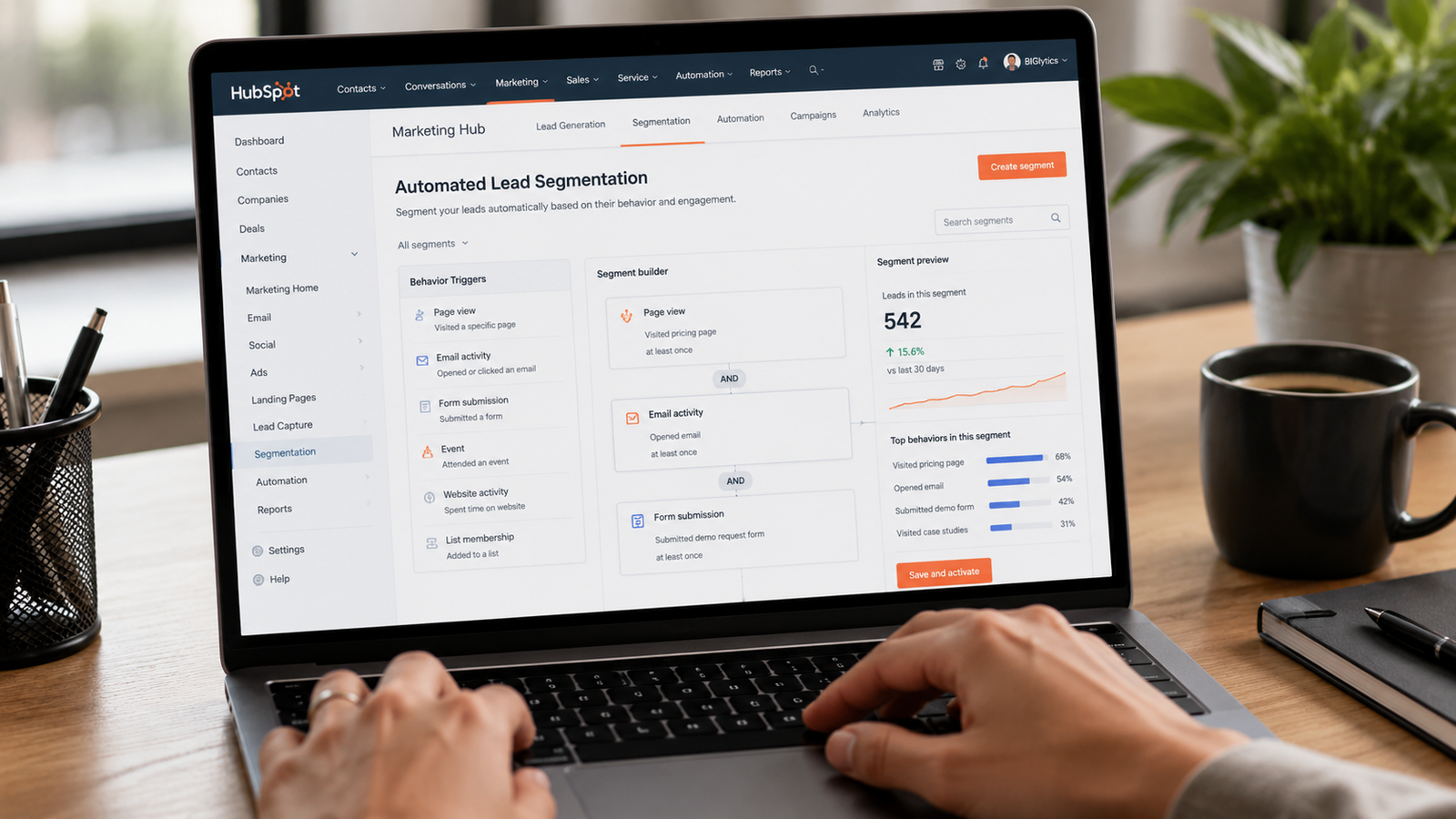
A prospect who downloads one guide is simply interested. A prospect who downloads that guide, returns to the website, visits pricing twice and clicks a demo CTA is telling a very different story. Modern marketing teams increasingly need software that can recognize that difference automatically.
That is where HubSpot Marketing Hub automated lead segmentation based on behavior becomes especially useful. HubSpot can create active segments that update automatically as contacts meet or stop meeting defined criteria, while its lead-scoring tools can evaluate properties and behavioral events to identify the most engaged prospects. Together, these capabilities can turn scattered customer interactions into actionable marketing audiences.
What Behavioral Lead Segmentation Means in HubSpot
Behavioral lead segmentation groups prospects according to actions they take during the buyer journey. Instead of relying only on job title, company size, location or industry, marketers can consider activities such as website visits, form submissions, CTA interactions, meetings and campaign engagement.
This approach matters because two contacts with identical demographic profiles can have completely different levels of purchase intent. HubSpot’s filtering system allows marketers to use behavioral criteria alongside contact properties and associated-record information. Its documentation even gives repeated visits to an important website page as an example of an active segment.
How HubSpot Active Segments Automate Audience Changes
HubSpot now uses the term segments for what were previously called lists. An active segment automatically updates its membership when records meet its criteria and removes them when they no longer qualify. This makes active segments particularly suitable for audiences based on changing behavior.
For example, a company could create an active segment containing contacts who have visited a pricing page at least twice. A new contact meeting that condition can automatically enter the audience. If the business uses additional time-based criteria, the segment can focus on recent behavior rather than treating an interaction from months ago as equally important.
Why Behavioral Data Can Reveal Buying Intent
Customer behavior often provides a more immediate signal of interest than static profile data. A job title may tell marketers who someone is, but behavior can show what that person is researching right now.
Someone reading introductory educational content may still be exploring a problem. Someone repeatedly visiting product pages, downloading comparison material and interacting with a demo CTA may be much further along. HubSpot’s segmentation and scoring capabilities allow these different signals to become criteria for audience building and prioritization.
Website Activity as a Segmentation Signal
Website behavior is one of the most useful sources of marketing intent. Page views can show which topics, products or solutions are attracting attention, while repeated visits can indicate sustained interest.
HubSpot specifically provides page-view criteria that can identify contacts who have visited a particular URL multiple times. Its example describes using repeated visits to a high-impact page such as a trial signup page as a potential high-intent signal. This allows marketers to build audiences around actual engagement instead of assumptions.
Pricing-Page Visits and Commercial Intent
Pricing pages often deserve special treatment because visitors are seeking information directly connected to a purchasing decision. However, marketers should not automatically interpret one pricing-page visit as proof that someone is sales-ready.
A better model combines pricing activity with other signals. For example, a company might segment contacts who visited pricing at least twice, downloaded a relevant case study and interacted with a demo CTA within a defined period. This produces a more meaningful intent audience than relying on one isolated page view.
CTA Engagement Adds Another Layer
Calls to action provide another useful behavioral signal because clicking a CTA usually represents deliberate engagement. A visitor who clicks a product-demo CTA has taken a more explicit step than someone who merely scrolls through a blog article.
This distinction can be incorporated into a segmentation strategy. A marketer might create separate audiences for contacts who clicked a demo CTA, downloaded a case study or requested product information. Each group can receive messaging aligned with the action that placed it into the segment.
Forms and Content Downloads
Form submissions can provide strong behavioral context because they often reveal what information a prospect wants. A contact downloading a beginner’s guide may need educational nurturing, while someone completing a product consultation form may deserve faster sales follow-up.
HubSpot’s filtering documentation provides form submission as an example of a workflow trigger. A contact who submits a specified form can enter a workflow that notifies sales or performs another automated action. This illustrates how segmentation and automation can work together rather than operating as separate marketing processes.
Email Engagement and Recency
Email behavior can also help marketers distinguish active subscribers from disengaged contacts. Opens, clicks and other interactions can provide useful signals when interpreted alongside timing and campaign context.
Recency is especially important. A contact who clicked a product email yesterday is different from someone who clicked the same type of email nine months ago. HubSpot’s guidance on automated email segmentation emphasizes dynamic rules and changing customer behavior, helping audiences stay aligned with current engagement.
Combining Behavior With Customer Fit
Behavior alone does not always identify the best lead. A highly engaged prospect may still be a poor customer fit, while a strategically important company may show limited activity because its buying process is slower.
HubSpot’s lead-scoring tools allow marketers to combine fit and engagement. Fit can use properties such as company size, industry or region, while engagement can evaluate behavioral events. This creates a more balanced approach: marketers can distinguish between people who are interested, people who fit the ideal customer profile and prospects who satisfy both conditions.
How Lead Scoring Works With Segmentation
Lead scoring assigns numerical values to records based on selected properties and event actions. HubSpot currently supports event groups for engagement scoring and property groups for fit scoring, with combined scoring available for evaluating both dimensions.
That score can then become another segmentation signal. For example, a marketing team could build an audience of contacts whose engagement score exceeds a particular threshold and who have recently visited a product page. The segment can then support personalized email, sales prioritization or workflow enrollment.
AI-Assisted Scoring Changes the Equation
HubSpot has also expanded AI capabilities around lead scoring. Its current documentation says AI-powered insights can examine account event-conversion data and identify events associated with stronger conversion outcomes. These recommendations can help marketers create scoring rules around high-impact activities.
This is significant because traditional scoring models depend heavily on marketers deciding which actions deserve points. AI-assisted insights can provide another evidence-based input by looking at historical conversion patterns. However, marketers should still review recommendations against their business model and customer journey rather than treating automated recommendations as unquestionable truth.
Predictive Lead Scoring and Probability
HubSpot also provides predictive lead-scoring capabilities in qualifying enterprise subscriptions. Its documentation states that predictive machine learning can analyze customers and estimate the probability that open contacts will become customers within 90 days.
Predictive scores can complement rule-based segmentation. A marketing team might use explicit behavioral rules to create an audience of recent high-intent contacts while using predictive information to prioritize which contacts deserve the most attention. This creates a bridge between deterministic segmentation and machine-learning-based prioritization.
The Importance of AND and OR Logic
Behavioral segmentation becomes considerably more powerful when marketers understand logical conditions. AND requires multiple criteria to be satisfied, creating a narrower audience. OR allows records meeting any of the selected criteria to qualify, creating a broader audience.
For example, “visited pricing AND clicked demo” identifies a more specific group than “visited pricing OR clicked demo.” HubSpot’s filter system supports these types of criteria, allowing marketers to build audiences that match different levels of intent.
Why Recency Should Be Built Into the Model
Behavior becomes less informative as it gets older. Someone who viewed a pricing page 18 months ago may no longer be considering the product, even if the CRM retains the historical activity.
Time windows solve part of this problem. A segment such as “visited pricing within the last 14 days” can represent current interest more accurately than a lifetime behavioral condition. Similarly, HubSpot’s scoring system can incorporate event criteria and limits to control how behavioral activity contributes to scores.
Positive and Negative Behavioral Signals
Effective segmentation should account for both engagement and disengagement. Positive signals might include demo requests, repeated product-page visits, meeting bookings and meaningful content downloads.
Negative signals can include prolonged inactivity, lack of response or behaviors suggesting that a prospect is no longer actively researching. These signals can support re-engagement campaigns or reduce sales prioritization. HubSpot’s lead-scoring functionality also supports negative point values and score decay, helping scores remain more representative of current engagement.
Connecting Segments to Marketing Automation
A segment becomes much more valuable when it leads to a relevant action. HubSpot can connect segmentation with marketing automation, allowing teams to use changing audience membership as part of customer journeys.
For instance, a newly engaged prospect could enter a nurturing workflow. A contact who reaches a high-intent score could receive sales-oriented follow-up. Someone who becomes a customer can leave prospect-focused campaigns and enter a customer communication path. HubSpot’s email automation tools also allow simple workflows to add contacts to segments following actions such as clicking an email link.
A Practical B2B SaaS Example
Consider a software company selling an enterprise analytics platform. It could create an active segment for contacts who have visited the pricing page at least twice in the last 30 days, downloaded a product comparison and clicked a demo CTA.
The marketing team could then combine that segment with an engagement score threshold. Contacts who meet both behavioral and score requirements might receive a personalized sales invitation, while contacts showing moderate engagement could continue through educational nurturing. This approach avoids treating every lead identically.
An E-Commerce Example
An online retailer could take a different approach. Instead of pricing-page visits, its key signals might include product views, category browsing, cart activity and previous purchases.
The retailer could create an active segment for customers who viewed a particular product multiple times but have not purchased. Another audience could contain recent buyers who have not returned within 90 days. Each segment could then receive different content rather than sending identical promotional messages to the entire database.
An Account-Based Marketing Example
Account-based marketing requires a slightly different perspective because the buying process can involve multiple people. HubSpot’s scoring system can evaluate companies and deals as well as contacts, with engagement for companies and deals potentially incorporating actions from associated contacts.
That means several contacts from one target company can collectively create a stronger buying signal. For example, if employees from the same organization attend a webinar, download technical material and book meetings, the account-level view can become more informative than looking at each contact separately.
Data Quality Is the Foundation
Automated segmentation is only as reliable as the data behind it. Duplicate contacts, inconsistent lifecycle stages, missing properties and unreliable tracking can produce audiences that look precise but are actually misleading.
HubSpot’s own guidance on automated segmentation emphasizes data cleanliness, validation, sync monitoring and consent hygiene. This is particularly important when automated segments trigger customer-facing communication because errors can scale quickly.
Privacy and Consent Matter
Behavioral marketing also creates a responsibility to manage data carefully. Businesses should ensure that tracking and marketing practices follow applicable privacy laws, subscription requirements and internal policies.
Consent data should be kept accurate so that automated segments do not accidentally include people who have opted out of particular communications. HubSpot’s guidance specifically highlights consent hygiene as an important part of automated segmentation.
Common Behavioral Segmentation Mistakes
One frequent mistake is tracking too many behaviors without understanding their business value. More data does not automatically produce better segmentation.
Another mistake is treating every interaction as an equally strong buying signal. Reading a blog post and requesting a product demo represent very different levels of intent. A mature segmentation strategy gives greater importance to behaviors that have demonstrated relationships with conversion.
A third mistake is creating overly complicated segments that nobody understands. If sales and marketing cannot explain why a contact entered an audience, the automation becomes difficult to trust.
How to Build a Better Segmentation Framework
Start with the customer journey. Identify the actions associated with awareness, consideration, evaluation, purchase and retention. Then select only the behaviors that meaningfully distinguish those stages.
Next, add fit information. Industry, company size, role and geography can help determine whether an engaged contact represents a valuable opportunity. Finally, introduce recency so that old behavior does not overwhelm current signals.
This produces a four-part framework: fit, behavior, recency and action.
Measuring Behavioral Segmentation Performance
The size of a segment is not the best measure of success. A 50,000-contact audience is not necessarily better than a 2,000-contact audience if the smaller group produces significantly stronger engagement and revenue.
Marketers should monitor metrics such as qualified-lead rate, meeting bookings, conversion rate, sales acceptance, pipeline contribution and revenue. Comparing behavior-based segments against broader audiences can reveal whether personalization is actually improving outcomes.
What the Future Looks Like
HubSpot’s current product direction points toward increasingly intelligent segmentation. Active segments already update automatically, lead scoring combines fit and behavioral signals, and AI-assisted scoring can surface events associated with stronger conversion patterns.
HubSpot has also described AI-driven Segments as part of its broader Marketing Hub development, alongside Marketing Studio and AI-powered marketing capabilities. The broader direction is clear: segmentation is moving from manually maintained audience lists toward dynamic, behavior-aware systems that can adapt to changing customer signals.
Key Takeaways
- HubSpot now calls its audience groups segments, rather than lists.
- Active segments automatically add and remove records according to changing criteria.
- Behavioral segmentation can use website activity, CTA interactions, form submissions and other events.
- Repeated visits to important pages can be used as an intent signal.
- Lead scoring can combine customer fit with behavioral engagement.
- AI-assisted scoring can identify potentially high-impact events using conversion data.
- Predictive scoring can estimate the likelihood that contacts will become customers within 90 days in qualifying editions.
- Recency helps prevent outdated behavior from distorting segmentation.
- Workflows can turn behavioral signals into automated marketing and sales actions.
- Data quality and consent management are essential for reliable automation.
Frequently Asked Questions
What is automated behavioral segmentation in HubSpot?
It is the process of automatically grouping contacts according to their changing behaviors, properties and engagement signals. Active segments update membership automatically as records meet or stop meeting defined criteria.
Can HubSpot segment leads based on website behavior?
Yes. HubSpot supports website-related filter criteria, including page-view conditions. Its documentation provides an example of identifying contacts who have viewed a particular URL multiple times.
Can HubSpot score leads based on behavior?
Yes. HubSpot’s lead-scoring tool can use event actions and property values to calculate engagement, fit or combined scores.
Can behavioral segments trigger workflows?
Yes. HubSpot supports workflows and marketing-email automation that can respond to qualifying behavior. For example, a form submission can trigger a workflow, while email interactions can be used in simple automation.
What behavioral signals are most valuable?
There is no universal list, but high-value signals often include demo requests, repeated product or pricing-page visits, meeting bookings, meaningful content downloads and sustained campaign engagement. The strongest signals should be identified from the organization’s own conversion data.
Does HubSpot use AI for lead segmentation and scoring?
Yes. HubSpot provides AI-assisted scoring insights that can identify high-impact events using account conversion data. HubSpot has also described AI-driven Segments as part of its Marketing Hub product development.
What is the best way to implement behavioral segmentation?
Begin with the customer journey and business objective. Identify meaningful behaviors, combine them with customer-fit information, add sensible recency windows and connect the resulting segments to relevant workflows. Then continually measure whether the segments improve qualified leads, conversions and revenue.
Conclusion
HubSpot Marketing Hub automated lead segmentation based on behavior represents a shift away from static audience lists toward continuously changing customer intelligence. Instead of asking only who a prospect is, marketers can also examine what that prospect is doing and how recently those actions occurred.
The strongest implementation combines active segments, behavioral events, lead scoring, customer-fit data, recency and workflow automation. HubSpot’s expanding AI capabilities add another layer by helping identify behavioral events associated with stronger conversion outcomes.
For marketers, the practical lesson is simple: do not automate everything just because you can track it. Focus on the behaviors that genuinely indicate customer interest, keep the data clean, respect consent and build automation around meaningful customer moments. When those pieces work together, behavioral segmentation can become a powerful foundation for more relevant marketing, smarter lead prioritization and stronger customer journeys.