
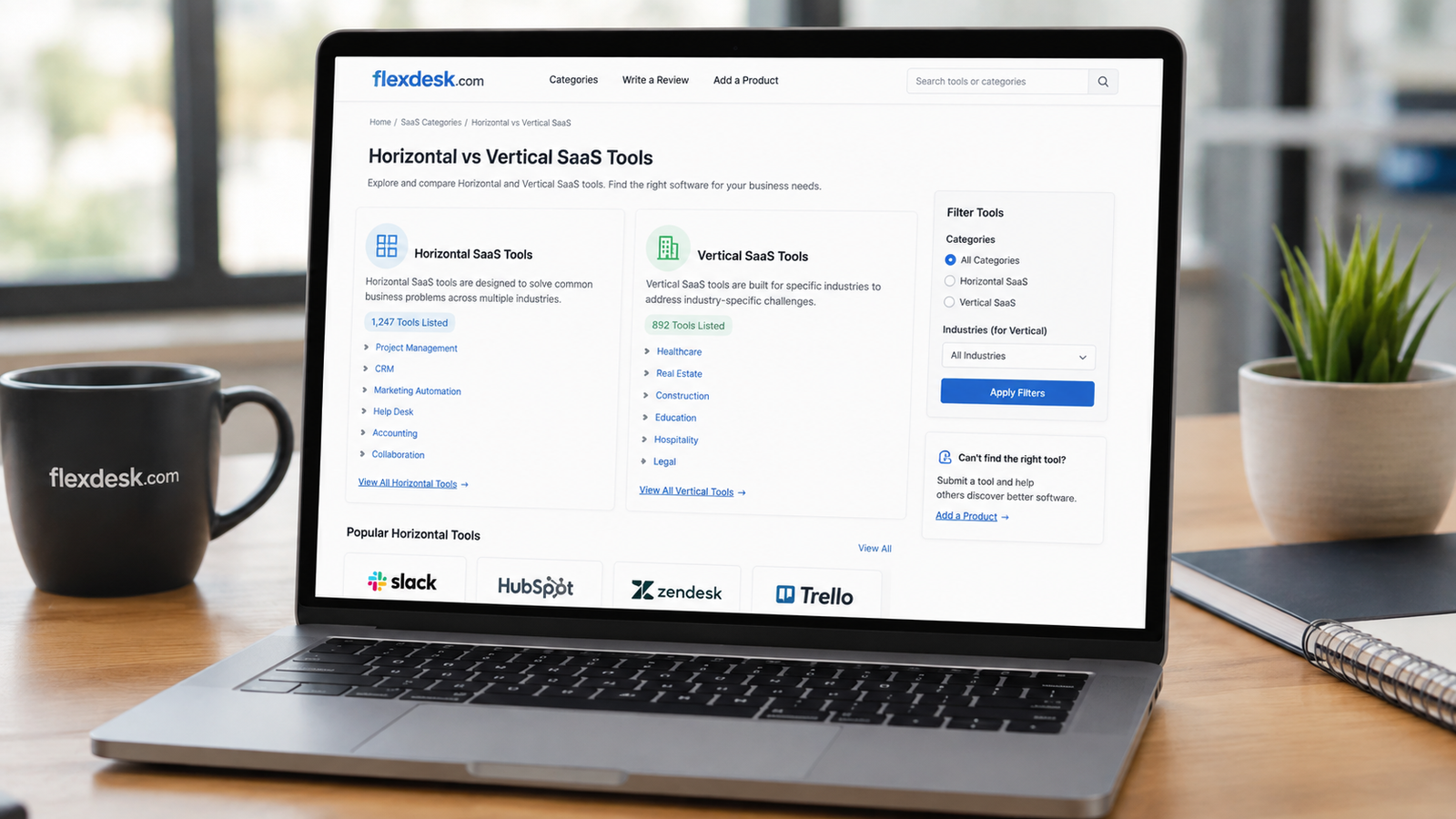
The software market is full of products that call themselves platforms, but that label does not tell buyers what kind of SaaS business they are actually looking at. FlexDesk.com horizontal vertical saas tool classification becomes particularly interesting because FlexDesk sits at the intersection of corporate real estate, workplace technology, lease administration, coworking and artificial intelligence. At first glance, its integrations and broad data capabilities might suggest a horizontal platform. Look closer, however, and the product is highly specialized around one customer group: corporate occupiers.
FlexDesk describes its platform as portfolio intelligence for corporate occupiers and says it provides a single source of truth for lease management, utilization tracking and coworking programs. Its current product architecture includes Portfolio Management, Coworking Booking Management and Utilization Intelligence.
What SaaS Classification Means in the First Place
Software-as-a-Service, or SaaS, describes a delivery model in which customers access software through the internet rather than installing and maintaining traditional on-premises applications. However, SaaS companies can be categorized in different ways depending on the customers they serve and the problems they solve. The most important distinction for this analysis is between horizontal and vertical SaaS.
Horizontal SaaS products address common business problems across numerous industries. A customer relationship management system, generic accounting platform, project-management application or team communication tool can potentially serve companies in technology, manufacturing, healthcare, retail and professional services. Vertical SaaS takes a narrower approach. It embeds industry-specific workflows, terminology, data structures, compliance requirements and integrations into the product.
The Short Answer: FlexDesk Is Vertical SaaS
The strongest classification for FlexDesk is vertical B2B SaaS, with a more specific description of corporate real estate and workplace-management software. The company’s own positioning provides the clearest evidence. FlexDesk says its platform is the first API-based and AI-native platform built exclusively for corporate occupiers. Its portfolio-management product is designed around corporate real estate data, leases, office utilization, rent obligations and workplace planning.
That specialization is the defining characteristic of vertical SaaS. FlexDesk is not attempting to become a general-purpose CRM, accounting system or project-management platform for every industry. Instead, it concentrates on a specialized business function within corporate organizations. Its data model incorporates lease documents, market comparable data, badge swipes, Wi-Fi data, HRIS information, sensor data, coworking information and desk or room bookings.
Why FlexDesk Does Not Fit the Traditional Horizontal SaaS Model
A horizontal SaaS platform normally succeeds by making a broadly applicable workflow useful across many industries. Its customers may have very different businesses, but they share the same fundamental software problem. FlexDesk takes the opposite route. Its workflows are built around corporate occupiers managing physical workplaces and commercial real estate portfolios.
Consider the questions the platform is designed to answer. How much office space is being used? When does a lease expire? What rent obligations are approaching? What is utilization by location? How much space might be required after headcount changes? Should a company renew, consolidate or modify its footprint? These are specialized corporate real estate questions rather than universal business workflows. FlexDesk’s product page explicitly highlights portfolio performance, lease management, utilization tracking, renewal alerts, rent obligations and future space needs.
FlexDesk’s Corporate Real Estate Focus
Corporate real estate is a specialized operating function. Companies with offices across multiple cities or countries need to manage leases, occupancy, employee attendance, workplace policies, expenses, renewals and space requirements. Historically, those activities could be distributed among spreadsheets, lease-management systems, facilities teams, HR systems and finance software.
FlexDesk is designed to bring many of these information streams together. Its portfolio-management product describes itself as a single source of truth for corporate real estate data and supports scenario analysis, space-efficiency analysis and portfolio-performance monitoring. The platform also supports traditional office leases, owned offices, serviced offices, coworking and owned assets.
That breadth does not make the product horizontal. In fact, it strengthens the vertical classification because the different components are connected around one specialized business domain: the corporate occupier’s real estate portfolio.
Portfolio Management Makes the Vertical Positioning Clear
Portfolio management is arguably the clearest evidence supporting the vertical SaaS classification. FlexDesk provides functionality specifically designed to manage leases and physical workplace assets. Users can access lease information, configure alerts, track rent obligations and connect utilization data to portfolio decisions.
The platform also includes financial-management workflows. According to FlexDesk, users can extract invoices into a general ledger, compare payment information with forecasted rent schedules and reference lease clauses when reviewing common-area-maintenance charges. These are highly specialized workflows associated with commercial lease administration and corporate real estate finance.
A generic horizontal SaaS application could theoretically be configured to store some of this information, but FlexDesk’s advantage comes from making the underlying CRE concepts native to the platform.
Utilization Intelligence Adds Another Specialized Layer
FlexDesk’s Utilization Intelligence product further reinforces its vertical positioning. The system connects existing attendance measurement technologies, including badge systems, Wi-Fi and network analysis, room and desk bookings and sensors. It then converts that information into workplace utilization insights.
The use cases are equally specialized. FlexDesk highlights reducing operating costs, assessing space-type inventory, monitoring return-to-office compliance and predicting demand. Corporate real estate, facilities and human resources teams can use the resulting information for renewal decisions, employee-attendance analysis, cleaning-cost planning and workplace design.
This is a good example of why the FlexDesk.com horizontal vertical saas tool classification question cannot be answered simply by looking at the platform’s APIs. Its underlying business logic remains deeply vertical even though it connects with many external systems.
Coworking Management Expands the Product Without Making It Horizontal
FlexDesk also operates in coworking management. Its platform allows corporate employees to access coworking inventory while giving administrators tools for spending controls, reservations, reporting and billing. The company says its network provides access to thousands of coworking locations and describes inventory that includes desks, meeting rooms and office suites.
The product’s integration with HRIS systems, single sign-on and corporate spending policies is particularly relevant to enterprise workplace teams. FlexDesk also says administrators can analyze booking behavior by department, inventory type, location and brand.
Again, this is a specialized workflow rather than a horizontal one. The software is not merely providing generic booking functionality. It is connecting flexible-office consumption to corporate real estate strategy and workplace policy.
API-Based Does Not Mean Horizontal
One potential source of confusion is FlexDesk’s API-based architecture. API-first software can integrate with many other systems, which sometimes makes a product appear more horizontal. But architecture and market classification are two different things.
FlexDesk says it can ingest lease data, market comparable information, badge swipes, Wi-Fi data, HRIS information, sensor data, coworking data and desk or room bookings. These integrations make the platform more flexible and potentially more valuable, but they do not change its core customer or industry focus.
A vertical SaaS company can have an extensive API ecosystem. In fact, specialized integration is often one of the reasons vertical SaaS products become valuable. The platform becomes the layer that understands how different data sources relate to a particular industry’s workflow.
AI-Native Features Strengthen FlexDesk’s Position
Artificial intelligence is another major part of FlexDesk’s current positioning. The company describes its technology as AI-native and says its platform supports AI-powered lease abstraction. Users can upload lease documents and have information automatically parsed into a codified data schema.
FlexDesk also describes an AI Copilot in beta, with capabilities including scenario planning, attendance and utilization analysis, interactive lease-language search, guided recommendations and cost-rationalization opportunities.
These capabilities illustrate an important trend in vertical SaaS. The future of industry-specific software is increasingly about turning specialized data into decisions rather than simply digitizing records. An AI system that understands lease language, office utilization and portfolio economics can potentially provide more relevant recommendations than a generic AI assistant without CRE-specific context.
FlexDesk and the Broader PropTech Market
A second useful classification is PropTech. PropTech broadly describes technology applied to real estate, property operations, transactions, construction, investment and related activities. Within that broader category, FlexDesk is most closely associated with corporate real estate and workplace technology.
This distinction matters because PropTech is a broad umbrella. A residential property-management application, construction-management platform, mortgage technology company and corporate workplace system can all be called PropTech while solving completely different problems.
FlexDesk’s specialization is the corporate occupier side of real estate. Its platform connects physical-office data with financial, lease and workforce information. That gives it a position between traditional corporate real estate software and newer workplace analytics platforms.
The Importance of Vertical SaaS in Corporate Real Estate
Vertical SaaS has gained attention because specialized software can solve problems that general-purpose platforms often address only through customization. Instead of forcing customers to configure generic objects and workflows, vertical platforms can make industry-specific concepts part of the product from the beginning.
For corporate real estate teams, this can reduce the gap between software functionality and actual operating practices. Lease renewal dates, square footage, rent obligations, headcount, utilization, occupancy ratios and workplace demand are not generic business objects. They have specific relationships that become more useful when software understands the context.
FlexDesk’s reporting capabilities reflect that approach. Its portfolio-management product says users can analyze square footage, visit rates, headcount, density ratios and cost-per metrics through purpose-built analytics.
FlexDesk’s Recent Product Evolution
The company’s product development also supports the idea that FlexDesk is building a specialized vertical platform rather than a generic SaaS application. In 2024, FlexDesk launched Utilization Intelligence, allowing corporate occupiers to combine attendance data from systems such as badge access, sensors, Wi-Fi and booking platforms.
Product development continued through 2025 and 2026. FlexDesk’s Q3 2025 update highlighted customizable utilization denominators, peak-versus-average utilization views, target thresholds and expanded reporting. Its Q1 2026 update added portfolio-analysis capabilities involving figures such as capacity and headcount, along with lease-document access improvements.
These updates point toward a platform increasingly focused on turning fragmented CRE information into ongoing operational intelligence.
Security and Enterprise Readiness
Enterprise SaaS classification also involves more than functionality. Corporate real estate systems may contain commercially sensitive lease information, financial data and employee attendance information, making security and access controls important considerations.
FlexDesk says its platform supports single sign-on and SCIM, geo- and role-based access controls and SOC 2 compliance. Its security documentation states that data in transit uses TLS 1.2 or higher and that customer data stores are encrypted at rest. The company also says its SOC 2 Type 2 report is available upon request.
These claims should still be independently assessed by prospective customers during vendor due diligence. Nevertheless, they demonstrate that FlexDesk is positioning itself for enterprise corporate-occupier environments rather than as a lightweight consumer productivity application.
A Practical SaaS Classification Framework for FlexDesk
For researchers, investors, journalists and technology buyers, the most useful classification can be expressed as a hierarchy:
| Category | FlexDesk classification |
|---|---|
| Delivery model | SaaS |
| Customer type | B2B |
| Market approach | Vertical SaaS |
| Primary industry | Corporate Real Estate |
| Broader sector | PropTech |
| Workplace category | Workplace / Occupier Technology |
| Core users | Corporate occupiers and CRE teams |
| Main functions | Portfolio, lease, utilization and coworking management |
| Architecture | API-based |
| AI positioning | AI-native |
| Enterprise orientation | Yes |
| Horizontal SaaS | No, not primarily |
This framework separates several concepts that are sometimes incorrectly combined. Being API-first does not make a product horizontal. Having multiple modules does not make it horizontal. Supporting customers in multiple countries does not make it horizontal. The more important question is whether the software’s core value proposition is designed around a particular industry or around a broadly shared business process.
How FlexDesk Compares With a True Horizontal SaaS Tool
Imagine a generic project-management application. A construction company, marketing agency, law firm and software startup can all use it. The product might include tasks, calendars, documents, notifications and reporting, but those functions do not inherently belong to one industry.
Now compare that with FlexDesk. The product is built around leases, commercial space, utilization, coworking, occupancy, headcount and workplace strategy. Its integrations are selected because they contribute to corporate real estate intelligence. That is the defining difference.
FlexDesk could certainly serve organizations in many sectors because almost any large employer may have offices. But customer diversity is not the same as horizontal SaaS positioning. A vertical SaaS provider can serve customers across industries while remaining vertically specialized around a business function or professional domain.
What the Classification Means for Customers
For potential customers, identifying FlexDesk as vertical SaaS helps clarify where its value may be strongest. Organizations with complex office portfolios, multiple leases, hybrid-work policies, coworking programs and distributed attendance data are likely to benefit most from a platform built specifically around these issues.
Smaller businesses with one office and straightforward lease arrangements may have less need for specialized portfolio intelligence. Similarly, a company looking only for generic employee scheduling or document storage may not require a corporate real estate platform.
The classification therefore provides a practical buying signal. FlexDesk is most relevant when the organization has a genuine CRE data-management problem rather than simply a generic software requirement.
What the Future Could Mean for Vertical CRE SaaS
The next stage of vertical SaaS is likely to move from system-of-record functionality toward system-of-intelligence functionality. In corporate real estate, that means software will increasingly be expected not only to store leases but also to interpret them, connect them with utilization and help teams model future scenarios.
FlexDesk’s AI Copilot direction reflects that transition. Its described capabilities include scenario planning, utilization analysis, lease-language search and recommendations. The more these capabilities mature, the more the distinction between lease administration, workplace analytics and strategic portfolio planning may blur.
That creates an interesting future for PropTech. A specialized platform that understands both the physical workplace and the financial structure behind it could become a strategic decision layer for corporate occupiers rather than simply another administrative database.
Key Takeaways
The FlexDesk.com horizontal vertical saas tool classification is best summarized as vertical B2B SaaS within the PropTech market, specializing in corporate real estate and workplace management.
The evidence is strong:
- FlexDesk explicitly targets corporate occupiers.
- Its portfolio-management tools are built around leases, rent obligations, space efficiency and CRE data.
- Its Utilization Intelligence product connects workplace attendance and occupancy information.
- Its coworking product links flexible workspace with corporate workplace programs.
- Its data integrations are specialized around CRE and employee-workplace information.
- Its AI features are designed for lease and portfolio intelligence rather than general-purpose productivity.
- Its API-based architecture does not make the company horizontal.
- Its broader industry classification is PropTech, while its SaaS classification is vertical SaaS.
- Its recent product development continues to deepen its corporate real estate specialization.
In other words, FlexDesk is best understood as specialized software for corporate occupiers, not general-purpose horizontal SaaS.
Frequently Asked Questions
Is FlexDesk horizontal or vertical SaaS?
FlexDesk is best classified as vertical SaaS. Its software is specifically designed for corporate occupiers and focuses on corporate real estate portfolio management, lease administration, workplace utilization and coworking programs.
Is FlexDesk a PropTech company?
Yes. FlexDesk can reasonably be classified as a PropTech company, more specifically within corporate real estate and workplace technology. Its platform connects leases, office utilization, coworking and workplace data to support corporate real estate decisions.
Why is FlexDesk considered vertical SaaS?
Its workflows and data model are built around a specialized business domain. Lease obligations, office occupancy, square footage, workplace utilization, renewal dates, coworking bookings and corporate real estate analytics are central to the platform.
Does being API-based make FlexDesk horizontal SaaS?
No. API architecture and SaaS market orientation are separate concepts. FlexDesk’s API-based approach allows it to integrate with HRIS, badge, Wi-Fi, sensor, coworking and booking systems, but the information is integrated specifically to support corporate real estate and workplace workflows.
Does FlexDesk use artificial intelligence?
Yes. FlexDesk describes its platform as AI-native and offers AI-powered lease abstraction. It also describes an AI Copilot in beta that supports scenario planning, utilization analysis, lease-language search and recommendations.
What industry does FlexDesk serve?
FlexDesk primarily serves corporate occupiers and corporate real estate teams. Its platform is designed to help organizations manage offices, leases, utilization, coworking programs and related workplace information.
What is the most accurate one-line classification of FlexDesk?
The most accurate description is: FlexDesk is a vertical B2B SaaS and PropTech platform for corporate real estate portfolio and workplace management.
Conclusion
The FlexDesk.com horizontal vertical saas tool classification becomes much clearer once architecture is separated from market focus. FlexDesk may connect to many systems, ingest diverse datasets and support organizations across different industries, but its underlying product is purpose-built around a specialized professional domain.
Its focus on corporate occupiers, lease management, utilization intelligence, coworking, workplace analytics and CRE portfolio decisions makes vertical SaaS the most defensible classification. Its broader category is PropTech, while its increasingly AI-driven architecture represents the next evolution of specialized enterprise software.
For technology buyers and researchers, that distinction matters. The real strength of a vertical SaaS platform is not simply that it delivers software through the cloud. It is that the software understands the industry’s problems deeply enough to turn specialized data into useful decisions. FlexDesk’s product development suggests that corporate real estate is precisely the problem space it is designed to understand.
As workplace strategies continue evolving, the companies that can connect leases, utilization, workforce data and financial information will have an increasingly valuable role in corporate decision-making. For anyone researching vertical SaaS examples, PropTech platforms or corporate real estate software, FlexDesk provides a useful case study in how a specialized SaaS company can combine APIs, AI and industry-specific workflows into one enterprise platform.