
Six months after launch, a founder in Austin realized her online marketplace could do almost everything except the one thing her business actually needed: split payouts automatically between hundreds of small vendors. She had picked her platform based on price and a slick demo. Now she was manually calculating commissions in a spreadsheet every Friday night. Her story is not rare. It is, in fact, the single most common regret among marketplace founders, and it is exactly why learning how to choose the best marketplace software matters more than most people realize until it is too late.
Marketplaces are no longer a niche corner of e-commerce. They now account for nearly 40 percent of global online retail sales, and that share keeps climbing every quarter. Multivendor platforms alone are projected to drive more than seven trillion dollars in sales within the next five years. Behind almost every one of these platforms sits a software decision made early on, often before the founder fully understood their own business model. Getting that decision right sets the foundation for years of growth. Getting it wrong means a painful, expensive migration down the road.
Why the Marketplace Software Decision Matters So Much
Choosing marketplace software is not like picking an email tool or a project management app. Marketplaces are two-sided or multi-sided businesses, which means the software has to serve buyers, sellers, and the platform operator simultaneously. A weak choice does not just create minor friction. It can quietly cap how many vendors you can onboard, how fast your search results load once your catalog grows, or how easily you can add a new payment method when a big client demands it.
There is also a structural reason this decision carries so much weight. Once vendors start listing products, once buyers start leaving reviews, and once your payment history builds up inside a platform, moving to a new system becomes a major operational project rather than a quick swap. Data has to be migrated, sellers have to be retrained, and search engine rankings tied to your marketplace URLs can take a hit during the transition. Founders who treat the software choice as an afterthought often end up paying for that decision twice: once in subscription fees, and again in the cost of switching later.
The businesses that get this right tend to do one thing differently. They evaluate marketplace software the way they would evaluate a co-founder, asking not just what it can do today but whether it can grow alongside the business for the next three to five years.
Build, Buy, or Validate First: The Real Starting Point
Before comparing any specific products, there is a more fundamental fork in the road. Entrepreneurs generally have three paths available. The first is a concierge minimum viable product, where the founder manually matches buyers and sellers using nothing more than a form, a spreadsheet, or a few email threads. This approach validates demand without writing a line of code and costs almost nothing beyond time.
The second path is ready-made marketplace software, which handles listings, payments, messaging, and user accounts out of the box. The third is fully custom development, building the platform from scratch with a hired engineering team. Custom builds typically run upward of three hundred thousand dollars and take nine to twelve months or longer before launch, compared to roughly twelve to twenty thousand dollars a year for established software. For the vast majority of founders, somewhere around nine in ten by most estimates, off-the-shelf marketplace software is the more sensible starting point.
Custom development still has its place, particularly for businesses with unusual transaction logic or massive scale requirements that no existing platform supports. But jumping straight to a custom build before validating that people actually want to buy and sell through your platform is one of the most expensive mistakes a founder can make. It is worth resisting the temptation to build everything perfectly before you know whether the marketplace concept works at all.
Define Your Marketplace Type Before You Compare Vendors
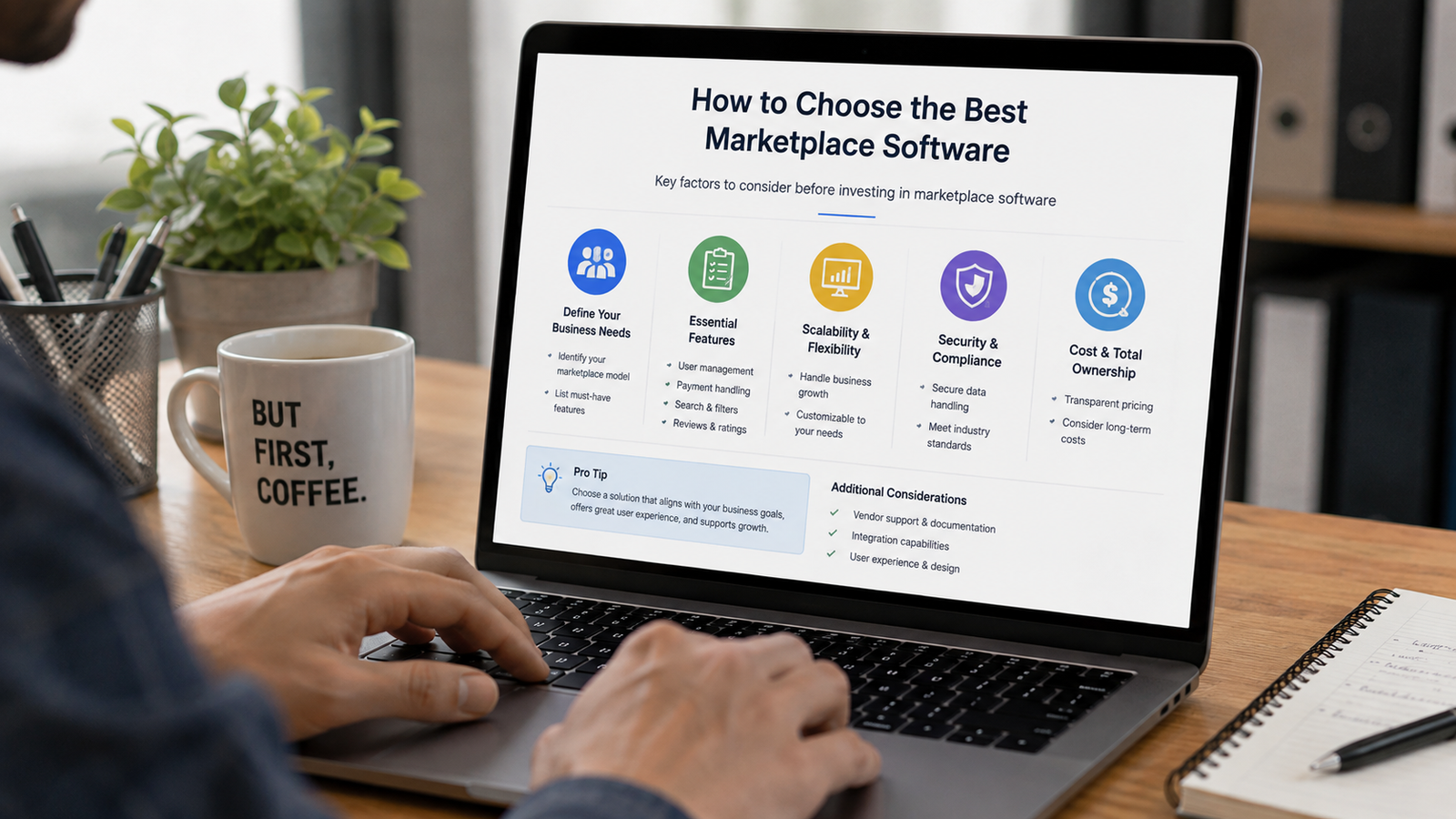
Every marketplace software guide worth reading agrees on this point: you cannot meaningfully compare platforms until you know what kind of marketplace you are building. A business-to-business marketplace connecting industrial suppliers has almost nothing in common, technically speaking, with a peer-to-peer platform like a neighborhood tool-sharing app. A rental marketplace needs calendar and booking logic that a straightforward goods marketplace never touches. A service marketplace needs scheduling and dispute resolution tools that a digital downloads marketplace can ignore entirely.
Software providers specialize, whether they advertise it clearly or not. A platform built primarily for B2C retail marketplaces often handles inventory and shipping beautifully but struggles with the quoting and negotiation workflows a B2B buyer expects. Conversely, a platform designed for freelance service marketplaces may lack robust shipping integrations altogether. Naming your marketplace type in plain language, B2B, B2C, peer-to-peer, rental, or service, before you start requesting demos will save weeks of wasted evaluation time.
This step also clarifies your buyer and seller expectations. A B2B buyer expects net-30 payment terms and bulk pricing tiers. A peer-to-peer buyer expects instant checkout and trust signals like verified reviews. Software that cannot flex to match these expectations will frustrate users regardless of how polished its interface looks in a sales demo.
The Core Features That Actually Separate Good Platforms From Great Ones
Once the marketplace type is clear, the real evaluation begins. Payment infrastructure sits at the top of the list, since this is where many platforms quietly fall short. Confirm the software handles split payments and automated vendor payouts natively, rather than through a bolted-on third-party workaround. Ask specifically how commissions are calculated, how refunds are processed across multiple sellers, and whether the platform supports the pricing model you intend to use, whether that is commission-based, subscription-based, or a hybrid.
Search and discovery deserve equally close attention, especially for marketplaces expecting large catalogs. A search function that performs well with five hundred listings can slow to a crawl at fifty thousand. Ask whether the search engine is built natively into the platform or relies on a third-party integration, and request performance benchmarks at a catalog size similar to what you expect within eighteen months. Filtering, faceted navigation, and relevance ranking all affect whether buyers actually find what they are looking for, which directly affects conversion rates.
Order and fulfillment logic is the next major category. Map the entire customer journey from onboarding through listing, purchase, fulfillment, payout, and returns, then check how many of those steps the software handles without custom development. Shipping flexibility matters here too. A platform should support multiple shipping models, including centralized shipping, seller-managed drop-shipping, or free shipping thresholds, so operators can choose what fits their specific business rather than being locked into one method.
Finally, look closely at integrations and compliance. The best marketplace software connects cleanly with customer relationship management tools, accounting software, and shipping providers through flexible APIs. Compliance with data protection standards such as GDPR is non-negotiable for any platform operating internationally, and security certifications are a reasonable thing to request proof of before signing a contract.
SaaS Versus Self-Hosted: Understanding the Real Tradeoffs
One of the more consequential forks in this decision involves choosing between a software-as-a-service model and a self-hosted deployment. SaaS platforms are hosted by the provider, updated automatically, and typically billed as a predictable monthly or annual subscription. This model suits founders who want to launch quickly and would rather focus on growing the business than managing servers.
Self-hosted platforms, by contrast, give the operator full control over the codebase and infrastructure. This appeals to businesses with unusual customization needs, strict data residency requirements, or the internal technical team to manage hosting and security patches. The tradeoff is real: self-hosting demands ongoing engineering resources that many early-stage marketplaces simply do not have. There is no universally correct answer here. The right choice depends on your team’s technical capacity, your growth timeline, and how much customization your business model genuinely requires versus how much is simply nice to have.
Watching for the Hidden Costs That Wreck Budgets Later
The advertised subscription price of marketplace software is rarely the full story. What industry insiders sometimes call the “plugin tax” refers to the accumulation of add-on fees for features that should arguably be included from the start: advanced search, additional payment gateways, custom reporting, or higher API call limits. These add-ons can quietly double or triple the effective monthly cost of a platform that looked affordable in the sales pitch.
Hosting and infrastructure costs deserve the same scrutiny. Native, all-in-one platforms tend to keep monthly budgets stable because hosting is bundled into the subscription. Platforms built on top of open-source frameworks may look cheaper upfront but often require separate hosting, security monitoring, and developer maintenance that add up quickly. Before signing any contract, request a full breakdown of every fee tier, including what happens to pricing as transaction volume grows. A platform that seems like a bargain at one hundred orders a month can become surprisingly expensive at ten thousand.
Scalability and Proof: Ask for the Numbers, Not the Promises
Marketing pages love the word “scalable,” but the term means little without evidence. Before committing, ask vendors for case studies with real numbers: the largest catalog size a client has run on the platform, the highest concurrent seller count, and peak order volume during high-traffic periods like holiday sales. A platform that has never been tested beyond a few thousand listings may struggle in ways that only appear once your marketplace actually starts growing.
It is also worth asking how the platform has handled sudden traffic spikes historically, since marketplaces often experience unpredictable surges tied to viral moments, seasonal demand, or a single popular seller. A platform that degrades under pressure does not just frustrate users in the moment. It can permanently damage trust in a marketplace that buyers and sellers were just beginning to rely on.
Key Takeaways
- Define your exact marketplace type, B2B, B2C, peer-to-peer, rental, or service, before comparing any software, since providers specialize and rarely excel at every model.
- For most founders, established marketplace software is more practical than custom development, which can cost hundreds of thousands of dollars and take a year or more to launch.
- Payment infrastructure, native search performance, and fulfillment workflow coverage are the features most likely to separate a platform that scales from one that does not.
- Watch for hidden plugin fees and rising hosting costs that can make an affordable-looking platform expensive once your marketplace grows.
- Choosing between SaaS and self-hosted deployment should be based on your team’s technical capacity and customization needs, not on price alone.
- Request real case studies and performance numbers from vendors rather than relying on marketing claims about scalability.
- Migrating marketplace software after launch is costly and disruptive, so investing extra time in the evaluation phase pays off for years afterward.
Frequently Asked Questions
What is the difference between marketplace software and building a custom marketplace?
Marketplace software is a pre-built platform that already includes listings, payments, and user management, letting founders launch in weeks. Custom development means hiring engineers to build every feature from the ground up, which typically costs significantly more and takes many months longer, but allows for fully bespoke functionality.
How much does marketplace software typically cost?
Established marketplace software generally runs in the range of a few hundred to a couple thousand dollars per month depending on features and transaction volume, while custom-built platforms can cost well into six figures before launch. Always request a full pricing breakdown that includes add-on fees, not just the base subscription.
Should a new marketplace business start with software or validate the idea manually first?
Many successful founders start with a manual, concierge-style approach, matching buyers and sellers by hand to confirm real demand before investing in any software. This reduces financial risk considerably and can reveal important insights about what features actually matter before a platform decision is locked in.
What features matter most for a B2B marketplace compared to a B2C marketplace?
B2B marketplaces typically need bulk pricing tiers, negotiated quotes, and extended payment terms, while B2C marketplaces prioritize fast checkout, mobile-friendly browsing, and consumer trust signals like reviews. Choosing software built with your specific model in mind avoids forcing awkward workarounds later.
Is it better to choose a SaaS marketplace platform or a self-hosted one?
SaaS platforms suit founders who want to launch quickly without managing servers, while self-hosted platforms suit businesses with strong technical teams and specific customization or data residency needs. Neither option is universally better; the right fit depends on internal resources and long-term growth plans.
How important is native payment splitting for marketplace software?
It is one of the most important features to verify before signing a contract, since multivendor marketplaces need to divide payments between the platform and multiple sellers automatically. Software that lacks native split payments often forces manual workarounds that become unmanageable as vendor counts grow.
Can a marketplace switch software providers after launch without major disruption?
Switching is possible but rarely simple, since vendor data, transaction history, and search engine rankings tied to existing URLs all need careful migration. This is exactly why thorough evaluation before the initial launch is worth the extra time investment.
The Bottom Line
Marketplaces succeed or stall based on decisions made long before the first sale happens, and the software choice sits at the center of that foundation. The founders who avoid painful, expensive migrations are rarely the ones who found the cheapest platform or the flashiest demo. They are the ones who took the time to define their marketplace type clearly, tested payment and search performance under realistic conditions, and asked vendors for proof rather than promises. With online marketplaces now representing nearly forty percent of global e-commerce and growing every quarter, this is not a decision worth rushing.
If you are currently comparing platforms, start by writing down your exact marketplace type and the three features your business absolutely cannot operate without. Bring that list into every vendor conversation, request real performance numbers, and resist any platform that cannot answer specific questions about scalability with specific evidence. The extra week spent on evaluation now is far cheaper than the migration project waiting on the other side of a wrong decision.