

Access to affordable financing has always been one of the biggest challenges for small and medium-sized businesses (SMBs). Traditional lending processes often involve lengthy paperwork, manual underwriting, slow approvals, and limited transparency. Modern financial technology has changed this landscape by introducing API-first platforms that connect lenders, fintech companies, banks, accounting software, payment processors, and business applications into one seamless ecosystem. Today, leading developers of API-first SMB credit access tools are enabling businesses to secure funding faster while helping financial institutions automate lending operations, reduce risks, and improve customer experiences. Instead of relying on outdated workflows, organizations can integrate lending capabilities directly into digital products using secure APIs. This shift has accelerated embedded finance, digital banking, and intelligent credit assessment across multiple industries. As demand for faster capital continues to grow, API-first innovation has become a strategic priority for fintech companies worldwide.
Quick Answer
Leading developers of API-first SMB credit access tools build software platforms that allow banks, fintech companies, lenders, and business applications to integrate credit services through secure APIs. These solutions simplify loan applications, automate underwriting, connect financial data, improve risk analysis, and deliver funding decisions significantly faster than traditional lending systems. Their technology also supports embedded finance, open banking, AI-driven credit scoring, digital identity verification, compliance automation, and real-time financial data sharing.
Understanding API-First SMB Credit Access Tools
API-first architecture is transforming how financial products are built and delivered. Instead of creating software with APIs added later, developers design every feature around secure, scalable, and reusable APIs from the beginning. This approach enables lenders, banks, SaaS providers, payment companies, and fintech startups to integrate credit products without building entire lending systems from scratch. Leading developers of API-first SMB credit access tools focus on flexibility because businesses require different lending workflows depending on their industries, customer profiles, and regulatory requirements. Their platforms connect accounting systems, payment gateways, banking data, tax records, payroll systems, invoicing software, and customer relationship management platforms into unified credit ecosystems. This interconnected approach allows financial institutions to make faster, more informed lending decisions. Businesses benefit from simplified applications, fewer manual documents, and faster approvals. As embedded finance continues expanding, API-first technology is becoming the standard foundation for modern SMB lending solutions.
Why API-First Matters for SMB Lending
Traditional loan systems often depend on disconnected software, manual reviews, and outdated infrastructure that slows decision-making. API-first development removes these bottlenecks by allowing systems to communicate instantly through standardized interfaces. Financial institutions can verify business identities, retrieve banking transactions, analyze accounting data, and calculate creditworthiness within seconds. Leading developers of API-first SMB credit access tools also prioritize scalability so financial platforms can process thousands of lending requests simultaneously. Modern APIs improve developer productivity by reducing integration complexity while enabling continuous software updates without disrupting users. Businesses gain access to personalized financing options because lenders can analyze richer financial datasets instead of relying solely on historical credit scores. This creates more inclusive lending opportunities for growing companies with limited traditional credit histories. API-first ecosystems therefore improve efficiency for both lenders and borrowers.
Core Characteristics of API-First Platforms
Successful API-first lending platforms generally include several defining characteristics:
- Modular architecture
- RESTful and GraphQL APIs
- Secure authentication
- Cloud-native deployment
- Real-time financial data access
- Automated compliance workflows
- AI-assisted underwriting
- Developer-friendly documentation
- Flexible SDKs
- High availability and scalability
Together, these capabilities help financial organizations launch innovative lending products much faster while maintaining security and regulatory compliance.
Why SMBs Need Modern Credit Access Solutions
Small businesses frequently struggle with inconsistent cash flow, seasonal revenue fluctuations, inventory purchases, payroll obligations, and expansion investments. Traditional financing methods rarely match the speed required in today’s competitive markets. Leading developers of API-first SMB credit access tools address these challenges by enabling lenders to analyze live financial information instead of relying exclusively on historical credit reports. Through API integrations, platforms can securely collect bank transactions, accounting records, payment histories, tax information, and operational metrics. These insights allow lenders to evaluate businesses more accurately and approve qualified applicants faster. Modern credit platforms also improve transparency by keeping borrowers informed throughout every stage of the lending process. Automated workflows reduce operational costs for lenders while improving customer satisfaction. As digital transformation continues accelerating across industries, API-first lending has become essential for supporting SMB growth and financial resilience.
Business Problems Solved by API-Based Lending
Many SMBs encounter similar financing obstacles regardless of industry. API-driven lending platforms help solve these issues through automation and intelligent data analysis.
| Traditional Challenge | API-First Solution |
|---|---|
| Slow approvals | Automated underwriting |
| Paper documentation | Digital document collection |
| Limited financial visibility | Real-time data connections |
| Manual verification | Identity automation |
| High operational costs | Workflow automation |
| Poor customer experience | Embedded digital lending |
| Fragmented systems | Unified API integrations |
| Limited scalability | Cloud-native infrastructure |
These improvements allow lenders to serve more businesses while reducing administrative workloads and operational risks.
Key Technologies Behind API-First Credit Platforms
The success of leading developers of API-first SMB credit access tools depends on combining multiple advanced technologies into unified lending ecosystems. Cloud computing provides scalable infrastructure capable of handling fluctuating lending volumes without performance degradation. Artificial intelligence accelerates underwriting by identifying financial trends, fraud indicators, and repayment probabilities from large datasets. Machine learning models continuously improve lending accuracy as more data becomes available. Open banking APIs enable secure access to business banking information with customer consent. Identity verification technologies reduce fraud through digital authentication, biometric verification, and document validation. Workflow automation coordinates loan origination, approval, servicing, and compliance activities across multiple departments. Event-driven architectures further improve responsiveness by allowing systems to exchange information instantly. Together, these technologies deliver faster, more reliable, and more intelligent lending experiences.
Artificial Intelligence in Credit Decisions
Artificial intelligence has become one of the most influential technologies in modern lending. Instead of relying solely on conventional credit reports, AI models analyze transactional behavior, cash flow trends, supplier payments, customer invoices, payroll stability, and business performance indicators. Leading developers of API-first SMB credit access tools use predictive analytics to estimate repayment capacity while minimizing default risks. Machine learning algorithms also detect fraudulent activities by identifying unusual transaction patterns and behavioral anomalies. These automated assessments support loan officers rather than replacing human judgment entirely. Financial institutions can therefore approve qualified applicants more confidently while reducing manual review time. Continuous learning enables AI systems to become increasingly accurate as lending portfolios expand. The result is smarter, fairer, and more efficient credit decision-making.
Open Banking and Financial Connectivity
Open banking has dramatically expanded access to financial information through secure customer-authorized APIs. Instead of requesting printed bank statements, lenders can retrieve verified financial data directly from participating institutions. Leading developers of API-first SMB credit access tools integrate open banking capabilities to improve underwriting accuracy while reducing document fraud. Businesses benefit because they spend less time collecting paperwork and more time focusing on operations. Financial institutions receive standardized, real-time information that supports faster credit decisions. Open banking also improves transparency since borrowers maintain control over data-sharing permissions. As regulatory frameworks mature globally, secure financial connectivity continues strengthening digital lending ecosystems. This innovation supports broader financial inclusion for underserved SMBs.
Essential Features Offered by Leading Developers
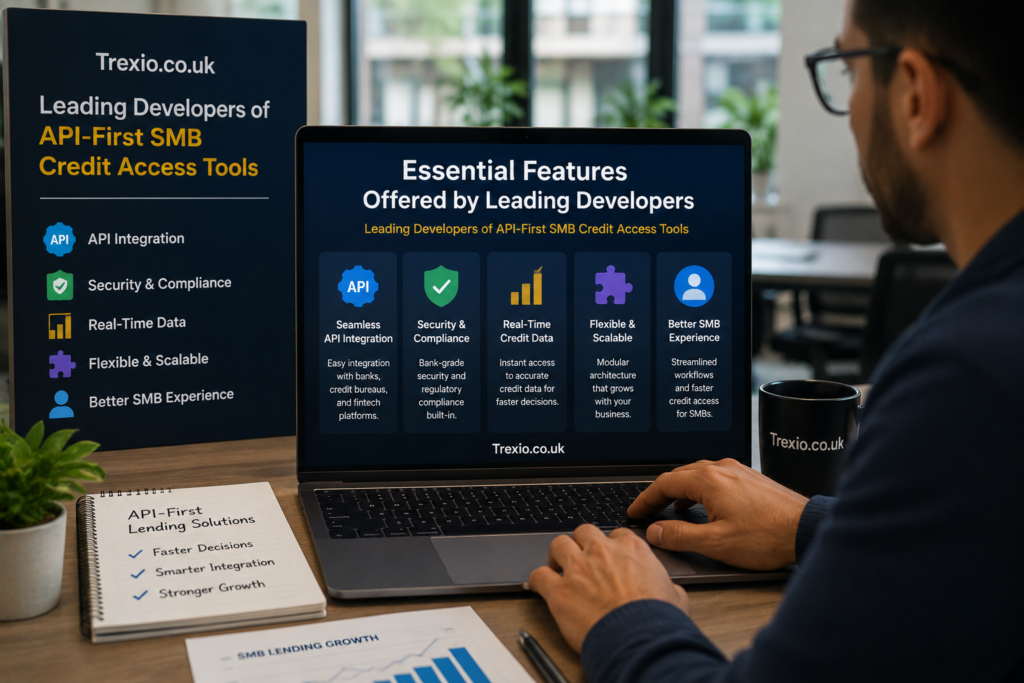
Successful API-first lending platforms distinguish themselves by providing comprehensive functionality beyond basic loan origination. Leading developers of API-first SMB credit access tools typically build flexible ecosystems capable of supporting multiple financial products, integration partners, and regulatory environments. Their solutions emphasize security, automation, scalability, developer experience, and customer satisfaction simultaneously. Businesses adopting these platforms can customize lending workflows without rebuilding core infrastructure. Financial institutions also gain operational visibility through analytics dashboards, monitoring tools, and automated reporting. Developer portals simplify implementation through extensive documentation, SDKs, testing environments, and technical support. These capabilities accelerate digital transformation while enabling organizations to launch innovative lending products more efficiently. Continuous software updates further ensure long-term adaptability in rapidly evolving financial markets.
Common Platform Features
Most leading platforms provide features including:
- Loan origination APIs
- Credit scoring engines
- Digital onboarding
- Business identity verification
- AML and KYC automation
- Payment integrations
- Accounting software connectivity
- Banking APIs
- Workflow orchestration
- Decision automation
- Risk analytics
- Portfolio monitoring
- Compliance reporting
- Fraud detection
- Developer documentation
These integrated capabilities allow financial institutions to deliver end-to-end digital lending experiences with greater speed, accuracy, and operational efficiency.
How Leading Developers of API-First SMB Credit Access Tools Support Embedded Finance
Embedded finance has become one of the fastest-growing segments within financial technology because businesses increasingly expect financial services to be available directly inside the software they already use. Leading developers of API-first SMB credit access tools make this possible by allowing software providers, e-commerce platforms, ERP vendors, accounting applications, and payment processors to integrate lending capabilities through secure APIs. Instead of redirecting users to separate banking portals, businesses can apply for working capital, invoice financing, or revolving credit without leaving their primary workflow. This seamless experience improves customer satisfaction while increasing lending opportunities for financial institutions. API-first infrastructure also reduces development time because providers can reuse standardized endpoints across multiple products. As embedded lending expands into new industries, these platforms continue introducing configurable APIs that adapt to different business models and compliance requirements. Their flexibility enables organizations to deliver personalized financing solutions while maintaining a consistent user experience. This evolution is redefining how businesses discover and access credit.
Industries Benefiting from API-First Credit Solutions
API-driven lending technology now serves organizations far beyond traditional banking. Retail companies use embedded financing to support inventory purchases during seasonal demand. Healthcare providers leverage financing solutions for equipment investments and operational expenses. Manufacturing businesses obtain working capital through integrated ERP platforms connected to lending APIs. Logistics companies access fleet financing without interrupting operational workflows. Professional service firms use embedded credit to manage payroll and project expenses more effectively. E-commerce platforms integrate merchant financing directly into seller dashboards, allowing entrepreneurs to secure funding within minutes. Software vendors improve customer retention by embedding flexible financing options into subscription platforms. As adoption continues growing, leading developers of API-first SMB credit access tools are expanding their ecosystems to serve an increasingly diverse range of industries.
Security and Compliance Considerations
Financial software must protect highly sensitive customer information while complying with evolving regulations across multiple jurisdictions. Leading developers of API-first SMB credit access tools prioritize security by implementing strong encryption, token-based authentication, secure API gateways, continuous monitoring, and detailed audit logging. Multi-factor authentication adds another layer of protection against unauthorized access, while automated security testing helps identify vulnerabilities before deployment. Compliance frameworks such as Know Your Customer (KYC), Anti-Money Laundering (AML), data privacy regulations, and financial reporting standards are often integrated directly into lending workflows. Cloud-native infrastructure further improves resilience by supporting redundancy, disaster recovery, and continuous availability. Regular penetration testing and independent security assessments strengthen trust among banks, fintech companies, and enterprise customers. Secure software development practices ensure vulnerabilities are addressed throughout the application lifecycle rather than after deployment. Together, these safeguards create reliable lending ecosystems capable of protecting both financial institutions and borrowers.
Essential Security Components
| Security Area | Purpose | Business Benefit |
|---|---|---|
| API Authentication | Verifies user identity | Prevents unauthorized access |
| Data Encryption | Protects sensitive information | Improves customer trust |
| KYC Automation | Verifies business identity | Faster onboarding |
| AML Screening | Detects suspicious activity | Regulatory compliance |
| Audit Logging | Tracks system activity | Easier investigations |
| Fraud Detection | Identifies unusual behavior | Reduces financial losses |
| Access Controls | Limits user permissions | Better operational security |
| Continuous Monitoring | Detects threats quickly | Higher system reliability |
Choosing the Right API-First Credit Platform
Selecting among leading developers of API-first SMB credit access tools requires evaluating far more than feature lists. Organizations should first determine whether the platform aligns with their lending strategy, integration requirements, customer volume, and regulatory obligations. Scalability is particularly important because lending demand can increase rapidly as businesses expand into new markets. Developers should also review API documentation quality, software development kits, testing environments, and implementation support. Reliable customer service and ongoing product updates indicate a provider committed to long-term innovation. Organizations should evaluate reporting capabilities, workflow customization, analytics dashboards, and automation features before making a decision. Pricing transparency, uptime guarantees, and security certifications are equally important considerations. A well-chosen API-first platform can significantly reduce development costs while accelerating digital lending initiatives.
Evaluation Checklist
Before selecting a provider, organizations should evaluate:
- API reliability and uptime
- Developer documentation quality
- Cloud infrastructure
- Security certifications
- AI underwriting capabilities
- Open banking integrations
- Compliance automation
- Custom workflow support
- Analytics and reporting
- Technical support responsiveness
- Scalability
- Pricing flexibility
- SDK availability
- Integration speed
- Future product roadmap
Future Trends Shaping API-First SMB Credit Access
The future of leading developers of API-first SMB credit access tools will be influenced by rapid advances in artificial intelligence, embedded finance, real-time payments, and predictive analytics. AI-powered underwriting models will continue improving lending decisions through increasingly sophisticated analysis of business performance indicators. Open finance initiatives will expand beyond banking data, allowing lenders to evaluate broader financial ecosystems with customer permission. Low-code and no-code development platforms will simplify API integration, enabling faster product launches even for organizations with smaller engineering teams. Real-time payment networks will reduce funding delays, allowing approved businesses to access capital almost immediately. Explainable AI is expected to become more common, giving lenders and borrowers greater transparency into automated credit decisions. Cross-border lending capabilities will also expand as standardized APIs improve interoperability between international financial systems. These innovations will make digital lending more accessible, efficient, and inclusive for businesses of every size.
Emerging Technologies to Watch

Intelligent Automation
Automation will continue replacing repetitive manual lending processes while allowing employees to focus on higher-value customer interactions and strategic decision-making.
Predictive Credit Analytics
Advanced analytics will identify borrowing needs before businesses actively seek financing, enabling proactive lending opportunities and stronger customer relationships.
Real-Time Financial Data
Continuous financial data synchronization will improve underwriting accuracy and support dynamic credit limits based on current business performance rather than historical snapshots.
Comparison of Traditional Lending vs API-First Lending
| Feature | Traditional Lending | API-First Lending |
|---|---|---|
| Loan Application | Paper-based | Digital |
| Approval Time | Days or Weeks | Minutes or Hours |
| Data Collection | Manual | Automated APIs |
| Underwriting | Manual Review | AI-Assisted |
| Customer Experience | Fragmented | Seamless |
| Integration | Limited | Extensive |
| Scalability | Moderate | High |
| Compliance | Manual Processes | Automated Workflows |
| Decision Accuracy | Historical Data | Real-Time Insights |
| Innovation Speed | Slow | Rapid |
Best Practices
Organizations implementing solutions from leading developers of API-first SMB credit access tools should begin with clearly defined business objectives and measurable success metrics. Selecting providers with secure, well-documented APIs reduces implementation complexity and supports long-term scalability. Financial institutions should integrate multiple verified data sources to improve underwriting accuracy rather than relying on a single dataset. Regular API monitoring helps identify performance issues before they affect customers. Automated compliance checks should be embedded throughout the lending workflow to reduce regulatory risks. Continuous employee training ensures teams remain familiar with evolving technologies and compliance requirements. Customer feedback should be incorporated into future product improvements to enhance user experience. Finally, organizations should review platform performance regularly and optimize workflows as business needs evolve.
Common Mistakes
Many organizations underestimate the planning required when implementing API-first lending platforms, resulting in delayed deployments and unnecessary expenses. Choosing providers solely based on pricing without evaluating scalability often creates long-term technical limitations. Ignoring security best practices can expose sensitive financial information and damage customer trust. Some businesses fail to monitor API performance continuously, leading to service disruptions that affect borrowers. Overlooking developer documentation quality can significantly increase integration time and maintenance costs. Insufficient compliance automation may create avoidable regulatory challenges as financial regulations evolve. Relying entirely on automated underwriting without appropriate human oversight may also introduce unnecessary lending risks. Avoiding these common mistakes helps maximize the value delivered by leading developers of API-first SMB credit access tools.
Pro Tips
- Prioritize providers offering comprehensive API documentation and sandbox environments.
- Build modular integrations that simplify future upgrades and new feature adoption.
- Use multiple financial data sources for more accurate credit assessments.
- Continuously monitor API performance and response times.
- Automate KYC, AML, and compliance checks wherever possible.
- Implement strong authentication and encryption across every API endpoint.
- Measure approval times, default rates, and customer satisfaction regularly.
- Design lending workflows with scalability in mind from the beginning.
- Keep software dependencies updated to maintain security.
- Review emerging fintech trends to remain competitive in the evolving lending market.
Conclusion
The rapid evolution of digital finance has made leading developers of API-first SMB credit access tools essential partners for banks, fintech companies, software providers, and lenders seeking to modernize business financing. By combining secure APIs, cloud-native infrastructure, artificial intelligence, open banking, workflow automation, and advanced analytics, these platforms dramatically improve how businesses access capital. Organizations benefit from faster approvals, improved customer experiences, lower operational costs, and more accurate lending decisions supported by real-time financial data. API-first architecture also provides the flexibility needed to adapt to changing regulations, integrate with emerging technologies, and support future innovation in embedded finance. As SMBs continue demanding faster and more accessible financing options, API-driven lending ecosystems will play an increasingly central role in global financial services. Businesses that invest in scalable, secure, and developer-friendly platforms today will be better positioned to compete in tomorrow’s digital economy. The continued advancement of these technologies promises a more efficient, inclusive, and intelligent future for small business lending.
Frequently Asked Questions
1. What are API-first SMB credit access tools?
They are software platforms designed around APIs that enable lenders, banks, fintech companies, and software providers to integrate digital lending capabilities quickly and securely.
2. Why are API-first platforms better than traditional lending systems?
They offer faster integrations, automated workflows, real-time financial data access, and significantly quicker lending decisions.
3. Who uses API-first credit platforms?
Banks, fintech companies, embedded finance providers, SaaS businesses, payment processors, accounting software vendors, and digital lenders commonly use these platforms.
4. How does AI improve SMB lending?
Artificial intelligence analyzes financial data, predicts repayment risk, detects fraud, and supports faster, more accurate underwriting decisions.
5. What role does open banking play?
Open banking enables secure sharing of financial information with customer consent, improving underwriting accuracy and reducing manual documentation.
6. Are API-first lending platforms secure?
Yes. Reputable providers implement encryption, authentication, access controls, fraud detection, continuous monitoring, and compliance automation to protect sensitive data.
7. Can small fintech startups use these platforms?
Yes. Many API-first solutions are scalable and allow startups to launch lending products without building complex infrastructure from scratch.
8. What should organizations evaluate before choosing a platform?
They should assess API quality, security, scalability, compliance support, AI capabilities, documentation, integrations, pricing, and customer support.
9. Do API-first credit platforms support embedded finance?
Yes. They enable businesses to embed lending services directly into software applications, creating seamless financing experiences.
10. What is the future of API-first SMB credit access tools?
Future developments include more advanced AI, broader open finance integration, real-time funding, predictive analytics, explainable AI, and increasingly automated lending ecosystems.
Author Bio
Author: A technology and fintech content specialist with extensive experience researching digital banking, embedded finance, API ecosystems, cloud computing, and financial software innovation. The author creates research-driven, SEO-optimized content aligned with Google’s EEAT and Helpful Content principles, helping business leaders and technology professionals understand emerging trends in modern financial services.