
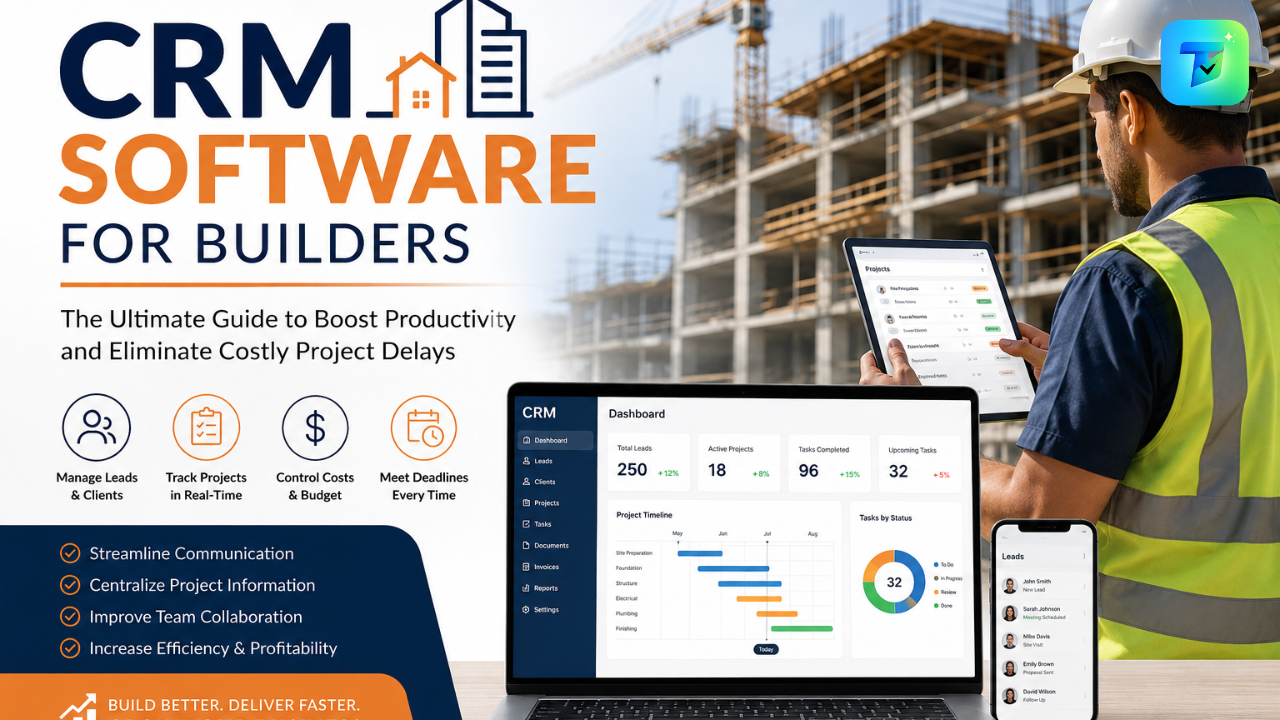
The construction industry is more competitive than ever, and managing customer relationships efficiently has become just as important as completing projects on time. Whether you run a small residential construction company or a large commercial building firm, keeping track of leads, estimates, clients, subcontractors, and ongoing projects can quickly become overwhelming. This is where CRM software for builders becomes an essential business tool.
Unlike traditional spreadsheets or manual record-keeping, CRM software helps builders organize customer information, automate repetitive tasks, improve communication, and monitor every stage of the customer journey. Instead of wasting valuable time searching for emails or project details, builders can access everything from one centralized platform. The result is better customer satisfaction, improved team collaboration, and increased profitability.
What Is CRM Software for Builders?
CRM software for builders is a customer relationship management solution specifically designed to support construction companies and contractors. It helps manage customer interactions while streamlining sales, project coordination, scheduling, document storage, and follow-up communication.
Unlike general CRM systems, builder-focused CRM platforms often include features that match the unique workflow of construction businesses. They support project lifecycle management, quote tracking, site visit scheduling, client communication, contract management, and sales pipeline monitoring, making daily operations much more efficient.
Why Builders Need a Specialized CRM
Construction projects involve multiple stakeholders, long sales cycles, and constant communication. A specialized CRM allows builders to keep every interaction organized while reducing administrative workload.
It also provides better visibility into ongoing projects, helping teams avoid missed deadlines, forgotten follow-ups, or misplaced client information. This organized approach improves both productivity and customer trust.
Key Features of CRM Software for Builders
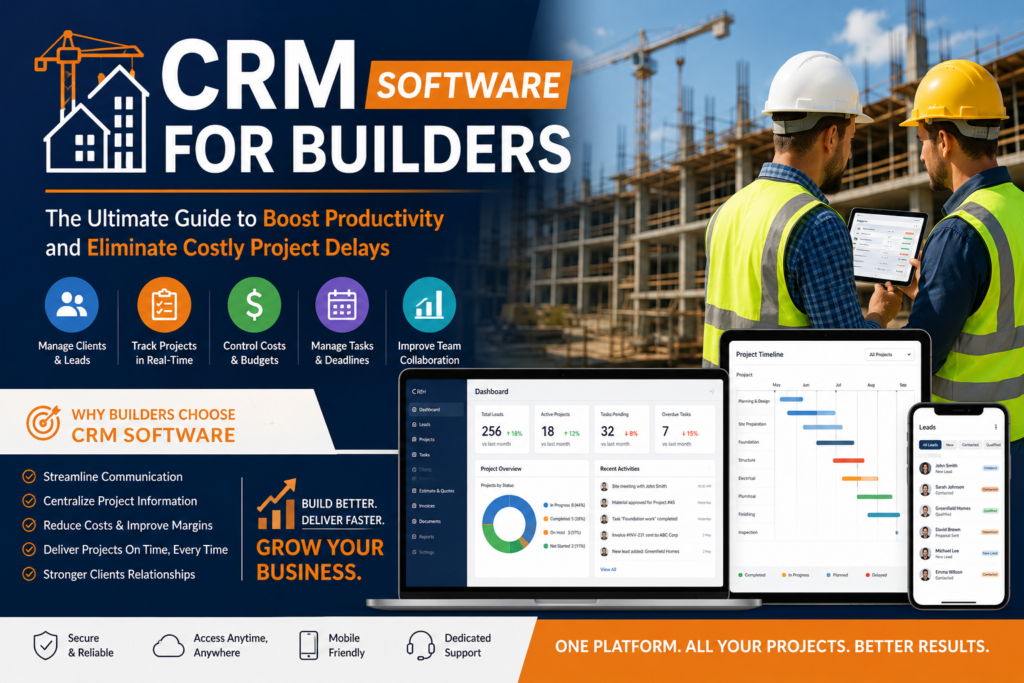
Choosing the right CRM means understanding which features add real value to your business. A reliable construction CRM should simplify operations instead of making them more complicated.
Lead Management
Every construction project starts with a lead. CRM software captures inquiries from different channels and stores them in one location.
Sales teams can prioritize qualified leads, schedule follow-ups, and monitor progress until the customer signs a contract.
Client Communication
Builders communicate with clients throughout every phase of a project. CRM Software for Builders keeps emails, phone call records, meeting notes, and messages organized in one place.
This centralized communication ensures everyone stays informed while reducing misunderstandings.
Project Tracking
Many CRM solutions integrate project management capabilities that allow builders to monitor project milestones, schedules, deadlines, and customer approvals.
Having project information alongside customer records creates a more efficient workflow.
Quote and Estimate Management
Preparing construction estimates requires accuracy. CRM software helps builders generate, store, and manage quotations while tracking whether customers have accepted or declined proposals.
This makes the sales process more transparent and organized.
Task Automation
Automation reduces repetitive work by sending appointment reminders, follow-up emails, and status updates automatically.
Instead of spending hours on manual tasks, builders can focus on delivering quality construction services.
Benefits of Using CRM Software for Builders
Implementing CRM software offers measurable advantages for construction companies of every size. The right system supports both business growth and customer satisfaction.
Better Customer Relationships
Clients appreciate timely responses and organized communication. CRM software ensures builders never miss important conversations or scheduled follow-ups.
Consistent communication builds trust, leading to stronger relationships and repeat business.
Improved Sales Performance
Sales teams gain complete visibility into every opportunity, making it easier to move prospects through the sales pipeline.
Better organization means fewer lost opportunities and higher conversion rates.
Increased Team Collaboration
Construction projects involve office staff, project managers, contractors, and clients. CRM Software for Builders creates a centralized workspace where everyone can access updated information.
This reduces communication gaps and improves coordination between departments.
Accurate Reporting
Modern CRM platforms generate reports on sales performance, customer activity, project status, and business growth.
These insights help business owners make informed decisions based on real data rather than assumptions.
How CRM Software Supports Construction Project Management
Although CRM software primarily focuses on customer relationships, many platforms also improve project management processes.
Builders can connect customer records with contracts, project timelines, invoices, and communication history. This integrated workflow reduces duplicate data entry while keeping every project organized from planning through completion.
Project managers also benefit from improved scheduling, document management, and progress tracking, allowing them to identify potential delays before they become costly problems.
Choosing the Best CRM Software for Builders
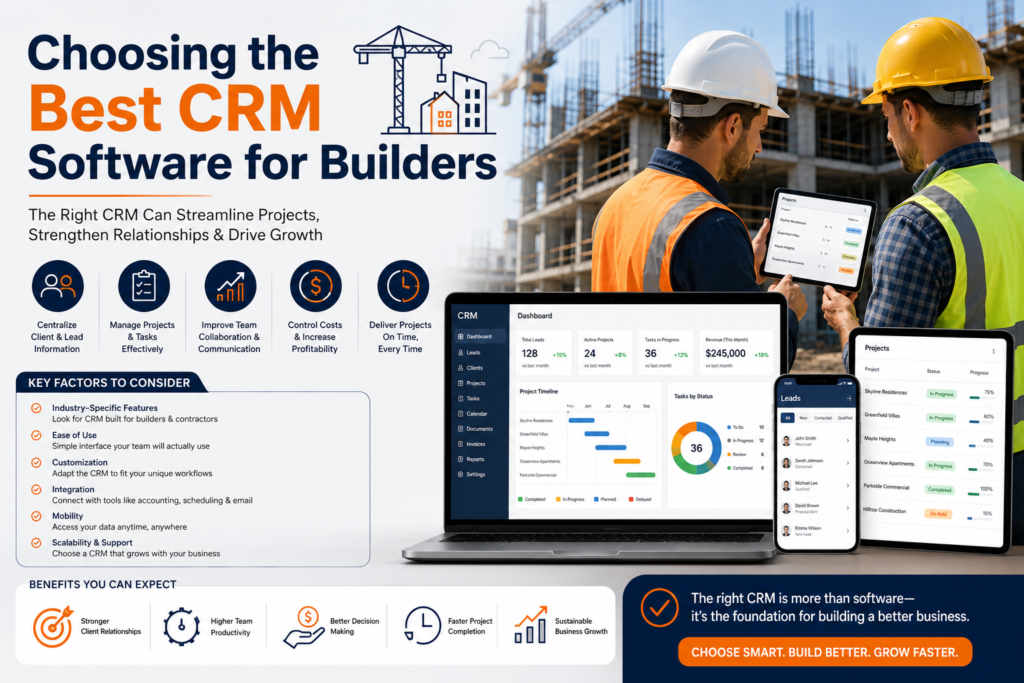
Not every CRM solution is suitable for construction businesses. Before selecting software, builders should evaluate their operational requirements and future growth plans.
Ease of Use
Complicated software often leads to low employee adoption. Choose a CRM with a clean interface and intuitive navigation.
Easy-to-use systems reduce training time and encourage consistent usage across the organization.
Customization
Every construction company operates differently. A flexible CRM should allow custom fields, workflows, reports, and dashboards.
Customization ensures the software adapts to your business rather than forcing you to change existing processes.
Mobile Accessibility
Construction professionals spend much of their time on job sites. Mobile access enables employees to update customer records, upload photos, and communicate with clients directly from their smartphones or tablets.
This improves efficiency without requiring workers to return to the office.
Integration Options
Builders often use estimating software, accounting systems, scheduling tools, and document management platforms.
Choosing CRM Software for Builders that integrates with existing business applications creates a more connected workflow.
Common Challenges Builders Face Without CRM Software
Many construction businesses continue relying on spreadsheets, handwritten notes, or disconnected software systems.
This outdated approach creates several operational challenges, including lost customer information, delayed follow-ups, inconsistent communication, duplicate records, and reduced productivity.
As businesses grow, these problems become more expensive and difficult to manage. CRM software provides a structured solution that eliminates much of this operational complexity.
Tips for Successful CRM Implementation
Purchasing CRM software is only the first step. Successful implementation requires proper planning and employee involvement.
Train Your Team
Provide comprehensive training so employees understand how the CRM supports their daily responsibilities.
When staff recognize the benefits, adoption rates improve significantly.
Keep Data Organized
Import clean, accurate customer information into the CRM system.
Removing duplicate records and outdated contacts improves reporting accuracy and overall system performance.
Monitor Performance
Review CRM reports regularly to evaluate lead conversion, customer satisfaction, and project efficiency.
Continuous monitoring helps identify areas where business processes can be further optimized.
Why CRM Software Is a Long-Term Investment
CRM software is not simply another business expense—it is a long-term investment in operational efficiency and customer experience.
As construction companies grow, managing larger client databases and more complex projects becomes increasingly challenging. A well-implemented CRM provides the scalability needed to support future expansion while maintaining consistent service quality.
Businesses that invest in organized customer management often experience stronger client retention, better sales performance, and improved operational efficiency over time.
Quick Bio
Category: Business Software
Primary Keyword: CRM software for builders
Industry: Construction Technology
Purpose: Improve customer relationship management, streamline project communication, organize leads, automate follow-ups, and increase construction business efficiency.
Ideal Users: Home builders, construction companies, contractors, renovation firms, commercial builders, project managers, and construction sales teams.
Related LSI Keywords: construction CRM, builder CRM system, contractor CRM software, construction project management, customer relationship management, lead management, client management software, sales pipeline, construction business software, project tracking software.
Conclusion
CRM software for builders has become an essential solution for construction businesses looking to improve organization, customer communication, and overall productivity. By centralizing customer information, automating repetitive tasks, and supporting project coordination, a CRM helps builders deliver better experiences while reducing operational challenges.
Choosing the right CRM depends on your business size, workflow, and long-term goals. A solution that is easy to use, customizable, mobile-friendly, and capable of integrating with other construction tools will provide lasting value. As customer expectations continue to rise, builders who adopt modern CRM technology will be better positioned to grow their business, strengthen client relationships, and stay competitive in an evolving construction industry.
Frequently Asked Questions (FAQ)
What is CRM software for builders?
CRM software for builders is a customer relationship management solution designed to help construction businesses manage leads, customers, projects, communication, estimates, and sales activities from one centralized platform.
How does CRM software help construction companies?
It improves lead management, customer communication, project organization, task automation, and team collaboration while reducing manual administrative work.
Can small construction businesses use CRM software?
Yes. Many CRM solutions are suitable for small builders and contractors because they simplify daily operations without requiring large IT resources.
Is CRM software different from project management software?
Yes. CRM software primarily manages customer relationships and sales activities, while project management software focuses on planning, scheduling, and executing construction projects. Some modern CRM platforms combine both functions.
What features should builders look for in CRM software?
Builders should prioritize lead management, client communication, mobile access, project tracking, estimate management, reporting, workflow automation, document storage, and software integrations.
Does CRM software improve customer satisfaction?
Yes. Organized communication, timely follow-ups, accurate project updates, and faster responses create a better customer experience, leading to higher satisfaction and stronger long-term relationships.