
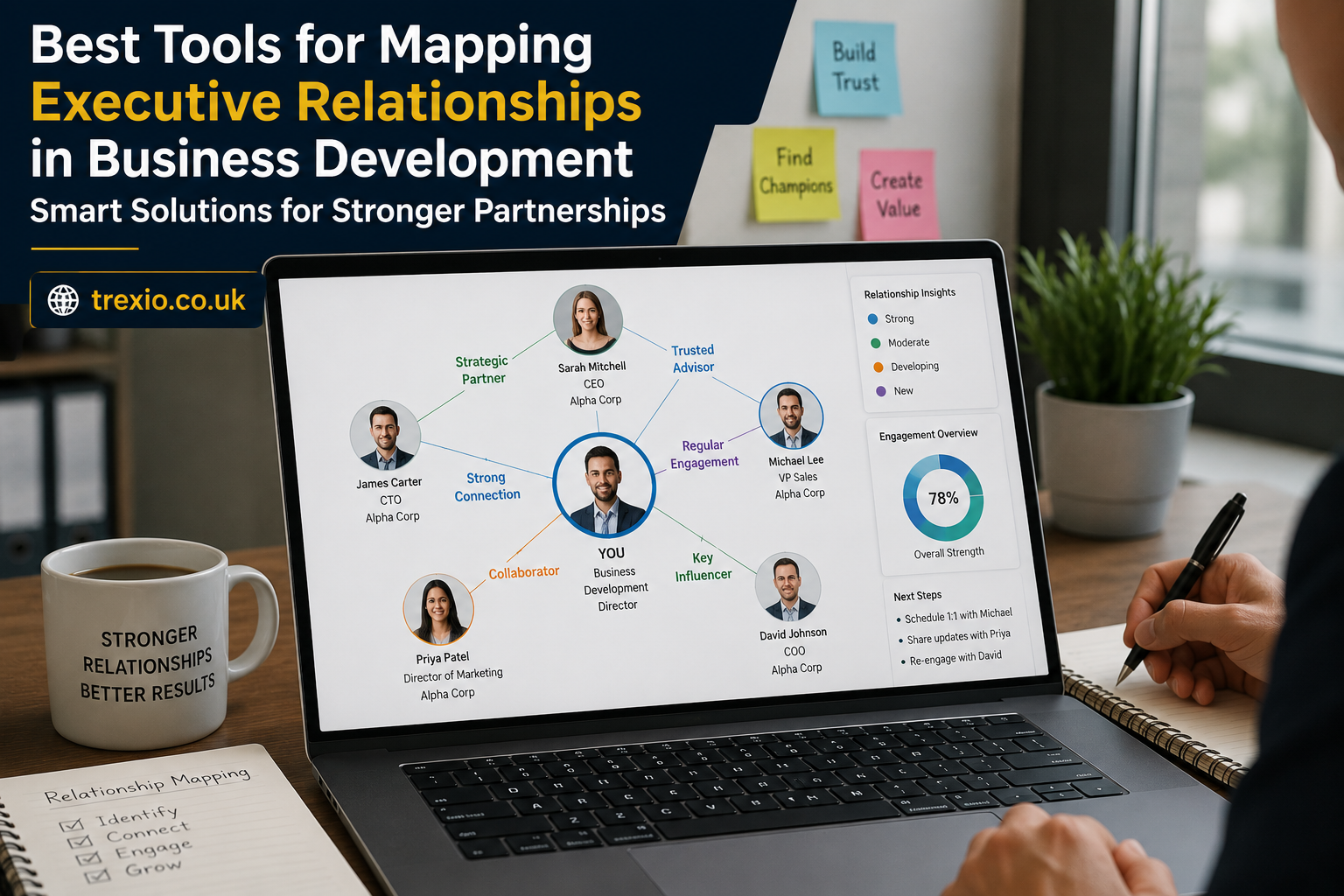
Business development has evolved far beyond collecting contact information and sending cold emails. Modern organizations compete by understanding how executives are connected across industries, partnerships, investors, customers, and internal stakeholders. This is where the best tools for mapping executive relationships in business development become essential. Instead of relying on spreadsheets or fragmented CRM records, companies now use intelligent platforms that visualize executive networks, identify influential decision-makers, and uncover warm introductions that increase conversion rates. These solutions empower sales leaders, partnership managers, account executives, and revenue teams to make informed decisions backed by relationship intelligence. As enterprise sales cycles continue to grow more complex, relationship mapping has become one of the most valuable competitive advantages available to business development professionals.
Organizations that invest in executive relationship mapping improve collaboration across departments while creating stronger customer engagement strategies. Rather than approaching prospects blindly, teams can understand reporting structures, stakeholder influence, buying committees, and existing business relationships before initiating conversations. This results in higher-quality meetings, improved trust, shorter sales cycles, and more predictable revenue growth. Throughout this guide, you’ll learn about the best tools for mapping executive relationships in business development, the essential features to evaluate, and the strategies that help organizations maximize the value of executive network intelligence.
Quick Answer
The best tools for mapping executive relationships in business development combine CRM integration, relationship visualization, organizational charts, stakeholder mapping, AI-powered insights, and collaboration features into one platform. They help business development teams identify key decision-makers, discover mutual connections, prioritize high-value opportunities, strengthen account-based selling strategies, and improve enterprise relationship management. The ideal solution depends on company size, CRM ecosystem, sales complexity, budget, and the depth of executive relationship intelligence required.
Why Executive Relationship Mapping Matters
Executive relationships influence nearly every major business decision within enterprise organizations. Purchasing decisions rarely depend on a single executive, as buying committees often include finance leaders, technology executives, procurement managers, operations directors, department heads, and senior leadership. The best tools for mapping executive relationships in business development help organizations understand these complex networks by identifying influencers, champions, decision-makers, blockers, and external advisors. Instead of approaching accounts with incomplete information, sales professionals gain a comprehensive view of stakeholder dynamics before engaging prospects. This level of visibility improves strategic planning while reducing the uncertainty that often delays enterprise deals. Relationship mapping also supports account expansion by highlighting cross-functional opportunities that might otherwise remain hidden. Companies using relationship intelligence can coordinate outreach more effectively while avoiding duplicate communication across teams. As enterprise buying becomes increasingly collaborative, executive relationship mapping continues to deliver measurable value.
Relationship mapping also strengthens long-term business partnerships beyond individual transactions. Executive turnover, organizational restructuring, mergers, acquisitions, and promotions constantly reshape corporate influence networks. Without accurate relationship visibility, organizations risk losing valuable connections that took years to develop. Modern platforms continuously update executive data, helping teams maintain accurate organizational maps that support business continuity. Business development professionals can identify new stakeholders quickly while preserving institutional knowledge across departments. This proactive approach improves customer retention, partnership growth, and strategic account management. Organizations that consistently invest in relationship intelligence often outperform competitors because they understand people—not just companies.
Understanding Executive Relationship Mapping
What Is Executive Relationship Mapping?
Executive relationship mapping is the process of visually documenting professional relationships among executives, stakeholders, decision-makers, influencers, investors, advisors, partners, and internal team members. The best tools for mapping executive relationships in business development transform complex organizational information into interactive visual diagrams that reveal reporting structures, influence levels, communication pathways, and existing business relationships. Instead of relying on memory or disconnected notes, organizations centralize relationship intelligence into searchable, collaborative platforms. These systems improve transparency while helping teams identify strategic opportunities for engagement. Relationship maps also highlight potential risks, including executive departures or weak stakeholder coverage. As organizations grow, these visual insights become increasingly valuable for maintaining consistent customer engagement.
Relationship mapping extends beyond simple organizational charts. Advanced platforms analyze executive interactions, CRM activities, email relationships, meeting histories, referrals, and external professional networks to build dynamic relationship ecosystems. This enables business development professionals to understand not only who reports to whom but also who influences purchasing decisions, innovation initiatives, and strategic partnerships. Such intelligence significantly enhances account planning while supporting data-driven business development strategies. Organizations that adopt executive relationship mapping often experience greater alignment between sales, marketing, customer success, and executive leadership.
Core Components of Relationship Mapping
Effective executive relationship mapping includes multiple interconnected elements that collectively create a comprehensive view of organizational influence. Executive profiles contain contact information, responsibilities, departmental alignment, and decision-making authority. Organizational hierarchies illustrate reporting relationships while identifying leadership structures across divisions. Stakeholder influence ratings help prioritize engagement efforts based on strategic importance. Communication histories preserve institutional knowledge by documenting previous interactions and relationship strength. Relationship timelines provide context regarding executive movement, promotions, acquisitions, and organizational change. CRM synchronization ensures that relationship intelligence remains accurate and accessible across business functions. Together, these components enable organizations to make smarter business development decisions supported by reliable executive insights.
Key Benefits for Business Development Teams
Better Stakeholder Visibility
One of the greatest advantages of using the best tools for mapping executive relationships in business development is improved stakeholder visibility. Enterprise organizations frequently involve dozens of executives in purchasing decisions, making it difficult to identify key influencers without structured relationship intelligence. Relationship mapping software reveals who controls budgets, who recommends vendors, who approves purchases, and who ultimately signs contracts. This visibility helps business development teams create highly targeted engagement strategies instead of relying on assumptions. Sales representatives become more confident during account planning because they understand organizational dynamics before initiating conversations. Improved visibility also reduces the likelihood of overlooking influential stakeholders whose support may determine deal success.
Stakeholder visibility enhances internal collaboration as well. Marketing, customer success, executive leadership, partnerships, and sales teams all gain access to consistent relationship information. Rather than maintaining separate contact records, departments collaborate using shared organizational intelligence that improves customer experiences across every interaction. This unified approach strengthens account management while increasing organizational efficiency. Businesses that prioritize stakeholder visibility typically experience stronger customer relationships and more predictable revenue growth.
Stronger Account-Based Selling
Account-based selling requires deep knowledge of executive priorities, organizational structures, and relationship networks. The best tools for mapping executive relationships in business development support this strategy by identifying every relevant stakeholder involved in complex purchasing decisions. Rather than focusing exclusively on one executive sponsor, business development teams build relationships across multiple departments, reducing dependence on a single contact. This diversified engagement strategy improves deal resilience while minimizing risk if leadership changes occur during lengthy sales cycles. Relationship mapping also helps organizations identify executive champions capable of influencing internal buying committees.
These insights allow sales teams to personalize messaging according to each stakeholder’s business objectives, responsibilities, and decision-making influence. Executive conversations become more relevant because representatives understand organizational priorities before meetings occur. Relationship intelligence further supports executive business reviews, strategic partnership discussions, and expansion opportunities within existing accounts. Organizations practicing account-based selling consistently benefit from stronger executive engagement and higher customer lifetime value.
Essential Features to Look For
AI-Powered Relationship Intelligence
Artificial intelligence has transformed the best tools for mapping executive relationships in business development by automating data collection, relationship scoring, and executive discovery. AI continuously analyzes communication patterns, CRM records, calendar interactions, public company information, and organizational updates to maintain accurate relationship maps. Instead of manually updating spreadsheets, business development teams receive intelligent recommendations regarding stakeholder engagement, relationship risks, and potential introductions. AI also identifies hidden connections that may accelerate business development efforts through mutual contacts or previous collaborations.
Predictive analytics further enhance executive relationship mapping by forecasting stakeholder influence, organizational changes, and buying behavior trends. Business development professionals can prioritize outreach using data-driven recommendations rather than intuition alone. AI-generated relationship scores improve decision-making while helping organizations allocate resources toward high-value accounts. As machine learning capabilities continue advancing, executive relationship intelligence becomes increasingly accurate and actionable.
CRM Integration
CRM integration remains one of the most important capabilities when evaluating executive relationship mapping software. Business development teams rely heavily on platforms like Salesforce, Microsoft Dynamics, HubSpot, and other CRM systems for managing customer interactions. The best tools for mapping executive relationships in business development synchronize seamlessly with these platforms, ensuring relationship intelligence remains current without requiring duplicate data entry. This integration improves productivity while reducing administrative workloads across revenue teams.
Integrated systems also support automated reporting, opportunity management, account planning, pipeline forecasting, and executive engagement tracking. Every interaction contributes to richer relationship intelligence, enabling organizations to improve customer experiences continuously. Companies with integrated relationship mapping platforms benefit from higher data accuracy and stronger operational efficiency.
Types of Executive Relationship Mapping Tools
CRM-Based Relationship Mapping Platforms
CRM-based relationship mapping platforms extend existing customer relationship management systems by adding visualization capabilities, stakeholder analysis, executive influence scoring, and organizational hierarchy mapping. These solutions are ideal for companies already invested in enterprise CRM ecosystems because they leverage existing customer data while introducing advanced relationship intelligence. The best tools for mapping executive relationships in business development within this category help organizations centralize account planning, executive engagement, and sales collaboration without requiring separate databases. This unified approach simplifies adoption while improving consistency across departments.
CRM-based solutions also improve reporting by connecting relationship intelligence directly to sales opportunities, customer success metrics, and partnership initiatives. Leadership teams gain comprehensive visibility into executive engagement across strategic accounts, enabling more informed business decisions. As organizations scale, integrated platforms support sustainable relationship management without increasing administrative complexity.
Standalone Relationship Intelligence Platforms
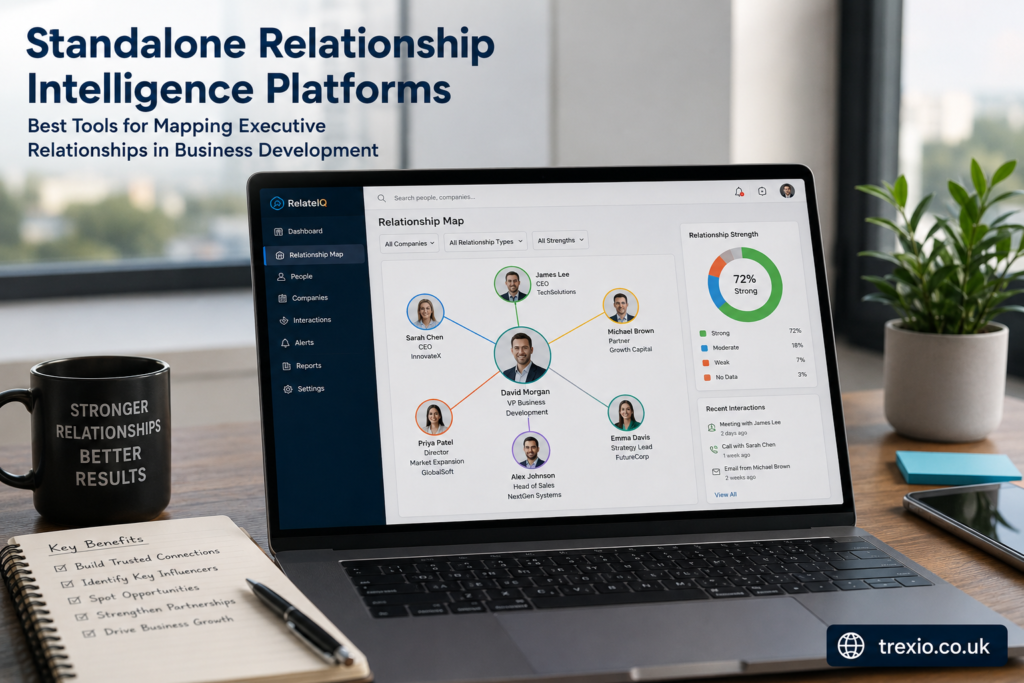
Standalone relationship intelligence platforms focus exclusively on executive network analysis, stakeholder visualization, and business relationship discovery. These tools often provide deeper organizational insights than traditional CRM extensions because relationship intelligence serves as their primary function. The best tools for mapping executive relationships in business development within this category frequently include AI-driven executive discovery, organizational change monitoring, influence analysis, referral tracking, and partnership visualization.
These platforms are particularly valuable for enterprise organizations managing complex sales cycles involving multiple executives across global accounts. Advanced visualization capabilities simplify strategic planning while improving collaboration between sales, partnerships, executive leadership, and customer success teams. Organizations seeking comprehensive relationship intelligence often choose standalone platforms because they provide specialized functionality unavailable within traditional CRM systems.
Manual vs Automated Executive Relationship Mapping
| Feature | Manual Mapping | Automated Relationship Mapping |
|---|---|---|
| Data Accuracy | Moderate | High |
| Executive Updates | Manual | Automatic |
| CRM Integration | Limited | Extensive |
| AI Insights | None | Advanced |
| Stakeholder Visibility | Basic | Comprehensive |
| Collaboration | Limited | Excellent |
| Scalability | Low | High |
| Time Required | High | Low |
| Reporting | Manual | Automated |
| Business Development Efficiency | Moderate | Excellent |
How Relationship Intelligence Improves Enterprise Sales
Relationship intelligence has become one of the most valuable assets for organizations pursuing enterprise accounts with long and complex buying cycles. The best tools for mapping executive relationships in business development help revenue teams understand how executives interact across departments, subsidiaries, strategic partners, and external advisors. Instead of focusing only on individual contacts, sales professionals gain a complete picture of influence networks that affect purchasing decisions. This visibility allows teams to identify executive sponsors, potential blockers, and internal champions before negotiations begin. Relationship intelligence also helps prioritize outreach based on executive influence rather than job titles alone. As a result, account planning becomes more strategic, personalized, and data-driven. Organizations that use relationship intelligence consistently improve executive engagement while reducing unnecessary communication with low-impact stakeholders. Over time, these insights contribute to stronger customer relationships, improved forecast accuracy, and increased win rates across enterprise opportunities.
Another significant advantage is the ability to coordinate efforts across multiple customer-facing teams. Sales, marketing, customer success, partnerships, and executive leadership can all access the same relationship data, ensuring every interaction is informed by the latest organizational insights. The best tools for mapping executive relationships in business development eliminate information silos that often lead to inconsistent messaging or duplicated outreach. Executive meetings become more productive because teams understand previous conversations, strategic initiatives, and organizational priorities before engagement begins. Relationship intelligence also identifies opportunities for executive sponsorship programs, referral strategies, and account expansion initiatives. Companies that invest in relationship-driven selling typically strengthen customer trust while creating long-term strategic partnerships. These benefits extend beyond individual transactions and support sustainable revenue growth for years to come.
Industry Use Cases for Executive Relationship Mapping
Technology and SaaS Companies
Technology providers often sell solutions involving multiple departments such as IT, security, finance, operations, procurement, and executive leadership. The best tools for mapping executive relationships in business development help software vendors identify technical evaluators, financial approvers, procurement contacts, and executive sponsors throughout the buying process. This structured approach improves stakeholder engagement while reducing delays caused by incomplete account visibility. Sales representatives can develop customized messaging for every decision-maker based on departmental priorities and business goals. Relationship mapping also supports customer expansion by identifying additional business units that may benefit from existing solutions. As software organizations scale globally, maintaining accurate executive relationship intelligence becomes increasingly valuable. Strong relationship mapping contributes to shorter enterprise sales cycles and improved customer retention.
Financial Services
Financial institutions manage highly regulated client relationships that require collaboration across compliance, legal, operations, executive leadership, and advisory teams. The best tools for mapping executive relationships in business development provide a centralized view of these complex stakeholder networks while supporting governance and documentation requirements. Relationship mapping enables financial professionals to understand decision authority across corporate structures and investment committees. Executive visibility also helps identify opportunities for wealth management, commercial banking, treasury services, and strategic advisory engagements. Organizations benefit from stronger relationship continuity when executives retire, change organizations, or transition into new leadership roles. Maintaining institutional relationship knowledge becomes easier through centralized mapping platforms. These capabilities improve client service while strengthening long-term business development strategies.
Healthcare and Life Sciences
Healthcare organizations often involve administrators, physicians, procurement leaders, financial executives, compliance officers, and clinical decision-makers during purchasing processes. The best tools for mapping executive relationships in business development help suppliers understand these complex organizational structures before initiating strategic discussions. Relationship mapping allows business development teams to coordinate communication across multiple stakeholders while respecting regulatory requirements and organizational governance. Executive insights also improve collaboration during large procurement initiatives involving hospitals, health systems, research institutions, and pharmaceutical companies. Accurate relationship intelligence reduces confusion while supporting more effective account planning. Organizations serving healthcare clients benefit from improved transparency, stronger executive engagement, and greater confidence throughout lengthy purchasing cycles.
How to Choose the Right Executive Relationship Mapping Tool
Selecting the right solution begins with understanding your organization’s business development objectives rather than simply comparing software features. The best tools for mapping executive relationships in business development should align with existing workflows, CRM platforms, reporting requirements, and long-term growth strategies. Organizations should evaluate ease of implementation, user adoption, scalability, AI capabilities, data quality, collaboration features, and security standards before making a purchasing decision. Integration with existing technology infrastructure is equally important because disconnected systems reduce efficiency and create duplicate work. Companies should also consider vendor support, onboarding resources, product updates, and customization capabilities. Choosing a flexible platform ensures the solution continues delivering value as business needs evolve. Investing time in a structured evaluation process significantly improves long-term success.
Decision-makers should also assess the quality of executive data available within each platform. Some solutions specialize in relationship visualization, while others emphasize AI-driven insights, account planning, or organizational intelligence. The best tools for mapping executive relationships in business development combine multiple capabilities into a single platform that supports collaboration across sales, partnerships, customer success, and executive leadership. Organizations should request product demonstrations, conduct pilot projects, and gather feedback from end users before final implementation. Measuring expected return on investment through efficiency improvements and revenue impact provides additional confidence during vendor selection. A thoughtful evaluation process helps organizations maximize both adoption and business value.
Comparison of Key Evaluation Factors
| Evaluation Factor | Why It Matters | High-Priority Level |
|---|---|---|
| CRM Integration | Prevents duplicate data entry | Very High |
| AI Relationship Insights | Improves opportunity prioritization | Very High |
| Organizational Charts | Visualizes executive structures | High |
| Collaboration Features | Aligns multiple departments | High |
| Security & Compliance | Protects sensitive relationship data | Very High |
| Custom Reporting | Supports executive decision-making | High |
| Scalability | Supports organizational growth | Very High |
| Ease of Adoption | Accelerates user acceptance | High |
| Mobile Accessibility | Enables field sales productivity | Medium |
| Customer Support | Improves implementation success | High |
Measuring Success After Implementation
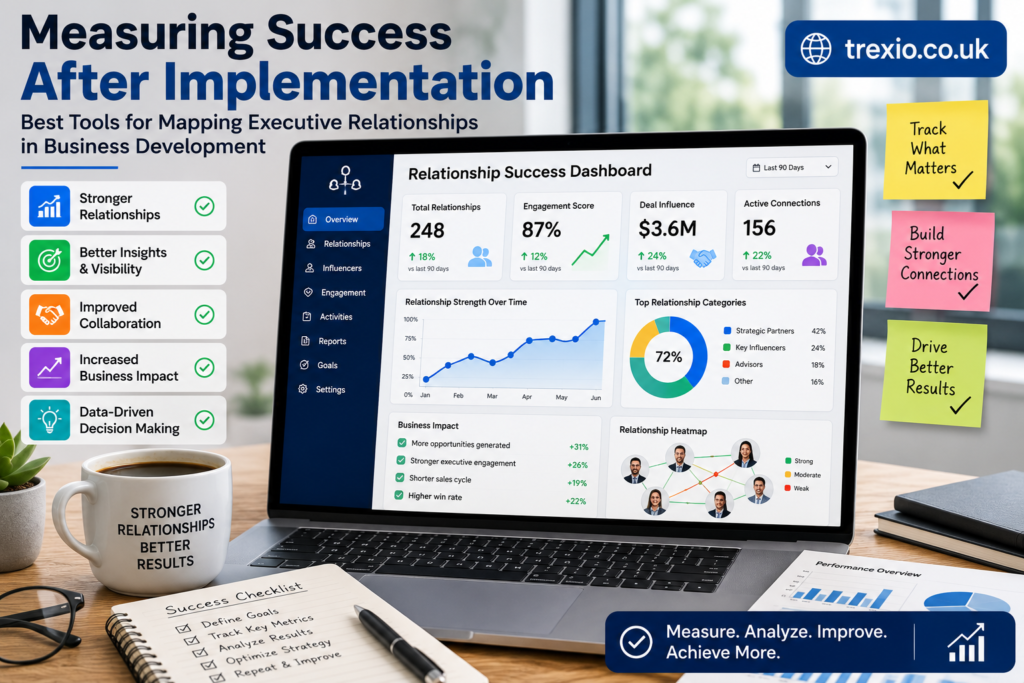
Organizations should define measurable performance indicators before deploying relationship mapping software. The best tools for mapping executive relationships in business development generate valuable analytics that help teams evaluate improvements in executive engagement, opportunity progression, customer retention, account expansion, and revenue growth. Monitoring stakeholder coverage ensures critical decision-makers remain actively engaged throughout the customer lifecycle. Sales leadership can also measure reductions in sales cycle length, improvements in meeting quality, and increases in executive-level conversations. Relationship intelligence becomes even more valuable when integrated into quarterly business reviews and strategic account planning sessions. Continuous measurement enables organizations to refine engagement strategies while identifying additional optimization opportunities. Data-driven improvement ensures long-term success.
Performance measurement should extend beyond revenue metrics alone. Organizations can evaluate internal collaboration, CRM data quality, executive response rates, customer satisfaction, and relationship continuity across departments. The best tools for mapping executive relationships in business development support ongoing optimization by identifying engagement gaps and recommending strategic actions. Regular reviews encourage consistent adoption while helping leadership demonstrate measurable business impact. Companies that continuously improve relationship intelligence processes typically experience stronger organizational alignment and better long-term customer outcomes.
Best Practices
- Maintain executive relationship maps with frequent data updates.
- Integrate relationship mapping directly with your CRM ecosystem.
- Train all customer-facing teams on consistent usage standards.
- Document executive interactions immediately after meetings.
- Map entire buying committees rather than individual contacts.
- Use AI recommendations to prioritize strategic outreach.
- Review relationship maps before every executive meeting.
- Establish standardized stakeholder influence scoring.
- Monitor organizational changes and executive transitions regularly.
- Conduct quarterly audits to maintain data accuracy and completeness.
Common Mistakes
- Relying only on job titles instead of actual influence.
- Maintaining separate relationship data across departments.
- Ignoring executive changes after mergers or reorganizations.
- Treating relationship mapping as a one-time project.
- Failing to integrate relationship intelligence with CRM platforms.
- Overlooking customer success and partnership teams during planning.
- Collecting excessive data without actionable insights.
- Neglecting user training and adoption programs.
- Using outdated organizational charts during account planning.
- Measuring software usage instead of business outcomes.
Pro Tips
- Map executive relationships at the beginning of every enterprise opportunity.
- Identify multiple executive champions to reduce single-contact dependency.
- Include advisors, board members, and strategic partners when appropriate.
- Combine relationship intelligence with account-based marketing initiatives.
- Schedule recurring relationship reviews for strategic accounts.
- Use stakeholder influence scores to prioritize executive outreach.
- Keep historical relationship information for organizational continuity.
- Encourage cross-functional collaboration through shared relationship dashboards.
- Monitor executive promotions and leadership announcements proactively.
- Continuously refine engagement strategies using relationship analytics.
Conclusion
Executive relationship mapping has become an essential capability for organizations competing in today’s complex B2B environment. The best tools for mapping executive relationships in business development provide far more than visual organizational charts—they deliver actionable relationship intelligence that improves account planning, stakeholder engagement, collaboration, and strategic decision-making. By connecting CRM data, executive insights, AI-powered recommendations, and organizational structures, these platforms enable revenue teams to build stronger and more meaningful business relationships. Companies that invest in relationship intelligence often achieve higher win rates, shorter enterprise sales cycles, and greater customer retention because they engage the right people at the right time.
Choosing the best tools for mapping executive relationships in business development requires careful evaluation of integration capabilities, scalability, security, collaboration features, and long-term business objectives. Organizations that combine modern technology with disciplined relationship management practices create a sustainable competitive advantage that extends well beyond individual sales opportunities. As executive networks continue to evolve, maintaining accurate relationship intelligence will remain a critical component of successful business development strategies. Businesses that embrace relationship mapping today position themselves for stronger partnerships, increased revenue, and long-term growth in an increasingly connected marketplace.
Frequently Asked Questions
1. What are the best tools for mapping executive relationships in business development?
The best solutions include platforms that combine CRM integration, stakeholder mapping, AI-powered relationship intelligence, organizational charts, collaboration tools, and executive engagement analytics.
2. Why is executive relationship mapping important?
It helps organizations identify key decision-makers, understand organizational influence, improve account planning, and strengthen enterprise sales strategies.
3. Can small businesses benefit from relationship mapping?
Yes. Even smaller organizations can improve networking, partnership development, and customer relationship management through structured executive mapping.
4. How does AI improve relationship mapping?
AI automates executive discovery, relationship scoring, organizational updates, communication analysis, and opportunity prioritization.
5. Is CRM integration necessary?
Yes. CRM integration improves data accuracy, eliminates duplicate work, and ensures relationship intelligence remains current across teams.
6. Which departments benefit from executive relationship mapping?
Sales, marketing, partnerships, customer success, executive leadership, account management, and business development all benefit from shared relationship intelligence.
7. How often should executive relationship maps be updated?
Organizations should review relationship data continuously and conduct formal audits at least quarterly or after significant organizational changes.
8. What industries use executive relationship mapping?
Technology, healthcare, financial services, manufacturing, consulting, telecommunications, professional services, and enterprise software companies commonly use these tools.
9. What should organizations consider before selecting a platform?
Key considerations include CRM compatibility, AI capabilities, scalability, collaboration features, security, reporting, user experience, and vendor support.
10. How does relationship mapping increase revenue?
It improves executive engagement, identifies decision-makers faster, strengthens account planning, supports account expansion, shortens sales cycles, and increases conversion rates.
Author Bio
About the Author
The author is an experienced SEO content strategist and B2B technology writer specializing in business development, CRM platforms, sales technology, relationship intelligence, and enterprise software. With extensive experience creating research-driven, EEAT-focused content, the author helps organizations publish practical resources that support informed decision-making, improve search visibility, and deliver lasting value to business professionals.