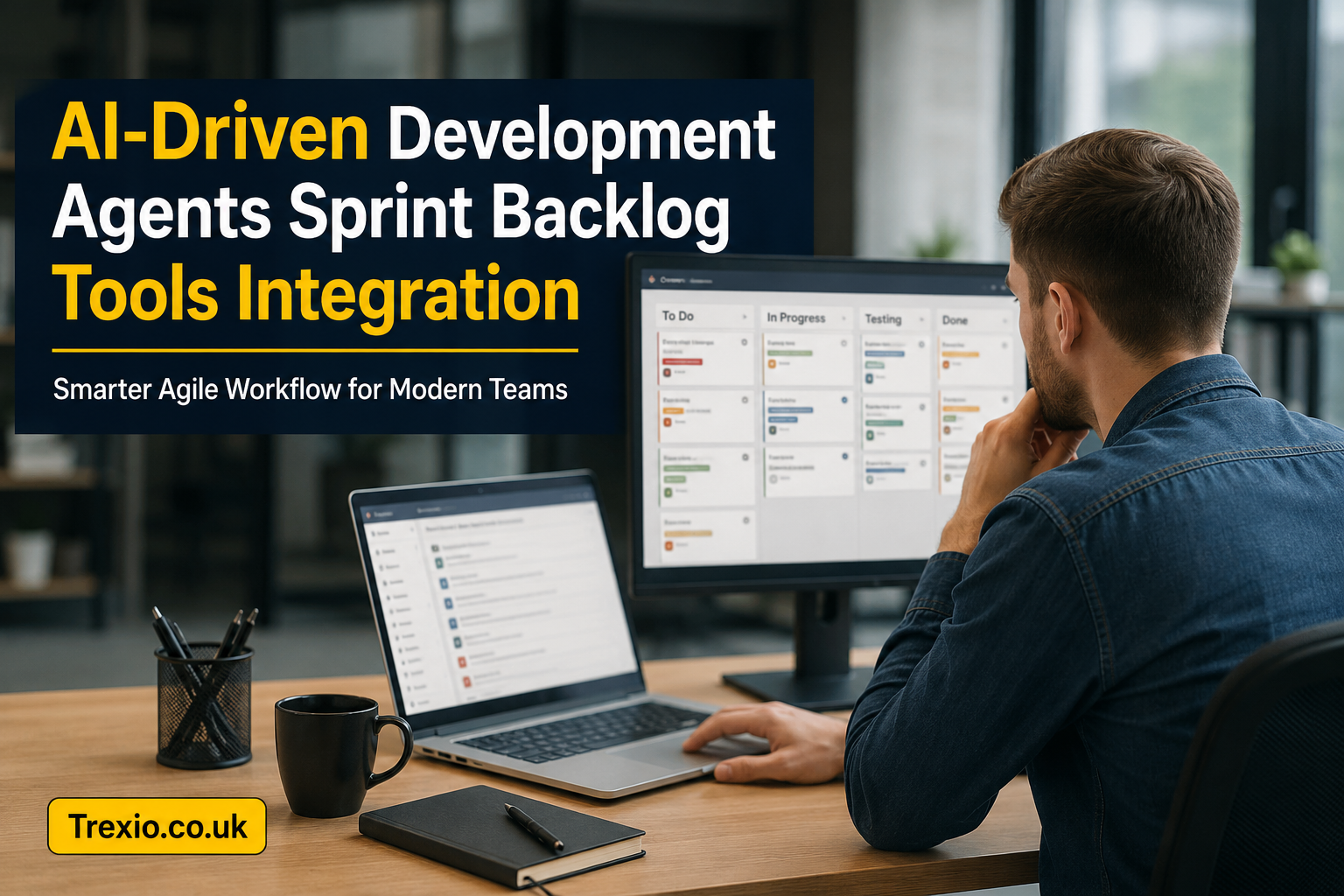
Modern software development has become increasingly complex as engineering teams manage expanding product backlogs, changing customer requirements, multiple development environments, and continuous deployment cycles. Traditional sprint planning often requires significant manual effort, making it difficult to maintain consistent priorities while responding quickly to new business needs. This is where AI-driven development agents sprint backlog tools integration is changing the way Agile teams work. Intelligent development agents can analyze project data, recommend backlog priorities, automate repetitive planning activities, identify risks before they affect delivery, and synchronize information across development platforms. Instead of replacing project managers or developers, these AI-powered assistants enhance decision-making by processing large amounts of project information within seconds. Organizations adopting AI-enhanced Agile workflows are discovering improved sprint predictability, better resource utilization, and faster software releases. As AI capabilities continue evolving, development teams are increasingly integrating intelligent agents into every stage of the software development lifecycle to improve efficiency without sacrificing quality.
Quick Answer
AI-driven development agents sprint backlog tools integration refers to connecting intelligent AI assistants with Agile project management platforms so they can automate backlog refinement, prioritize user stories, estimate workloads, identify sprint risks, recommend task assignments, synchronize project data, and provide real-time development insights. These integrations help development teams reduce manual planning, improve sprint accuracy, enhance collaboration, and accelerate software delivery while maintaining Agile best practices.
Understanding AI-Driven Development Agents
AI-driven development agents are intelligent software systems designed to assist engineering teams throughout the software development lifecycle by automating repetitive tasks and providing data-driven recommendations. Unlike traditional automation scripts that execute predefined instructions, these agents continuously analyze project data, learn from historical development patterns, and adapt their recommendations based on evolving team performance. They can interpret sprint goals, evaluate dependencies, monitor code repositories, identify workflow bottlenecks, and even recommend improvements to project planning. Modern AI agents often leverage machine learning, natural language processing, and predictive analytics to understand project context more effectively. Rather than replacing human judgment, they support developers, Scrum Masters, product owners, and engineering managers with actionable insights. Their ability to integrate with multiple project management platforms makes them valuable across diverse Agile environments. As software projects become increasingly data-driven, AI development agents serve as intelligent collaborators that help teams make faster and more informed decisions.
Core Capabilities of AI Development Agents
The most advanced AI development agents perform much more than basic task automation. They analyze historical sprint velocity, evaluate workload distribution, detect inconsistencies within product backlogs, generate documentation, summarize meetings, recommend sprint goals, and monitor delivery risks. Many agents can automatically categorize user stories, estimate implementation complexity, identify duplicate tasks, and suggest backlog refinement opportunities. Their predictive capabilities allow project managers to anticipate delays before they impact release schedules. AI agents also improve communication by creating concise project summaries that keep stakeholders informed without requiring manual reporting. Continuous learning enables these systems to become more accurate as additional project data becomes available. Their adaptability makes them suitable for organizations of various sizes, from startup engineering teams to enterprise software departments.
Why AI Agents Matter in Agile Development
Agile methodologies emphasize continuous improvement, rapid feedback, and iterative delivery, but maintaining these principles becomes increasingly challenging as projects scale. AI-driven development agents simplify complex planning processes by reducing administrative workload while increasing planning accuracy. Product owners spend less time manually organizing backlogs, developers receive clearer priorities, and Scrum Masters gain improved visibility into sprint health. AI-generated recommendations support objective decision-making based on measurable project metrics instead of assumptions. Teams can focus more on delivering customer value rather than managing spreadsheets or manually updating project boards. As Agile environments continue evolving, AI serves as an intelligent layer that strengthens collaboration and accelerates software delivery without disrupting existing development practices.
The Role of Sprint Backlog Tools in Agile Teams
Sprint backlog tools provide the organizational structure that Agile teams rely upon to manage user stories, tasks, priorities, bugs, and sprint objectives. These platforms serve as the central workspace where product owners define work, developers update progress, and Scrum Masters monitor sprint performance. Without effective backlog management, teams often struggle with unclear priorities, duplicated work, missed deadlines, and inconsistent delivery. Modern backlog management solutions offer significantly more functionality than simple task lists by incorporating workflow automation, reporting dashboards, dependency tracking, and collaboration features. Integrating AI into these tools further enhances their value by automating many planning activities traditionally performed manually. This combination enables teams to maintain organized, adaptive, and continuously optimized sprint backlogs that evolve alongside project requirements.
Common Sprint Backlog Components
Every effective sprint backlog includes prioritized user stories, technical tasks, acceptance criteria, estimated effort, assigned team members, implementation status, dependencies, and sprint objectives. AI-driven development agents sprint backlog tools integration helps organize these components more efficiently by identifying missing information, suggesting clearer descriptions, and highlighting potential conflicts before sprint execution begins. Intelligent systems can evaluate whether stories align with business priorities, estimate implementation complexity using historical data, and recommend adjustments that improve sprint balance. These capabilities reduce planning uncertainty while improving transparency across engineering teams. Better backlog organization ultimately contributes to more predictable software releases and improved customer satisfaction.
Challenges of Manual Sprint Backlog Management
Manual backlog management often becomes increasingly difficult as software projects grow in complexity. Product owners frequently spend hours reviewing feature requests, prioritizing tasks, estimating effort, and updating project documentation. Human error may introduce duplicate stories, inconsistent priorities, overlooked dependencies, or inaccurate estimates. Communication delays between stakeholders can further complicate planning, leading to sprint interruptions and changing objectives. AI-driven development agents address these challenges by continuously monitoring backlog quality, detecting inconsistencies, and recommending improvements based on historical project performance. Automation minimizes repetitive administrative work while helping teams maintain consistent planning standards across multiple development cycles.
How AI-Driven Development Agents Integrate with Sprint Backlog Tools
The effectiveness of AI-driven development agents sprint backlog tools integration depends largely on seamless connectivity between intelligent automation platforms and Agile project management systems. AI agents collect information from sprint boards, issue trackers, version control systems, documentation repositories, testing platforms, and communication tools to build a comprehensive understanding of project health. This unified data enables AI to provide more accurate recommendations regarding sprint planning, backlog prioritization, workload distribution, and release forecasting. Integration also ensures that updates made in one platform automatically synchronize across connected systems, reducing duplicate work and improving information consistency. Intelligent agents become active participants in project management by continuously analyzing changes and suggesting optimizations throughout the development lifecycle. The result is a more responsive, collaborative, and data-driven Agile environment.
Data Synchronization Across Development Platforms
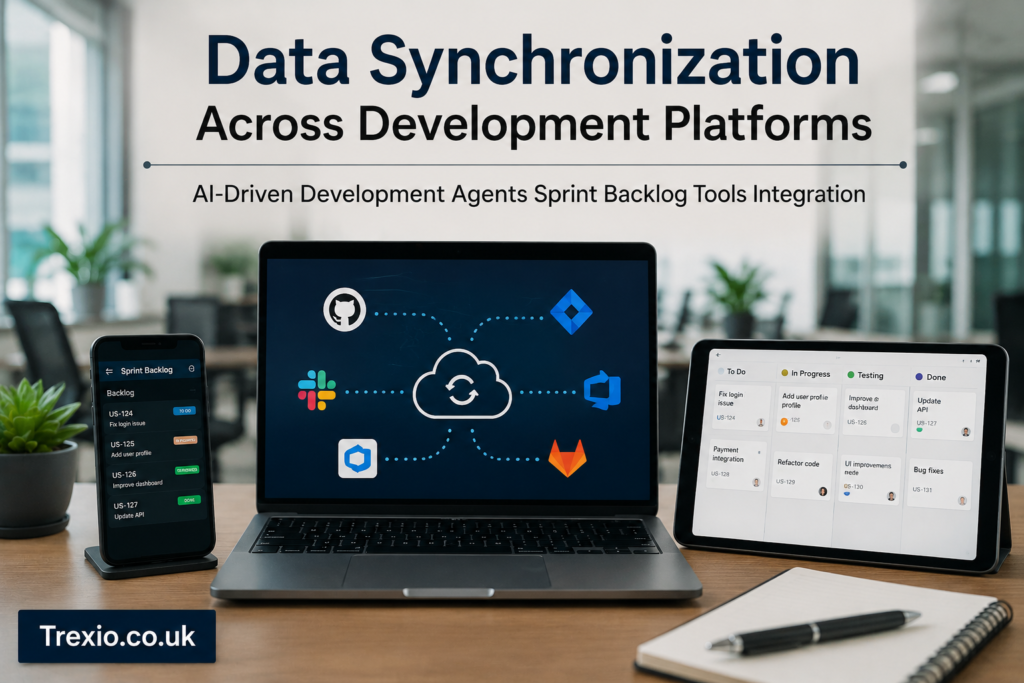
Successful integrations rely on continuous synchronization between project management software, code repositories, CI/CD pipelines, testing environments, documentation systems, and collaboration platforms. AI agents monitor updates across these connected systems to maintain an accurate representation of project progress. When developers complete tasks, merge code, or update documentation, the AI automatically adjusts sprint metrics, identifies newly available work, and informs relevant stakeholders. This continuous synchronization minimizes outdated information while improving overall project visibility. Teams spend less time manually updating project boards and more time delivering high-quality software.
Intelligent Backlog Prioritization
Backlog prioritization often involves balancing customer needs, technical debt, business objectives, engineering capacity, and release schedules. AI development agents evaluate these factors simultaneously using predictive analytics and historical performance data. Rather than relying solely on manual prioritization, product owners receive evidence-based recommendations regarding which user stories should enter upcoming sprints. AI considers implementation complexity, business impact, dependency chains, resource availability, and delivery risks before generating suggestions. These recommendations improve sprint alignment with strategic objectives while helping engineering teams maximize productivity throughout each iteration.
Predictive Sprint Planning
Predictive sprint planning represents one of the most valuable applications of AI within Agile environments. By analyzing previous sprint performance, developer productivity, workload distribution, bug trends, and delivery timelines, AI agents estimate future sprint capacity with increasing accuracy. Product owners gain realistic planning recommendations instead of relying exclusively on subjective estimates. Engineering managers can proactively identify overloaded team members, potential bottlenecks, or unrealistic sprint commitments before work begins. Predictive planning reduces sprint failures while supporting continuous improvement through measurable performance insights.
Key Benefits of AI-Driven Development Agents Sprint Backlog Tools Integration
Organizations implementing AI-driven development agents sprint backlog tools integration often experience measurable improvements in planning accuracy, software quality, and overall delivery speed. One of the biggest advantages is the reduction of repetitive administrative work that traditionally consumes valuable engineering hours. Instead of manually sorting backlog items, assigning priorities, and generating sprint reports, AI agents perform these activities automatically while maintaining consistency across projects. Development teams also benefit from improved visibility because AI continuously analyzes project health and highlights potential issues before they become blockers. Better forecasting allows stakeholders to make informed product decisions using real-time data rather than assumptions. AI-generated recommendations also improve collaboration between product managers, developers, quality assurance engineers, and leadership teams by keeping everyone aligned with current priorities. As organizations scale, intelligent automation helps maintain Agile discipline without significantly increasing management overhead. The long-term result is higher productivity, stronger customer satisfaction, and more predictable software releases.
Improved Developer Productivity
Developers perform best when they can focus on building software rather than managing project administration. AI-driven development agents sprint backlog tools integration automatically updates task statuses, summarizes pull requests, organizes sprint documentation, and recommends the next highest-priority work item. This eliminates frequent context switching that often interrupts development flow. AI also helps developers locate related documentation, previous implementation examples, and dependency information within seconds. Engineering teams spend less time searching for information and more time writing reliable code. Intelligent recommendations also reduce uncertainty during sprint execution because developers receive clearer task descriptions and implementation guidance. Higher productivity does not simply mean working faster—it means consistently delivering better software with fewer interruptions.
Better Sprint Predictability
Accurate sprint forecasting remains one of the most valuable outcomes of AI-driven development agents sprint backlog tools integration. AI models analyze historical velocity, completion rates, defect trends, and workload distribution to estimate realistic sprint capacity. Instead of overcommitting teams, product owners receive recommendations based on actual engineering performance. Predictive analytics also identify stories that may require additional refinement before entering a sprint. These insights help reduce unfinished work, missed deadlines, and unexpected bottlenecks. Consistent forecasting improves stakeholder confidence because release timelines become more reliable. Over multiple iterations, planning accuracy continues improving as AI learns from previous sprint outcomes.
Popular Sprint Backlog Tools That Support AI Integration
Many Agile project management platforms now provide built-in AI capabilities or allow third-party intelligent agents to integrate through APIs and automation frameworks. Choosing the right platform depends on team size, workflow complexity, security requirements, and existing development infrastructure. Modern organizations increasingly prefer platforms that combine backlog management, sprint planning, reporting, collaboration, and AI-powered insights within a unified environment. Integration flexibility is especially important because software teams often use multiple tools throughout the development lifecycle. Selecting solutions that easily exchange data helps maximize the value of AI-driven development agents sprint backlog tools integration. The following comparison highlights common capabilities available across leading Agile platforms.
| Tool Type | AI Features | Best For | Integration Strength |
|---|---|---|---|
| Agile Project Management Platforms | Sprint planning, backlog recommendations, reporting | Medium to large teams | Excellent |
| DevOps Platforms | Code insights, deployment monitoring | Engineering organizations | Excellent |
| Issue Tracking Systems | Task prioritization, automation | Product development | High |
| Collaboration Platforms | Meeting summaries, notifications | Cross-functional teams | High |
| Documentation Platforms | Knowledge search, AI writing assistance | Distributed teams | High |
Features to Prioritize
When evaluating solutions that support AI-driven development agents sprint backlog tools integration, organizations should prioritize automation capabilities, workflow customization, predictive analytics, API availability, security controls, and reporting flexibility. Strong integration support ensures data remains synchronized across engineering tools without manual intervention. AI-powered backlog recommendations should be transparent and explainable so product owners understand why priorities change. Teams should also evaluate scalability because successful Agile environments continue growing over time. Selecting flexible platforms reduces migration costs while supporting future AI innovations. A balanced combination of usability and intelligent automation delivers the greatest long-term value.
Security and Governance Considerations
As AI becomes increasingly involved in software planning, organizations must establish strong governance policies to protect project data and maintain compliance. AI-driven development agents sprint backlog tools integration often accesses source code metadata, sprint plans, documentation, customer requirements, and collaboration records. Proper authentication, encryption, role-based permissions, and audit logging help ensure sensitive information remains secure. Organizations should clearly define which AI agents can access specific project data and monitor automated activities regularly. Human oversight remains essential because AI recommendations should always support—not replace—engineering judgment. Regular governance reviews also ensure compliance with internal security standards and industry regulations. Responsible AI implementation strengthens trust while minimizing operational risk. A secure integration strategy allows organizations to benefit from intelligent automation without compromising data integrity.
Responsible AI Decision-Making
AI recommendations should always remain transparent and reviewable. Product owners, Scrum Masters, and engineering leaders should understand how recommendations are generated before accepting automated changes. Maintaining human approval for significant backlog modifications prevents unintended prioritization errors. Responsible governance encourages collaboration between AI systems and experienced professionals rather than relying exclusively on automation. Continuous monitoring also identifies situations where AI models require retraining because project requirements have evolved. This balanced approach supports reliable decision-making throughout the Agile lifecycle.
Future Trends in AI-Driven Development Agents Sprint Backlog Tools Integration
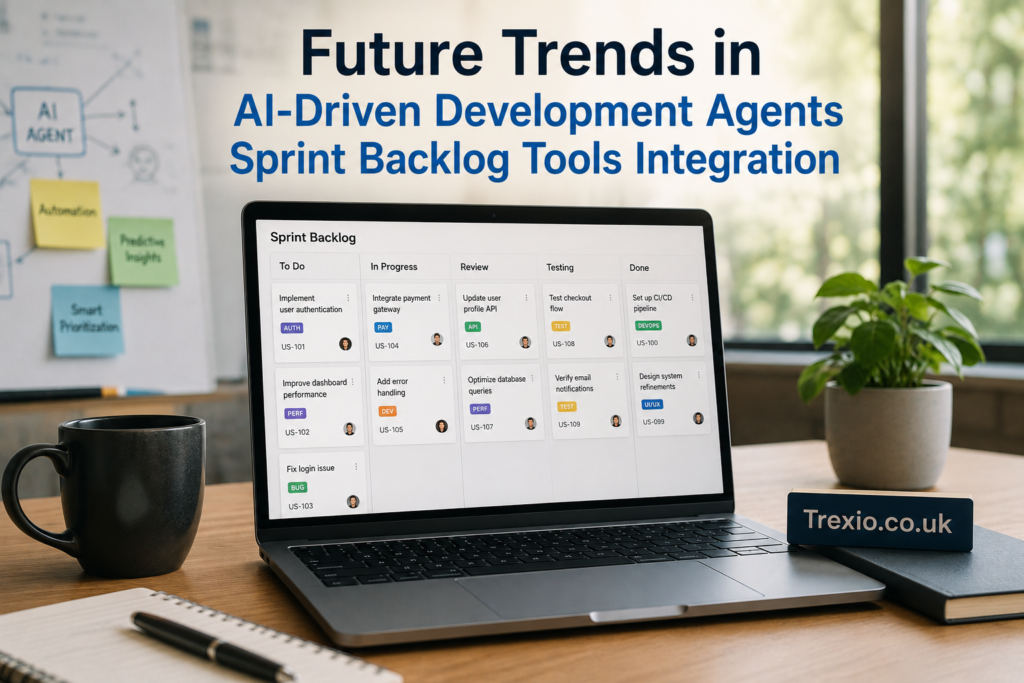
The future of AI-driven development agents sprint backlog tools integration extends well beyond backlog automation. Emerging AI systems are expected to participate actively in sprint retrospectives, release planning, architecture reviews, and engineering knowledge management. Autonomous development assistants may recommend software designs, generate implementation strategies, evaluate technical debt, and coordinate work across multiple teams simultaneously. Natural language interfaces will likely allow product owners to describe business objectives conversationally while AI automatically generates user stories, acceptance criteria, and sprint plans. Predictive analytics will become increasingly sophisticated by combining customer feedback, production monitoring, business metrics, and engineering performance into unified recommendations. AI may also improve cross-functional collaboration by translating technical discussions into business-friendly summaries for executives and stakeholders. While human creativity, leadership, and decision-making will remain irreplaceable, intelligent agents will continue expanding their role as collaborative engineering partners. Organizations investing in AI-ready Agile practices today will be better positioned to adapt to tomorrow’s rapidly evolving software development landscape.
Emerging Innovations
Future innovation areas include autonomous backlog refinement, AI-assisted release management, intelligent dependency mapping, automated sprint retrospectives, advanced workload balancing, predictive defect prevention, and conversational project management assistants. As foundation models continue improving, engineering teams will gain increasingly personalized recommendations based on organizational workflows and coding standards. These advancements will further strengthen software quality while reducing operational complexity.
Best Practices for AI-Driven Development Agents Sprint Backlog Tools Integration
Successful adoption requires thoughtful planning rather than simply enabling AI features. Organizations achieve the best outcomes when they combine intelligent automation with established Agile principles.
- Define clear sprint planning objectives before introducing AI.
- Keep product backlogs clean and consistently organized.
- Train AI using high-quality historical project data.
- Maintain human review for major prioritization decisions.
- Continuously monitor AI recommendations for accuracy.
- Integrate development, testing, documentation, and deployment systems.
- Measure productivity improvements using objective metrics.
- Regularly retrain AI models as workflows evolve.
- Encourage team feedback to improve AI adoption.
- Establish governance policies for security and compliance.
Common Mistakes to Avoid
Many organizations fail to realize the full value of AI-driven development agents sprint backlog tools integration because of avoidable implementation mistakes.
- Expecting AI to replace Scrum Masters or product owners.
- Ignoring data quality before enabling automation.
- Integrating too many disconnected tools simultaneously.
- Blindly accepting every AI recommendation.
- Failing to monitor AI performance over time.
- Overlooking security and access permissions.
- Neglecting developer training.
- Using outdated backlog information.
- Measuring success only by sprint speed instead of delivery quality.
- Treating AI implementation as a one-time project rather than an ongoing improvement initiative.
Pro Tips
- Begin with one development team before expanding organization-wide.
- Standardize backlog templates to improve AI recommendations.
- Connect AI with CI/CD pipelines for richer project insights.
- Review predictive sprint forecasts before every planning session.
- Use AI-generated reports to support retrospective discussions.
- Monitor velocity trends alongside customer satisfaction metrics.
- Encourage developers to validate AI-generated estimates.
- Combine automation with continuous Agile coaching.
- Periodically audit AI decisions for fairness and consistency.
- Keep integration documentation updated as workflows evolve.
Conclusion
AI-driven development agents sprint backlog tools integration is reshaping modern Agile software development by combining intelligent automation with structured project management. Rather than replacing experienced professionals, AI serves as a collaborative assistant that helps engineering teams prioritize work, refine backlogs, forecast sprint capacity, and improve delivery consistency. Organizations adopting these technologies benefit from reduced administrative effort, enhanced collaboration, stronger planning accuracy, and improved software quality. As AI capabilities mature, integrations will become increasingly proactive, enabling real-time recommendations throughout the entire software development lifecycle. Success depends on balancing automation with human expertise, maintaining high-quality project data, and establishing responsible governance practices. Teams that embrace AI thoughtfully can achieve faster innovation while preserving the flexibility and customer focus that define Agile methodologies. Investing in intelligent backlog management today positions organizations for sustainable growth in an increasingly competitive digital landscape.
Frequently Asked Questions (FAQs)
1. What is AI-driven development agents sprint backlog tools integration?
It is the process of connecting AI-powered development assistants with Agile backlog management tools to automate planning, prioritization, reporting, and sprint management.
2. Can AI replace Scrum Masters?
No. AI supports Scrum Masters by automating repetitive tasks and providing recommendations, but leadership, facilitation, and team decision-making remain human responsibilities.
3. Does AI improve sprint planning?
Yes. AI analyzes historical sprint data, team velocity, workload, and dependencies to provide more accurate planning recommendations.
4. Which teams benefit most from AI backlog integration?
Software engineering teams of all sizes can benefit, especially organizations managing multiple Agile projects with complex dependencies.
5. Is AI integration secure?
When implemented with encryption, authentication, role-based access controls, and governance policies, AI integrations can meet enterprise security requirements.
6. Can AI prioritize user stories automatically?
Yes. AI evaluates business value, technical complexity, historical performance, dependencies, and resource availability to recommend backlog priorities.
7. Does AI integrate with DevOps workflows?
Yes. Many AI development agents integrate with project management, version control, CI/CD pipelines, testing tools, and documentation platforms.
8. What are the biggest advantages of AI-driven backlog management?
Major benefits include improved productivity, reduced manual effort, better sprint forecasting, enhanced collaboration, and more consistent software delivery.
9. How should organizations begin implementing AI?
Start with a pilot project, evaluate measurable improvements, gather team feedback, refine workflows, and then expand adoption gradually.
10. Will AI become standard in Agile software development?
Current industry trends indicate that AI-assisted planning, backlog management, and engineering collaboration will become increasingly common as organizations pursue greater efficiency and data-driven decision-making.
Author Bio
About the Author
The author is an experienced SEO content strategist and technology writer specializing in artificial intelligence, Agile software development, DevOps, cloud computing, and enterprise software solutions. With extensive experience creating EEAT-focused technical content, the author helps businesses and technology professionals understand emerging innovations through practical, research-driven, and reader-focused articles that prioritize accuracy, usability, and long-term value.