
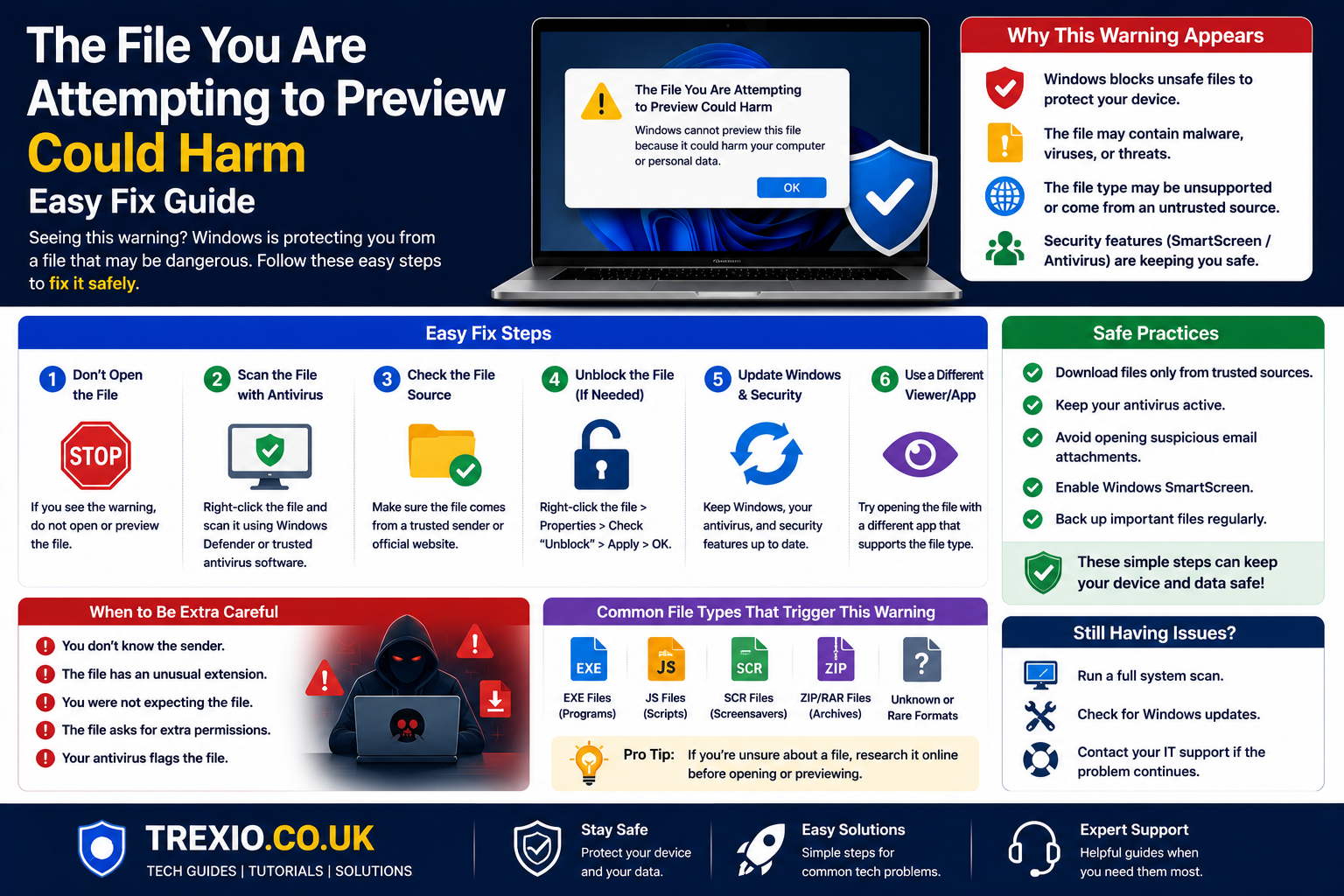
Seeing the message “the file you are attempting to preview could harm” can be alarming, especially when you’re expecting an important document or email attachment. Many users assume their computer has already been infected, while others ignore the warning entirely. Neither reaction is ideal.
In reality, the file you are attempting to preview could harm is a security warning designed to protect your device from potentially dangerous files. Whether you’re using Gmail, Outlook, Google Drive, OneDrive, or another cloud service, this message helps prevent accidental malware infections. Understanding why the file you are attempting to preview could harm appears is the first step toward deciding whether the file is safe to open.
This guide explains everything you need to know about the file you are attempting to preview could harm, its common causes, and practical solutions for safely handling suspicious files.
Quick Summary
If you encounter the file you are attempting to preview could harm, it usually means the platform has detected that the file could contain malware, harmful scripts, or unsupported content. The warning doesn’t always mean the file is malicious, but it should never be ignored.
Quick highlights:
- The warning protects users from malware.
- It commonly appears in Gmail and cloud storage services.
- Unknown file types often trigger it.
- Scan files before downloading.
- Verify the sender before opening attachments.
- Keep antivirus software updated.
- Never bypass the warning unless you’re confident the file is safe.
What Does “The File You Are Attempting to Preview Could Harm” Mean?
When you see the file you are attempting to preview could harm, the service you’re using has determined that displaying the file inside its preview window could pose a security risk.
Instead of opening the document directly, the platform blocks the preview to protect your device. The warning the file you are attempting to preview could harm doesn’t necessarily confirm the file is infected. Rather, it indicates that the system cannot verify its safety.
Some platforms analyze files using automated malware detection, while others simply restrict previews for potentially risky file formats.
Why Does “The File You Are Attempting to Preview Could Harm” Appear?
Several situations can trigger the file you are attempting to preview could harm.
Unknown File Extension
Files with uncommon extensions may not be recognized by the preview service. Since the platform cannot safely render the content, the file you are attempting to preview could harm warning appears instead.
Examples include:
- EXE
- MSI
- BAT
- CMD
- JS
- VBS
- SCR
Suspicious Email Attachments
If an attachment comes from an unknown sender, email providers may display the file you are attempting to preview could harm before allowing any interaction.
This is particularly common with phishing emails carrying malware.
Malware Detection
Cloud services automatically scan uploaded files.
If their security systems detect unusual behavior or known malware signatures, the file you are attempting to preview could harm is displayed to prevent accidental execution.
Password-Protected Archives
ZIP or RAR files secured with passwords cannot always be scanned properly.
Because the contents remain encrypted, the service may warn users that the file you are attempting to preview could harm.
Unsupported Preview Format
Sometimes the file is perfectly safe, but the platform simply cannot generate a secure preview.
Instead of displaying corrupted or unsupported content, it warns users with the file you are attempting to preview could harm.
Common Situations Where You May See This Warning
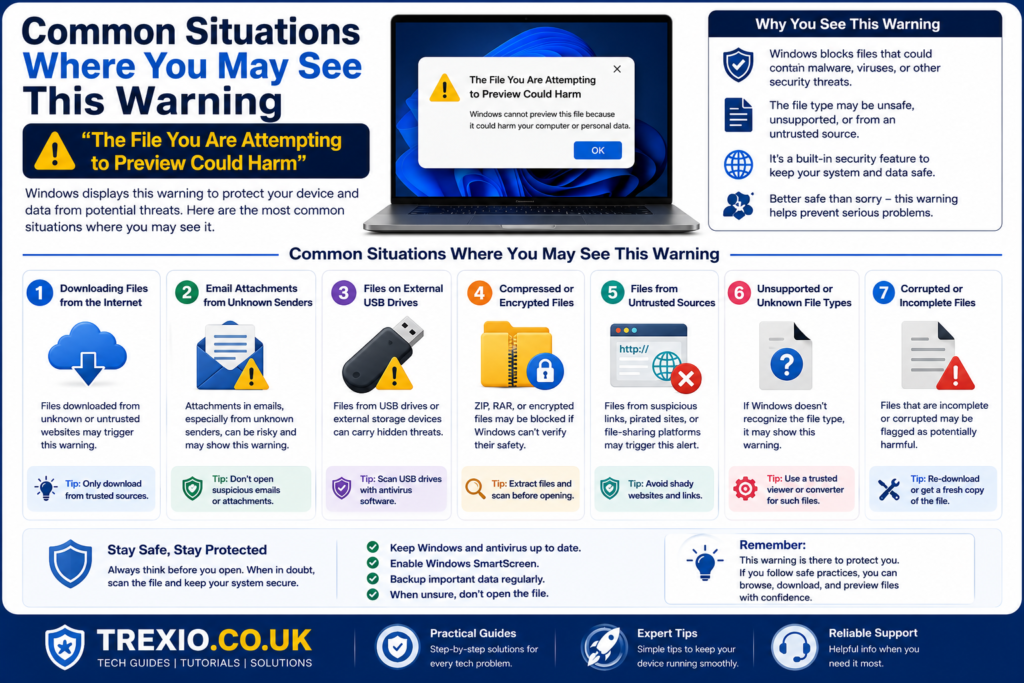
Gmail Attachments
Gmail regularly displays the file you are attempting to preview could harm for executable files and suspicious archives.
Google Drive
Google Drive scans uploaded files for malware.
Large files or unknown formats sometimes trigger the file you are attempting to preview could harm.
Microsoft OneDrive
OneDrive also blocks previews of files that may contain executable code.
Dropbox
Dropbox occasionally restricts previews when file integrity cannot be verified.
Company Email Systems
Corporate email providers often apply even stricter security filters, making the file you are attempting to preview could harm more common.
Is “The File You Are Attempting to Preview Could Harm” Always Dangerous?
No.
Although the file you are attempting to preview could harm sounds serious, many legitimate files trigger it.
Examples include:
- Software installers
- Firmware updates
- Programming scripts
- Batch files
- Administrative tools
The warning simply encourages caution.
Comparison Table Top Software for Scanning Suspicious Files
| Software | Best For | Key Features | Free Version | Pricing | Platform |
|---|---|---|---|---|---|
| Microsoft Defender | Everyday Windows protection | Built-in real-time malware scanning, ransomware protection, cloud-based security | Yes | Included with Windows | Windows |
| Malwarebytes | Removing malware | Detects malware, spyware, adware, and ransomware with fast scanning | Yes | Premium available | Windows, macOS, Android, iOS |
| Bitdefender Antivirus | Advanced security | Multi-layer ransomware defense, web protection, phishing detection | Limited | Paid plans | Windows, macOS |
| Norton 360 | Complete device protection | Antivirus, VPN, password manager, dark web monitoring | Trial | Subscription | Windows, macOS, Mobile |
| ESET NOD32 Antivirus | Lightweight antivirus | Fast scanning, exploit blocker, anti-phishing, low system impact | Trial | Subscription | Windows |
How Cloud Services Detect Harmful Files
Signature-Based Detection
Security platforms compare uploaded files against databases containing millions of known malware signatures.
If a match exists, the file you are attempting to preview could harm appears immediately.
Behavioral Analysis
Modern cloud services don’t rely solely on signatures.
Instead, they analyze how a file behaves in secure environments. If suspicious activity is detected, users receive the file you are attempting to preview could harm before opening the file.
Machine Learning Detection
Artificial intelligence helps identify previously unseen threats.
By recognizing suspicious code patterns, cloud providers can warn users with the file you are attempting to preview could harm even before traditional antivirus databases are updated.
| Software | Best For | Key Features | Free Version | Pricing | Platform |
|---|---|---|---|---|---|
| Avast Free Antivirus | Home users seeking free protection | Real-time threat detection, Wi-Fi security scan, ransomware shield, web protection | Yes | Premium starts at around $49.99/year | Windows, macOS, Android, iOS |
| Kaspersky Standard | Strong malware detection | Real-time antivirus, anti-phishing, safe browsing, performance optimization | Trial | Starts at around $38/year | Windows, macOS, Android, iOS |
| McAfee Total Protection | Multi-device security | Antivirus, VPN, identity monitoring, firewall, secure browsing | Trial | Starts at around $39.99/year | Windows, macOS, Android, iOS |
| Trend Micro Maximum Security | Online banking and shopping | AI-powered threat detection, ransomware protection, email scanning, privacy tools | Trial | Starts at around $39.95/year | Windows, macOS, Android, iOS |
| Sophos Home Premium | Family and remote management | AI malware detection, web filtering, ransomware protection, remote device management | Trial | Starts at around $59.99/year | Windows, macOS |
Feature Comparison Table
| Feature | Microsoft Defender | Malwarebytes | Bitdefender | Norton 360 | ESET NOD32 | Avast | Kaspersky | McAfee | Trend Micro | Sophos Home |
|---|---|---|---|---|---|---|---|---|---|---|
| Real-Time Protection | ✅ | ✅ | ✅ | ✅ | ✅ | ✅ | ✅ | ✅ | ✅ | ✅ |
| Ransomware Protection | ✅ | ✅ | ✅ | ✅ | ✅ | ✅ | ✅ | ✅ | ✅ | ✅ |
| Phishing Protection | ✅ | ✅ | ✅ | ✅ | ✅ | ✅ | ✅ | ✅ | ✅ | ✅ |
| Firewall | Windows Built-in | No | ✅ | ✅ | Limited | ✅ | ✅ | ✅ | ✅ | No |
| VPN Included | No | No | Limited | ✅ | No | Limited | Limited | ✅ | No | No |
| Multi-Device Support | Limited | ✅ | ✅ | ✅ | Limited | ✅ | ✅ | ✅ | ✅ | ✅ |
| Email Protection | Basic | Limited | ✅ | ✅ | ✅ | ✅ | ✅ | ✅ | ✅ | Limited |
| Lightweight Performance | ✅ | ✅ | ✅ | Good | Excellent | Good | Excellent | Moderate | Good | Good |
Pricing Comparison Table
| Software | Free Plan | Trial | Starting Price | Best Value For |
|---|---|---|---|---|
| Microsoft Defender | Yes | Not Required | Included with Windows | Windows users |
| Malwarebytes | Yes | Yes | $44.99/year | Malware removal |
| Bitdefender Antivirus | Limited | Yes | $29.99/year | Advanced security |
| Norton 360 | Trial | Yes | $49.99/year | Complete protection |
| ESET NOD32 | No | Yes | $39.99/year | Fast performance |
| Avast Free Antivirus | Yes | Yes | $49.99/year | Free users |
| Kaspersky Standard | No | Yes | $38/year | Strong malware detection |
| McAfee Total Protection | No | Yes | $39.99/year | Families |
| Trend Micro Maximum Security | No | Yes | $39.95/year | Safe online shopping |
| Sophos Home Premium | No | Yes | $59.99/year | Remote management |
How to Choose the Right Software
Choosing the right antivirus solution depends on how you use your device and the types of files you regularly download. If you frequently encounter the file you are attempting to preview could harm, look for software that provides strong real-time protection, cloud-based threat detection, and ransomware defense.
Consider these factors before making your choice:
- Select software with real-time malware scanning.
- Look for phishing and email attachment protection.
- Ensure it receives regular security updates.
- Choose a lightweight solution if you have an older computer.
- Consider VPN and identity protection if you frequently browse online.
- Compare pricing with the features you actually need.
- Read independent testing results for malware detection accuracy.
- Make sure it supports all of your devices.
Our Recommendation
If you are a Windows user, Microsoft Defender is an excellent starting point because it is already included with the operating system and offers reliable everyday protection.
For users who often download files from email or cloud storage and want an extra layer of security, Bitdefender Antivirus provides one of the best balances of performance, malware detection, and ease of use.
If you want complete digital protection—including a VPN, password manager, and identity monitoring—Norton 360 is a strong premium option.
Regardless of the software you choose, always verify the source of downloaded files and never ignore the warning the file you are attempting to preview could harm unless you are certain the file is trustworthy.
Conclusion
Receiving the file you are attempting to preview could harm does not automatically mean your file contains malware. Instead, it serves as a valuable security warning designed to protect your device from potentially dangerous downloads, suspicious attachments, or unsupported file types.
Whenever you see the file you are attempting to preview could harm, pause before opening the file. Verify the sender, scan the file with reputable antivirus software, and avoid downloading files from unknown sources. Practicing these simple habits can significantly reduce the risk of malware infections, ransomware attacks, and data loss.
Understanding why the file you are attempting to preview could harm appears helps you make informed decisions and keeps your computer, personal information, and online accounts safe.
Frequently Asked Questions (FAQs)
1. What does “the file you are attempting to preview could harm” mean?
It is a security warning indicating that the platform cannot safely preview the file because it may contain harmful content or an unsupported format.
2. Is the warning always accurate?
No. Many legitimate files, such as software installers and scripts, can trigger the warning even if they are safe.
3. Can I still download the file?
Yes, in many cases you can download it, but you should scan it with trusted antivirus software before opening it.
4. Why does Gmail show this warning?
Gmail blocks previews of files it considers risky, especially executable files, scripts, and suspicious archives.
5. Can antivirus software remove the warning?
No. Antivirus software cannot remove the warning itself, but it can determine whether the downloaded file is actually malicious.
6. Is Google Drive detecting a virus?
Not necessarily. Google Drive may display the warning simply because it cannot verify the file’s safety or preview it securely.
7. What file types commonly trigger this warning?
Common examples include EXE, MSI, BAT, CMD, JS, VBS, SCR, and password-protected ZIP or RAR archives.
8. What should I do before opening a suspicious file?
Verify the sender, scan the file with updated antivirus software, check the file extension, and only open it if you trust its source.
Quick Bio
FlashIQ is a technology-focused platform dedicated to helping users solve everyday computer, software, mobile, and internet issues. From troubleshooting Windows errors to explaining security warnings like the file you are attempting to preview could harm, FlashIQ publishes practical, easy-to-follow guides, software comparisons, and technology tips to help readers stay productive and secure online.