Modern businesses rely on technology to build stronger customer relationships, improve productivity, and increase revenue. As customer expectations continue to evolve, companies need flexible platforms that can adapt to changing business requirements without slowing innovation. This is where salesforce development services become one of the most valuable investments for organizations of every size. Whether a company wants to automate sales, improve customer support, or build custom applications, Salesforce provides an ecosystem capable of supporting long-term digital transformation. However, getting the most value from Salesforce requires more than simply purchasing licenses. Businesses need experienced developers who understand customization, integration, automation, security, and scalability. Professional salesforce development services help organizations unlock the platform’s full capabilities while reducing manual work and improving customer experiences. Throughout this guide, you’ll learn how these services create measurable business value and why they continue to be a critical component of modern CRM strategies.
Quick Answer
Salesforce development services involve customizing, developing, integrating, and optimizing the Salesforce platform to meet specific business requirements. These services include Salesforce implementation, custom application development, API integrations, workflow automation, Lightning development, AppExchange solutions, CRM optimization, and ongoing support. By using professional salesforce development services, businesses can improve productivity, automate repetitive tasks, strengthen customer relationships, and maximize their Salesforce investment.
Understanding Salesforce Development Services
Salesforce development services refer to the professional design, customization, implementation, enhancement, and maintenance of Salesforce CRM solutions based on unique business objectives. Rather than using Salesforce exactly as it comes out of the box, organizations customize the platform to support their own workflows, customer journeys, reporting needs, and operational processes. Professional developers build custom objects, automate repetitive activities, integrate third-party applications, and improve the overall user experience. Every company has different operational requirements, making customization essential for maximizing return on investment. Experienced Salesforce developers also ensure that new features remain secure, scalable, and compatible with future Salesforce releases. Businesses across healthcare, retail, finance, manufacturing, education, and technology increasingly depend on salesforce development services to improve efficiency and customer satisfaction. Instead of adapting business processes to software limitations, companies adapt Salesforce to fit their business model. This flexibility explains why Salesforce remains one of the world’s leading CRM platforms.
Why Salesforce Is More Than Just a CRM
Many people think Salesforce is simply customer relationship management software, but its capabilities extend far beyond contact management. It serves as a comprehensive business platform capable of supporting sales, marketing, service, commerce, analytics, artificial intelligence, and application development. Organizations use Salesforce to automate lead management, manage customer support tickets, create personalized marketing campaigns, analyze business performance, and even build enterprise-grade applications. Professional salesforce development services allow businesses to tailor these capabilities according to industry-specific needs. Developers can create custom dashboards, approval workflows, industry solutions, and mobile applications without rebuilding existing systems. This flexibility allows organizations to innovate faster while maintaining a centralized source of customer data. As digital transformation continues accelerating, Salesforce has evolved into an enterprise platform that supports nearly every customer-facing business function.
Why Businesses Need Salesforce Development Services
Companies often begin using Salesforce with standard features, but growth eventually introduces more complex requirements that default configurations cannot support. Multiple departments may require different workflows, reports, permission structures, or integrations with existing software. Without proper customization, employees may resort to manual workarounds that reduce efficiency and increase errors. Professional salesforce development services eliminate these limitations by creating solutions specifically designed around business goals. Developers optimize workflows, simplify user experiences, automate approvals, improve reporting accuracy, and connect Salesforce with external systems. These improvements reduce operational costs while increasing employee productivity. Businesses also gain better visibility into customer interactions, enabling smarter decisions and more personalized service. Investing in experienced Salesforce developers ensures the CRM evolves alongside the organization instead of becoming outdated.
Business Problems Salesforce Development Solves
| Business Challenge | Salesforce Development Solution |
|---|---|
| Manual workflows | Workflow automation |
| Duplicate customer data | Data validation and automation |
| Poor reporting | Custom dashboards |
| Slow approvals | Automated approval processes |
| Multiple disconnected systems | API integrations |
| Limited scalability | Custom application development |
| Low employee productivity | Optimized user experience |
| Customer service delays | Automated case management |
Core Components of Salesforce Development Services
Professional salesforce development services cover much more than coding alone. Developers analyze business requirements before designing scalable solutions that improve operational efficiency. The development process typically includes business analysis, architecture planning, Salesforce customization, Apex programming, Lightning component development, Visualforce enhancements, API integration, workflow automation, testing, deployment, optimization, and long-term maintenance. Every stage contributes to building a reliable CRM ecosystem capable of supporting business growth. Developers also prioritize security, ensuring sensitive customer information remains protected according to compliance requirements. Organizations benefit from faster implementations because experienced professionals follow Salesforce best practices and development standards. Continuous monitoring and optimization further improve platform performance over time. Together, these services transform Salesforce into a strategic business platform rather than simply another software application.
Major Development Services
Salesforce Consulting
Consultants evaluate business requirements before recommending the best Salesforce architecture.
Salesforce Customization
Developers configure Salesforce features to support unique workflows.
Salesforce App Development
Custom applications extend Salesforce functionality beyond standard capabilities.
Salesforce Integration
External systems communicate seamlessly through APIs and middleware.
Salesforce Migration
Organizations safely transfer customer data from legacy systems into Salesforce.
Salesforce Support
Continuous optimization ensures the platform performs efficiently after deployment.
Salesforce Development Lifecycle
A successful salesforce development services project follows a structured lifecycle rather than jumping directly into coding. The first stage involves understanding business goals, current challenges, and future scalability requirements. Consultants gather detailed requirements from stakeholders across different departments to ensure the solution supports every major business process. Developers then create technical architecture and implementation plans before beginning customization. During development, new features are built using Salesforce best practices to ensure maintainability and security. Comprehensive testing identifies potential issues before deployment into production environments. Once deployed, users receive training to maximize adoption and productivity. Ongoing maintenance keeps Salesforce aligned with changing business needs and regular Salesforce platform updates. Following this structured lifecycle significantly reduces implementation risks while improving project success rates.
Typical Development Process
| Phase | Purpose |
|---|---|
| Discovery | Business analysis |
| Planning | Solution architecture |
| Development | Coding and customization |
| Testing | Quality assurance |
| Deployment | Production release |
| Training | User adoption |
| Maintenance | Continuous improvement |
Salesforce Clouds Supported by Development Services
One of the biggest strengths of salesforce development services is their ability to support multiple Salesforce Clouds. Each cloud addresses different business functions while sharing customer data across the same platform. Developers customize these clouds according to organizational objectives, allowing departments to collaborate more efficiently. Sales teams gain improved pipeline visibility, marketers automate campaigns, customer service agents resolve cases faster, and executives receive real-time analytics. Businesses avoid data silos because every department operates within a connected ecosystem. Professional customization ensures every Salesforce Cloud aligns with company-specific workflows instead of forcing standardized processes. This unified approach improves collaboration, customer satisfaction, and operational performance while supporting future expansion.
Popular Salesforce Clouds
| Salesforce Cloud | Primary Purpose |
|---|---|
| Sales Cloud | Sales automation |
| Service Cloud | Customer support |
| Marketing Cloud | Marketing automation |
| Commerce Cloud | Digital commerce |
| Experience Cloud | Customer portals |
| Financial Services Cloud | Banking and finance |
| Health Cloud | Healthcare management |
| Education Cloud | Educational institutions |
Custom Salesforce Development
Every business operates differently, making custom development one of the most valuable aspects of salesforce development services. Instead of relying solely on standard Salesforce features, developers build solutions tailored to unique operational needs. Custom objects, Lightning components, Apex classes, Visualforce pages, automation flows, validation rules, and dashboards improve user productivity while reducing manual effort. Organizations can also create industry-specific workflows that align with internal processes and regulatory requirements. These customizations make Salesforce easier for employees to use while improving data quality and reporting accuracy. As business requirements evolve, developers continue refining these solutions without disrupting daily operations. Custom development ensures Salesforce remains a competitive advantage instead of becoming a generic CRM system. This flexibility enables businesses to innovate faster while maintaining consistent customer experiences.
Benefits of Custom Salesforce Development
Improved Efficiency
Automated workflows reduce repetitive tasks and minimize manual data entry.
Better Customer Experience
Personalized customer journeys improve engagement and satisfaction.
Greater Scalability
Custom solutions grow alongside expanding business operations.
Enhanced Reporting
Tailored dashboards provide meaningful business insights for decision-makers.
Salesforce Integration Services
Modern organizations rely on dozens of software platforms to manage operations, making seamless integration essential. Professional salesforce development services connect Salesforce with ERP platforms, accounting software, marketing automation tools, payment gateways, communication systems, inventory management applications, and cloud services. API integrations eliminate duplicate data entry while ensuring consistent information across departments. Employees spend less time switching between applications because connected systems automatically synchronize information. Integration also improves reporting since executives access centralized business intelligence from multiple sources. Developers carefully design secure APIs that maintain data integrity while supporting high-performance communication between systems. These integrations reduce operational complexity and improve organizational efficiency. As businesses adopt additional technologies, Salesforce remains the central hub connecting their digital ecosystem.
Salesforce Automation Solutions
Automation is one of the most valuable outcomes businesses gain from salesforce development services because it eliminates repetitive work and allows employees to focus on higher-value activities. Instead of manually assigning leads, sending follow-up emails, updating records, or requesting approvals, Salesforce automation completes these actions based on predefined business rules. Developers use Salesforce Flow, Apex triggers, Process Builder (where applicable), scheduled jobs, and intelligent workflows to automate complex business operations. Automation also improves consistency because every process follows standardized rules regardless of who performs the task. Sales representatives spend more time building relationships instead of updating spreadsheets, while customer service agents receive automated case routing that speeds response times. Managers benefit from automatic notifications, reminders, and performance reports that provide real-time visibility into operations. As organizations grow, automation scales effortlessly without requiring additional administrative effort. Professional salesforce development services ensure these automated processes are efficient, secure, and easy to maintain as business requirements evolve.
Common Automation Features
| Automation Feature | Business Benefit |
|---|---|
| Lead Assignment | Faster response to new prospects |
| Email Automation | Consistent customer communication |
| Approval Workflows | Quicker business decisions |
| Case Routing | Improved customer support |
| Task Creation | Better employee productivity |
| Scheduled Reports | Timely business insights |
| Data Validation | Higher data accuracy |
| Record Updates | Reduced manual effort |
Salesforce Lightning Development
Salesforce Lightning has transformed the platform by providing a modern, responsive, and highly customizable user interface. Through professional salesforce development services, developers build Lightning Web Components (LWCs) that deliver faster performance, reusable functionality, and improved user experiences. Unlike traditional development methods, Lightning enables businesses to create dynamic applications with responsive layouts that work across desktops, tablets, and smartphones. Developers also customize Lightning pages to simplify navigation and reduce the number of clicks required to complete common tasks. Employees benefit from intuitive dashboards, interactive reports, and personalized workspaces that improve productivity. Since Lightning components are modular, organizations can update individual features without rebuilding entire applications. This flexibility supports continuous improvement while keeping maintenance costs manageable. Businesses investing in Lightning development often experience greater user adoption because employees find the interface easier and more efficient to use.
Advantages of Lightning Development
Faster User Experience
Lightning Web Components load quickly, improving productivity and user satisfaction.
Reusable Components
Developers create modular components that can be reused across multiple applications.
Mobile Responsiveness
Applications automatically adapt to different screen sizes and devices.
Simplified Maintenance
Modular architecture makes future enhancements faster and more cost-effective.
Salesforce Security and Compliance
Protecting customer information is a top priority for organizations that rely on Salesforce to manage sensitive business data. Professional salesforce development services incorporate security best practices into every stage of development, ensuring applications remain protected against unauthorized access and data breaches. Developers configure role hierarchies, profiles, permission sets, field-level security, sharing rules, and authentication controls to enforce appropriate access levels. Encryption, audit trails, and secure API integrations further strengthen platform security while helping organizations meet regulatory requirements. Industries such as healthcare, finance, insurance, and government often require additional compliance measures, making experienced Salesforce developers especially valuable. Regular security reviews help identify vulnerabilities before they become significant risks. Secure coding standards also minimize potential issues during future platform updates. A well-designed Salesforce environment balances accessibility for authorized users with strong protection for confidential business information.
Essential Security Features
| Security Feature | Purpose |
|---|---|
| Role Hierarchy | Controls data visibility |
| Permission Sets | Flexible user permissions |
| Field-Level Security | Protects sensitive fields |
| Multi-Factor Authentication | Strengthens login security |
| Audit Logs | Tracks system activities |
| Data Encryption | Protects confidential information |
| Sharing Rules | Controls record access |
| Session Management | Enhances account protection |
Salesforce Testing and Quality Assurance
Successful implementations depend on thorough testing before new features reach production. As part of comprehensive salesforce development services, developers perform unit testing, integration testing, user acceptance testing, regression testing, and performance testing to verify system reliability. Testing ensures custom code works correctly, integrations exchange accurate data, and automation behaves as expected under different business scenarios. Developers also validate security settings and confirm that new enhancements do not negatively impact existing functionality. User acceptance testing allows employees to evaluate new features in realistic environments before deployment. Early identification of issues reduces project delays and prevents costly production errors. Continuous testing also supports smoother Salesforce updates because potential compatibility issues are discovered in advance. High-quality testing ultimately increases user confidence while protecting business continuity.
Salesforce Deployment and Ongoing Support
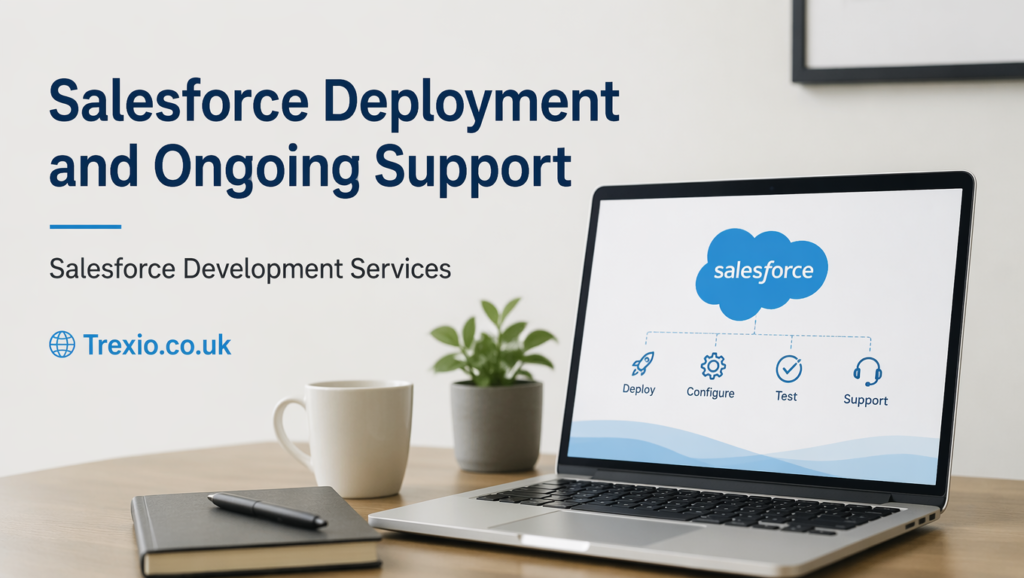
Deploying Salesforce customizations is not the end of the development journey. Businesses continue evolving, requiring ongoing enhancements, maintenance, and optimization to maximize long-term value. Professional salesforce development services include structured deployment strategies that minimize downtime and reduce implementation risks. Developers use change sets, DevOps pipelines, version control systems, and sandbox environments to safely migrate changes into production. After deployment, support teams monitor system performance, resolve technical issues, optimize workflows, and implement requested improvements. Regular reviews ensure Salesforce continues meeting organizational goals as business processes change. Ongoing support also includes user training, documentation updates, and proactive performance optimization. This continuous partnership helps organizations maintain a competitive advantage while protecting their Salesforce investment.
Choosing the Right Salesforce Development Partner
Selecting the right provider for salesforce development services significantly influences project success. Businesses should evaluate potential partners based on technical expertise, Salesforce certifications, industry experience, communication practices, and project management methodology. Experienced partners begin by understanding business objectives rather than immediately recommending technical solutions. They provide transparent timelines, realistic budgets, and scalable architectures that support future growth. Strong development teams also emphasize documentation, knowledge transfer, and post-launch support to ensure long-term success. Reviewing case studies, client testimonials, and previous implementations can provide valuable insight into a provider’s capabilities. Organizations should also assess whether the development partner follows Salesforce best practices and maintains familiarity with the platform’s latest features. Choosing a collaborative, experienced team reduces implementation risks and delivers greater long-term business value.
What to Evaluate Before Hiring
| Evaluation Criteria | Why It Matters |
|---|---|
| Salesforce Certifications | Demonstrates verified expertise |
| Industry Experience | Better understanding of business needs |
| Communication | Keeps projects aligned |
| Development Process | Improves quality and predictability |
| Support Services | Ensures long-term success |
| Client References | Validates past performance |
| Security Knowledge | Protects sensitive business data |
| Scalability Planning | Supports future growth |
Best Practices for Salesforce Development Services
- Begin every project with detailed business requirement analysis before writing any code.
- Design scalable architectures that can support future organizational growth.
- Follow Salesforce development best practices and coding standards consistently.
- Use Lightning Web Components whenever appropriate for modern user experiences.
- Automate repetitive business processes to improve productivity and reduce manual errors.
- Maintain comprehensive documentation for customizations, integrations, and workflows.
- Perform thorough testing before every production deployment.
- Monitor platform performance regularly and optimize slow processes.
- Prioritize user training to improve adoption and maximize return on investment.
- Review security configurations frequently to maintain compliance and protect customer data.
Common Mistakes to Avoid
- Customizing Salesforce without understanding long-term business objectives.
- Writing unnecessary custom code when standard Salesforce features can accomplish the same goal.
- Ignoring user feedback during development and testing phases.
- Failing to document customizations for future maintenance.
- Overcomplicating workflows that could remain simple and efficient.
- Neglecting data quality during migration projects.
- Skipping comprehensive testing before deployment.
- Overlooking security and permission configurations.
- Choosing development partners based solely on the lowest price.
- Ignoring ongoing optimization after implementation.
Pro Tips
- Build with scalability in mind to reduce future redevelopment costs.
- Keep customizations as simple as possible while meeting business requirements.
- Leverage Salesforce Flow before implementing custom Apex code whenever practical.
- Schedule periodic platform health assessments to identify optimization opportunities.
- Invest in user adoption programs to maximize CRM effectiveness.
- Use dashboards and analytics to measure the business impact of new features.
- Integrate Salesforce with essential business systems to eliminate data silos.
- Stay current with Salesforce seasonal releases and new platform capabilities.
- Maintain a structured sandbox strategy for development and testing.
- Partner with certified Salesforce professionals for complex enterprise projects.
Conclusion
Salesforce development services empower organizations to transform Salesforce from a standard CRM into a fully customized business platform that supports sales, marketing, customer service, operations, and long-term digital transformation. Through strategic customization, intelligent automation, secure integrations, Lightning development, and ongoing optimization, businesses can streamline processes while delivering exceptional customer experiences. Every organization has unique operational requirements, making tailored Salesforce solutions far more valuable than one-size-fits-all implementations. Experienced developers help businesses improve productivity, enhance reporting, strengthen security, and create scalable architectures capable of supporting future growth. Continuous maintenance and regular optimization ensure the platform evolves alongside changing business goals and Salesforce innovations. Companies that invest in professional salesforce development services often experience higher employee efficiency, better customer engagement, and stronger returns on their CRM investment. By following proven development practices and partnering with experienced professionals, organizations can unlock the full potential of the Salesforce ecosystem and establish a solid foundation for sustainable business success.
Frequently Asked Questions
1. What are Salesforce development services?
Salesforce development services include customization, implementation, integration, automation, application development, testing, deployment, and ongoing support to tailor Salesforce to specific business needs.
2. Who needs Salesforce development services?
Businesses of all sizes that want to customize Salesforce, automate workflows, integrate external systems, or improve CRM efficiency can benefit from these services.
3. How long does a Salesforce development project take?
Project timelines vary depending on complexity. Small customizations may take a few weeks, while enterprise implementations can require several months.
4. What programming language is used in Salesforce development?
Salesforce primarily uses Apex for server-side development, Lightning Web Components for modern user interfaces, SOQL for querying data, and JavaScript for front-end functionality.
5. Can Salesforce integrate with third-party applications?
Yes. Salesforce supports integration with ERP systems, accounting software, marketing platforms, payment gateways, collaboration tools, and many other business applications through APIs and middleware.
6. Is Salesforce suitable for small businesses?
Yes. Salesforce offers scalable solutions that can be customized for startups, small businesses, mid-sized companies, and large enterprises.
7. Why is Lightning development important?
Lightning development delivers modern interfaces, faster performance, reusable components, improved mobile experiences, and easier long-term maintenance.
8. How do Salesforce development services improve productivity?
They automate repetitive tasks, streamline workflows, reduce manual data entry, improve reporting, and enable employees to focus on higher-value work.
9. How important is security in Salesforce development?
Security is essential. Proper permissions, encryption, authentication, audit logging, and secure coding practices protect sensitive business and customer information.
10. How do I choose the right Salesforce development partner?
Look for certified professionals with relevant industry experience, proven project success, strong communication, transparent processes, reliable support, and a commitment to Salesforce best practices.
Author Bio
About the Author
The author is an experienced technology and CRM content specialist with extensive expertise in enterprise software, cloud platforms, digital transformation, and customer relationship management. With a strong focus on SEO, EEAT principles, and practical business guidance, the author creates in-depth, research-driven content that helps organizations understand complex technologies and make informed decisions about Salesforce development, CRM optimization, and business automation.