
Do Messages Deliver When Blocked?
Many people ask the same frustrating question after sending a text and never receiving a reply: do messages deliver when blocked? Whether you’re trying to reconnect with someone, checking if your phone is working correctly, or simply curious about how messaging systems operate, understanding what happens after someone blocks your number can eliminate confusion. Modern smartphones use different technologies such as SMS, MMS, RCS, and internet-based messaging services, meaning the answer isn’t always identical across every device or platform. Some messages disappear into the background without any notification, while others appear to send normally even though the recipient never receives them. Because every messaging service handles blocking differently, it’s easy to misunderstand what the delivery indicators actually mean. This guide explains how blocking affects message delivery across major platforms, separates myths from reality, and provides practical information based on how today’s messaging systems work. By the end of this article, you’ll clearly understand do messages deliver when blocked and what every delivery status actually means.
Quick Answer
Do Messages Deliver When Blocked?
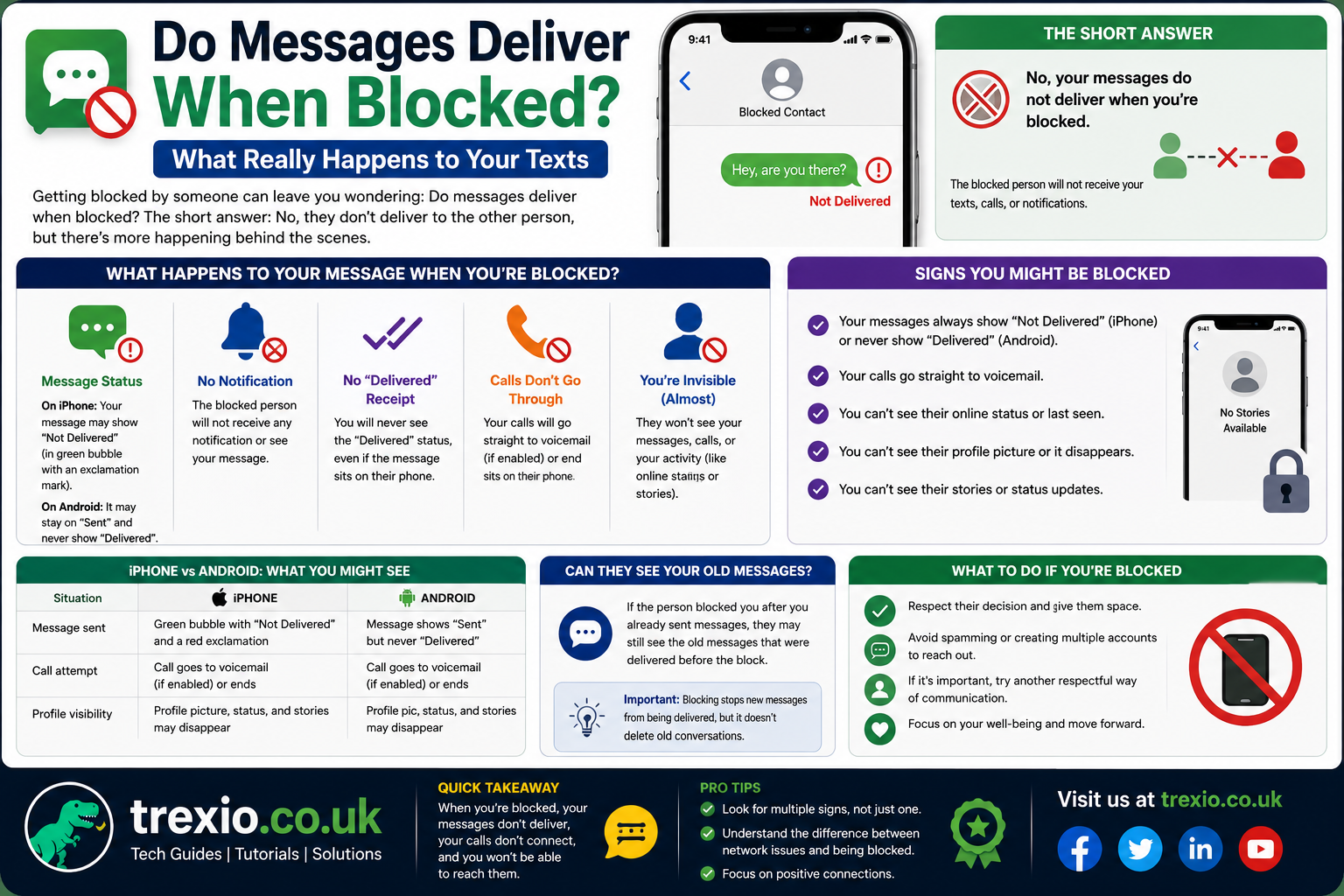
The short answer is no—in most cases, messages do not reach someone who has blocked your number. However, the exact behavior depends on whether you’re using SMS, MMS, iMessage, RCS, WhatsApp, Facebook Messenger, Telegram, Signal, or another messaging platform. Your phone may still allow you to type and send the message because it doesn’t always know you’ve been blocked. Instead, the blocking decision is made by the recipient’s carrier or messaging service. As a result, your message may appear to send successfully without actually being delivered. On some services, you won’t receive a delivery confirmation at all, while on others, you’ll simply notice that messages remain in a pending state. This difference is one reason why people continue asking do messages deliver when blocked, since there isn’t one universal behavior across every messaging app. Understanding the underlying technology helps explain why the sender often receives very little information.
Understanding How Blocking Works
What Does Blocking Actually Do?
Blocking is a privacy feature designed to prevent unwanted communication between users. Once someone blocks your number or account, their device or messaging service automatically rejects incoming communication from you. Depending on the platform, this may include phone calls, text messages, multimedia messages, FaceTime calls, voice messages, and even profile updates. Most systems intentionally hide the fact that you’ve been blocked to protect the privacy of the person who initiated the block. This means the sender usually doesn’t receive a notification stating they have been blocked. Instead, the messaging experience continues almost normally from the sender’s perspective, even though communication has effectively stopped. This privacy-first approach is one of the primary reasons do messages deliver when blocked remains a frequently searched question. The messaging system is designed to avoid revealing another person’s privacy choices while still preventing unwanted contact.
Why You Aren’t Told You’re Blocked
Technology companies intentionally avoid displaying “You have been blocked” notifications because such alerts could encourage harassment or repeated attempts to contact the other person. Instead, messaging services minimize the information available to the sender. For example, a sent message might never change to “Delivered,” or it may simply appear as though the recipient’s phone is offline. Since network interruptions, poor cellular coverage, and powered-off devices can produce similar behavior, it’s impossible to conclude that blocking is the only explanation. This deliberate ambiguity protects user privacy while maintaining a consistent messaging experience. As a result, when people wonder do messages deliver when blocked, they often mistake ordinary delivery delays for evidence of blocking or vice versa. Understanding this design philosophy makes the behavior much easier to interpret.
Types of Messaging Services and How Blocking Differs
SMS (Short Message Service)
SMS is the traditional text messaging system supported by nearly every mobile carrier worldwide. Unlike internet messaging services, SMS travels through your carrier’s cellular network rather than Wi-Fi or mobile data. When someone blocks your phone number through their carrier or device, future SMS messages generally stop reaching their inbox. Your phone often still displays the message as sent because it successfully transferred the text to your mobile carrier. However, successful transmission to your carrier doesn’t necessarily mean the recipient actually received it. This distinction explains why many users continue asking do messages deliver when blocked after seeing no obvious error message. SMS technology simply wasn’t designed to provide detailed delivery information in every situation. Consequently, the sender rarely receives confirmation about what happened after transmission.
MMS (Multimedia Messaging Service)
MMS works similarly to SMS but allows users to send photos, videos, audio clips, documents, and group messages. Blocking generally prevents MMS messages from reaching the recipient as well. Since multimedia messages require additional network processing, delivery failures may sometimes appear more obvious than regular text messages. However, the sender still won’t necessarily receive a notification explaining that blocking caused the failure. Instead, the message may remain pending, fail silently, or appear to send successfully depending on the carrier. This uncertainty contributes to ongoing confusion surrounding do messages deliver when blocked, especially when media attachments are involved. Every carrier implements MMS delivery slightly differently, making behavior less predictable than many users expect.
Internet Messaging Services
Applications such as WhatsApp, Signal, Telegram, Facebook Messenger, Instagram Direct Messages, and other internet-based platforms use encrypted data connections instead of cellular SMS networks. These apps typically provide delivery indicators such as checkmarks or status labels that reveal whether a message has reached the recipient’s device. However, blocking often interrupts those delivery confirmations. In many cases, messages remain with a single checkmark or pending status indefinitely because they never reach the blocked recipient. Each platform uses its own privacy policies, so the visible signs differ slightly. Nevertheless, the central question—do messages deliver when blocked—generally has the same answer across most internet messaging apps: blocked messages are not delivered to the intended recipient.
Does Blocking Work the Same on Every Phone?
iPhone Blocking Behavior
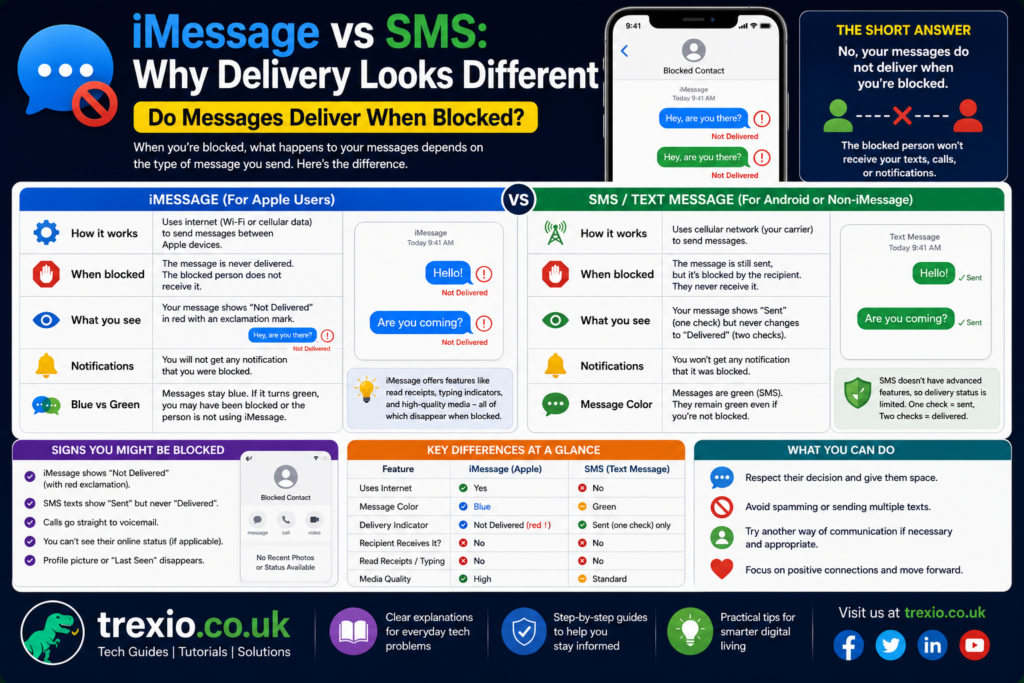
Apple’s iPhone combines SMS, MMS, and iMessage into one messaging application, but these technologies behave differently. If the recipient blocks your phone number, iMessage conversations usually stop showing “Delivered” beneath newly sent messages. SMS messages, however, may appear to send because they travel through your carrier instead of Apple’s servers. This difference often leads people to believe that one message type succeeded while another failed. In reality, blocked communication generally never reaches the recipient regardless of which messaging technology is being used. Apple’s privacy protections intentionally avoid notifying blocked senders. Therefore, do messages deliver when blocked on iPhone depends on the messaging protocol, but the practical outcome remains that blocked users cannot successfully communicate through Messages.
Common iPhone Indicators
- Messages no longer show “Delivered.”
- FaceTime calls fail to connect.
- Calls may go directly to voicemail.
- Replies suddenly stop without explanation.
- Previous conversations remain visible, but new communication fails.
Android Blocking Behavior
Android devices vary because manufacturers like Samsung, Google, Motorola, OnePlus, and others customize the operating system differently. Additionally, Android users may rely on Google Messages with RCS, Samsung Messages, or carrier messaging applications. Despite these differences, blocking generally prevents future communication from reaching the recipient. Some Android messaging apps still display “Sent,” while others show no delivery status whatsoever. RCS messaging may display pending delivery indefinitely if the recipient has blocked the sender. Since implementations vary between manufacturers and carriers, users often search do messages deliver when blocked hoping for one definitive answer. Although interfaces differ, the overall effect remains largely consistent: blocked messages typically never reach the other person.
iMessage vs SMS: Why Delivery Looks Different
iMessage Delivery Status
Apple’s iMessage uses Apple’s servers rather than standard carrier networks. When communication is functioning normally, you’ll typically see “Delivered” below your message shortly after it reaches the recipient’s device. If you’re blocked, that delivery confirmation usually disappears. However, this isn’t definitive proof because network issues, airplane mode, disabled iMessage, or a switched-off device can produce identical behavior. This uncertainty is intentional and helps preserve user privacy. Because several technical conditions create the same symptoms, do messages deliver when blocked cannot be answered solely by checking the delivery label. Instead, it’s important to evaluate multiple signs together rather than relying on a single indicator.
SMS Delivery Behavior
Unlike iMessage, traditional SMS usually doesn’t display detailed delivery confirmations on every carrier. Your phone may simply show that the message was sent to the network without confirming whether the recipient actually received it. Consequently, blocked SMS messages often appear no different from successfully transmitted ones. This design makes SMS particularly confusing for people trying to determine whether they’ve been blocked. Carriers intentionally reveal very little information beyond successful network submission. As a result, do messages deliver when blocked remains one of the most misunderstood questions involving standard text messaging technology.
Common Myths About Blocked Messages
Myth 1: Every Sent Message Means It Was Delivered
Many people assume that pressing the Send button automatically means the other person received the message. In reality, sending and delivering are two separate processes. Your phone successfully sends the message to your messaging service or carrier first, after which the network attempts to deliver it. If the recipient has blocked your number, that second step generally never completes. This misunderstanding causes unnecessary confusion and false assumptions about communication. Knowing the distinction between transmission and delivery provides a much clearer understanding of do messages deliver when blocked. Technical success at one stage doesn’t guarantee successful delivery at the next.
Myth 2: Multiple Messages Eventually Go Through
Another widespread misconception is that repeatedly sending messages will eventually bypass a block. Modern messaging systems don’t work that way. Blocking remains active until the recipient manually removes it, meaning additional messages continue to be rejected. Sending repeated texts won’t increase the chances of delivery and may even violate platform policies if harassment occurs. Messaging systems are designed specifically to prevent blocked communication from reaching the recipient. Therefore, repeatedly testing do messages deliver when blocked won’t change the outcome.
How Blocking Affects Popular Messaging Apps
The answer to do messages deliver when blocked becomes more nuanced when you move beyond traditional SMS and iMessage. Every messaging application has its own infrastructure, privacy settings, and delivery indicators. Some platforms provide visible status updates, while others intentionally limit what the sender can see. This design helps protect the privacy of the person who initiated the block. Although the user experience differs, the underlying goal remains consistent: preventing unwanted communication without revealing unnecessary information to the sender. Understanding these platform-specific differences can help you interpret message statuses more accurately. It also prevents you from drawing incorrect conclusions based on a single missing checkmark or delivery notification. The following sections explain how the most popular messaging services typically behave after someone blocks your account.
WhatsApp is one of the most widely used messaging platforms worldwide, and its blocking behavior is designed to prioritize user privacy. If someone blocks you, messages you send will usually remain with a single gray check mark, indicating that the message reached WhatsApp’s servers but not the recipient’s device. You’ll also stop seeing updates to the person’s “Last Seen,” “Online” status, and profile photo in many situations, although privacy settings can produce similar effects. Voice and video calls generally fail to connect as well. Importantly, none of these signs alone prove you’ve been blocked because the user may have changed privacy preferences or temporarily disconnected from the internet. When people ask do messages deliver when blocked, WhatsApp’s answer is generally no, but the app intentionally avoids displaying a direct notification. This privacy-focused approach reduces the likelihood of harassment while giving users more control over their communications. As a result, multiple indicators should always be considered together rather than relying on a single clue.
Facebook Messenger
Messenger uses internet-based messaging, so message delivery depends on Meta’s servers rather than your mobile carrier. If someone blocks you on Messenger, future messages typically won’t reach their inbox. Depending on the type of block applied, you may also lose the ability to start new conversations or see their active status. Sometimes a conversation remains visible while new messages never receive a successful delivery status. Because Messenger supports several privacy options, including ignoring conversations and restricting contacts, blocked behavior can sometimes resemble other account settings. This ambiguity often causes users to wonder do messages deliver when blocked when they notice conversations becoming inactive. The platform deliberately limits the information available to blocked users, ensuring that privacy decisions remain confidential. Understanding these design choices makes Messenger’s behavior much easier to interpret.
Telegram and Signal
Telegram and Signal both emphasize secure communication, but they implement blocking differently. Telegram may still allow messages to appear sent from the sender’s perspective, while the recipient never receives them after blocking occurs. Signal similarly prevents future communication without explicitly notifying the sender. Since both applications prioritize encryption and user privacy, they intentionally reveal very little about another person’s account status. Profile updates, read receipts, and delivery confirmations may also behave differently depending on privacy settings. Because of these variables, the question do messages deliver when blocked cannot be answered by looking at only one indicator within either application. Instead, the overall communication pattern provides a more reliable picture. In nearly every normal blocking scenario, however, new messages do not successfully reach the intended recipient.
Comparison Table: Message Delivery After Blocking
| Platform | Are Messages Delivered After Blocking? | Delivery Status Visible? | Sender Notified About Block? |
|---|---|---|---|
| SMS | No, in most cases | Usually limited | No |
| MMS | No | Limited or carrier-dependent | No |
| iMessage | No | “Delivered” often disappears | No |
| RCS | Generally no | May remain pending | No |
| No | Single check mark typically remains | No | |
| Facebook Messenger | No | Delivery may fail | No |
| Telegram | No | Varies by app behavior | No |
| Signal | No | Limited indicators | No |
Can Messages Be Delivered If Someone Unblocks You Later?
What Happens to Previously Sent Messages?
One of the most common follow-up questions after do messages deliver when blocked is whether messages sent during the blocked period appear once the person removes the block. In most messaging systems, the answer is no. Messages that failed to reach the recipient while the block was active are generally not stored for later delivery. Instead, they are discarded by the messaging service or carrier after delivery fails. Once the block is removed, only new messages sent afterward have the opportunity to reach the recipient successfully. This behavior helps maintain consistent privacy protections and avoids delivering communications that the recipient intentionally prevented. Although specific implementations differ slightly among platforms, previously blocked messages are rarely recovered. Therefore, unblocking someone does not usually trigger the delivery of older texts that were sent while the block was in effect.
Does Timing Matter?
Timing can occasionally influence what you observe, especially if a message is already in transit when the recipient activates the block. In rare situations involving temporary network delays, a message that had already been accepted for delivery might still arrive before the block fully takes effect. However, this is uncommon and depends on how quickly the messaging platform processes the block request. Once the block becomes active, subsequent communications are generally prevented from reaching the recipient. This is another reason why isolated incidents should not be used to determine whether someone has blocked you. Instead of focusing on a single message, evaluate the overall communication pattern over time. Doing so provides a much more reliable understanding of do messages deliver when blocked across different services.
Other Reasons Messages May Not Be Delivered
Network Connectivity Problems
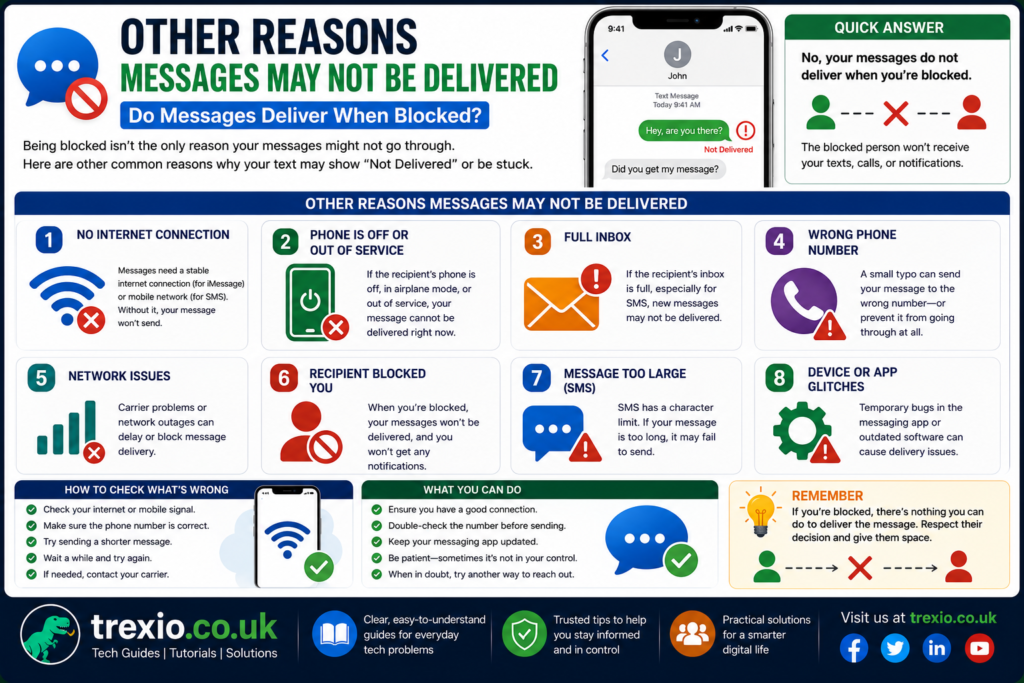
Not every failed message indicates blocking. Weak cellular coverage, Wi-Fi interruptions, server outages, and temporary carrier issues can all prevent successful delivery. If the recipient’s phone is powered off or disconnected from the network, messages may remain pending until connectivity returns. In some cases, delivery is simply delayed rather than permanently rejected. This is especially common during periods of heavy network congestion or when traveling internationally. Before assuming you’ve been blocked, consider whether temporary technical issues could explain the behavior. Understanding these possibilities helps answer do messages deliver when blocked more accurately by separating genuine blocking from ordinary communication problems. Patience is often the best approach before drawing conclusions.
Device or Account Changes
Changing phones, switching carriers, disabling iMessage, uninstalling a messaging application, or creating a new account can all affect message delivery. These situations sometimes produce the same symptoms as blocking, including missing delivery confirmations or unanswered texts. For example, an iPhone user who switches to Android without properly deregistering iMessage may temporarily experience messaging issues. Likewise, deleting or deactivating a messaging account can interrupt conversations even though no block exists. Because so many technical scenarios create similar results, relying on a single delivery indicator is rarely sufficient. Looking at the broader context helps avoid incorrect assumptions about do messages deliver when blocked. Technical changes are often overlooked despite being common causes of messaging problems.
Best Practices
- Respect another person’s privacy if you suspect they have blocked your number.
- Avoid repeatedly sending messages in an attempt to test whether the block exists.
- Verify that your own device has a stable internet or cellular connection before assuming delivery failed.
- Keep your messaging applications and operating system updated for the most reliable performance.
- Understand the differences between SMS, MMS, RCS, and internet messaging platforms.
- Remember that missing delivery confirmations do not automatically prove you’ve been blocked.
- Use official messaging features rather than third-party “block checker” applications, which are often unreliable.
- Consider alternative explanations such as network outages, phone replacements, or account changes before reaching conclusions.
Common Mistakes
Assuming No Reply Means You’re Blocked
Many people immediately believe they have been blocked simply because they receive no response. In reality, there are countless reasons someone may not reply, including busy schedules, technical issues, forgotten notifications, or a deliberate decision not to respond. Silence alone is not reliable evidence of blocking.
Relying on One Indicator
Another common mistake is treating a missing delivery receipt or failed call as definitive proof. Messaging systems intentionally make blocking difficult to confirm. Multiple unrelated technical situations can produce identical symptoms, making it important to evaluate several factors together.
Using Third-Party Detection Apps
Many websites and applications claim they can tell you with certainty whether someone has blocked you. Most of these tools cannot access another person’s private messaging information and frequently make unsupported claims. Relying on them often creates more confusion than clarity.
Pro Tips
Understand Platform Differences
Learn how your preferred messaging app handles delivery receipts, read receipts, and blocking. Knowing these differences reduces unnecessary confusion.
Don’t Obsess Over Delivery Status
Delivery indicators provide useful information but rarely tell the complete story. Network conditions, privacy settings, and software updates can all influence what you see.
Keep Communication Respectful
If you suspect someone has blocked you, respect their decision. Attempting to bypass blocking through alternative accounts or repeated contact is generally inappropriate and may violate platform policies.
Focus on Reliable Evidence
Instead of relying on internet rumors, consult official documentation from your device manufacturer or messaging service when troubleshooting delivery problems. Accurate information leads to better conclusions.
Conclusion
The question do messages deliver when blocked has a straightforward answer in most situations: they generally do not. However, understanding why requires recognizing the differences between SMS, MMS, iMessage, RCS, and internet-based messaging applications such as WhatsApp, Messenger, Telegram, and Signal. Modern messaging platforms intentionally protect user privacy by avoiding direct notifications that someone has blocked you. As a result, delivery indicators alone cannot provide absolute certainty because network issues, account changes, and device settings can produce similar behavior. Evaluating multiple signs together offers a more accurate understanding than relying on a single failed message or missing delivery receipt. Rather than searching for ways to bypass blocking, it’s better to respect personal boundaries and understand how today’s communication technologies are designed to function. By learning how each messaging system handles blocked conversations, you can interpret delivery statuses more confidently and avoid many of the common misconceptions surrounding digital communication.
Frequently Asked Questions
1. Do messages deliver when blocked on an iPhone?
In most cases, no. If someone has blocked your number, new iMessages and SMS messages generally do not reach the recipient, although the visible behavior depends on the messaging method being used.
2. Can someone read my messages after unblocking me?
Usually not. Messages sent while the block was active are generally not delivered later after the block is removed.
3. Will I receive a notification if someone blocks me?
No. Most messaging platforms intentionally avoid informing users that they have been blocked.
4. Does “Sent” mean the recipient received my message?
Not necessarily. “Sent” often means your device successfully transmitted the message to the network, not that it reached the recipient.
5. Why does my message still show one check mark on WhatsApp?
A single check mark usually means the message reached WhatsApp’s servers but has not been delivered to the recipient’s device. Blocking is one possible explanation, but not the only one.
6. Can blocked SMS messages be recovered later?
Generally, no. Messages that fail because of blocking are typically not stored for future delivery.
7. Does calling someone help confirm whether I’m blocked?
Not definitively. Calls going directly to voicemail may result from blocking, but they can also occur because the phone is off, in Do Not Disturb mode, or outside network coverage.
8. Are third-party apps able to detect if someone blocked me?
No application can reliably confirm another person’s private blocking status across all messaging platforms. Be cautious of services making such claims.
9. Can I bypass a block by sending messages from another app?
A block usually applies only to the specific platform or phone number where it was set. However, attempting to bypass someone’s block is not recommended and may violate platform rules or personal boundaries.
10. Is being blocked the only reason messages aren’t delivered?
No. Network outages, software issues, carrier problems, account changes, disabled messaging services, and device settings can all prevent successful message delivery.
Author Bio
About the Author
The author is an experienced technology writer specializing in mobile devices, messaging platforms, cybersecurity, and consumer software. With a strong focus on accuracy, practical testing, and user-friendly explanations, they create in-depth guides that follow Google’s E-E-A-T and Helpful Content principles. Their goal is to simplify complex technical topics so readers can make informed decisions with confidence.