

Digital customer experience has become one of the most important factors influencing how customers perceive a brand. Every interaction across websites, mobile apps, social media, live chat, email, and online support shapes customer expectations. Businesses no longer compete only on products or pricing because customers value convenience, personalization, and fast service just as much. A smooth digital customer experience encourages repeat purchases, strengthens trust, and increases customer loyalty over time. Companies that consistently deliver excellent online experiences often outperform competitors in customer retention and revenue growth. Modern consumers expect every digital interaction to be intuitive, secure, and personalized according to their needs. As technology continues evolving, organizations must continually optimize every touchpoint to remain competitive. This guide explores the first half of everything businesses should understand about creating an exceptional digital customer experience.
Quick Answer
A digital customer experience refers to every interaction customers have with a company through digital channels such as websites, mobile apps, social media platforms, email, online stores, customer portals, and live chat. It combines usability, personalization, responsiveness, security, and consistent branding to create positive customer journeys. Businesses that invest in improving digital customer experience typically achieve higher customer satisfaction, stronger engagement, increased loyalty, improved conversion rates, and better long-term profitability.
What Is Digital Customer Experience?
A digital customer experience encompasses every online interaction between customers and a business throughout the entire customer lifecycle. These interactions begin long before a purchase and continue well after the sale through support, follow-up communication, loyalty programs, and personalized recommendations. Customers may visit a website, download a mobile application, read online reviews, contact customer service through live chat, or engage with social media content. Every one of these moments contributes to their overall perception of the brand. A positive digital customer experience removes friction, simplifies decision-making, and provides consistent service across every digital platform. Companies that understand customer behavior can optimize these interactions to make each step easier and more enjoyable. Businesses today invest heavily in customer journey mapping, user experience design, customer analytics, and artificial intelligence to continuously improve online engagement. Delivering exceptional experiences has become a competitive advantage in nearly every industry.
Unlike traditional customer service, digital customer experience focuses on proactive engagement rather than simply resolving problems. Organizations analyze customer preferences, browsing history, purchasing habits, and behavioral data to anticipate customer needs before they arise. Digital transformation enables companies to deliver highly relevant experiences using automation, recommendation engines, personalized content, and intelligent customer support. The goal is to create interactions that feel natural rather than transactional. Customers expect businesses to recognize their preferences regardless of the device or channel they use. When companies successfully connect every digital touchpoint, customers experience seamless transitions that strengthen trust and encourage repeat business. This customer-centric approach improves both satisfaction and long-term business performance while supporting sustainable growth in increasingly competitive digital markets.
Why Digital Customer Experience Matters
Businesses that prioritize digital customer experience often see measurable improvements in customer retention, online engagement, and overall profitability. Consumers today have countless alternatives available with only a few clicks, making it easier than ever to switch brands after a poor experience. A slow website, confusing navigation, delayed support response, or complicated checkout process can quickly drive customers elsewhere. Excellent digital experiences reduce customer frustration while increasing confidence in the brand. Organizations that continuously improve customer interactions build stronger emotional connections that encourage repeat purchases and positive word-of-mouth recommendations. These positive experiences also increase customer lifetime value while lowering acquisition costs because satisfied customers frequently become loyal advocates. Investing in digital customer experience has therefore become an essential business strategy rather than simply a technology initiative.
Customer expectations continue rising as leading brands establish new standards for convenience, speed, and personalization. Businesses that fail to adapt often struggle to maintain customer loyalty in highly competitive industries. Modern customers expect fast-loading websites, responsive mobile experiences, personalized recommendations, secure payment systems, and consistent communication across every channel. Companies that successfully meet these expectations often outperform competitors by delivering memorable interactions at every stage of the customer journey. Strong digital customer experience also supports higher conversion rates because customers feel more comfortable completing purchases when every step feels intuitive and trustworthy. Continuous improvement based on customer feedback, behavioral analytics, and performance metrics allows businesses to remain responsive to changing market demands while strengthening long-term customer relationships.
Key Components of Digital Customer Experience
User-Friendly Website Design
Website usability serves as the foundation of a successful digital customer experience because it often represents the customer’s first impression of a brand. Visitors expect clean layouts, intuitive navigation, fast loading speeds, and accessible content that helps them accomplish their goals quickly. Poor design choices can increase bounce rates and reduce customer confidence before meaningful engagement even begins. Businesses should prioritize responsive design, mobile optimization, readable typography, clear calls to action, and logical page structures that guide users naturally through the website. Search functionality should also deliver accurate results while minimizing unnecessary clicks. Regular usability testing helps identify friction points that prevent customers from completing desired actions. When customers can easily find information, compare products, and complete transactions, overall satisfaction naturally improves.
Fast Performance and Reliability
Speed significantly influences every aspect of digital customer experience because customers expect immediate access to information and services. Even minor delays in page loading or application performance can reduce engagement and increase abandonment rates. Businesses should optimize website infrastructure, compress images, minimize unnecessary scripts, implement content delivery networks, and monitor performance continuously. Reliable hosting and scalable cloud infrastructure ensure consistent performance during periods of high traffic. Customers also value stability because frequent downtime negatively affects trust and purchasing confidence. Performance optimization supports search engine visibility while improving user satisfaction across desktop and mobile devices. Consistent reliability demonstrates professionalism and strengthens long-term customer relationships.
Understanding the Digital Customer Journey
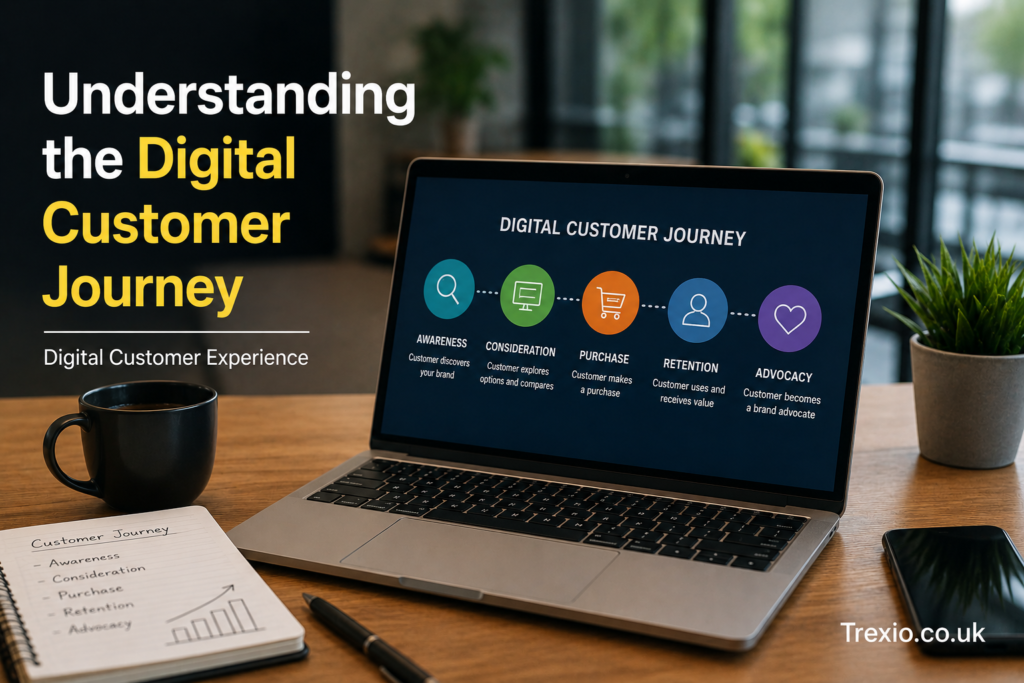
The digital customer experience begins long before customers become paying clients. Awareness typically starts through search engines, online advertisements, referrals, social media content, or educational blog articles. Potential customers then research products, compare alternatives, read reviews, and evaluate company credibility before making purchasing decisions. Every stage of this journey presents opportunities to build trust through valuable content, transparent communication, and consistent branding. Businesses that understand these behavioral patterns can optimize each interaction to remove obstacles and encourage progression toward conversion. Customer journey mapping helps organizations identify pain points, missed opportunities, and areas requiring improvement. Continuous optimization ensures customers experience smooth transitions between every digital touchpoint while reducing frustration and increasing overall satisfaction.
After making a purchase, the digital customer experience continues through onboarding, customer support, personalized communication, loyalty programs, and future recommendations. Many businesses mistakenly focus only on acquiring customers rather than nurturing long-term relationships after conversion. Effective post-purchase experiences encourage repeat business while transforming satisfied customers into enthusiastic brand advocates. Organizations should maintain ongoing engagement through educational resources, proactive support, exclusive offers, and personalized recommendations based on customer preferences. Customer feedback should also be actively collected and analyzed to identify opportunities for continuous improvement. Businesses that optimize the complete customer lifecycle typically enjoy stronger retention rates, increased customer lifetime value, and more sustainable growth.
Personalization and Customer Expectations
Why Personalization Is Essential
Modern consumers increasingly expect personalized digital customer experience across every interaction they have with businesses. Generic marketing messages rarely produce the same engagement as customized experiences tailored to individual interests, purchasing history, browsing behavior, and demographic characteristics. Personalization enables businesses to recommend relevant products, deliver customized content, and provide timely support that feels genuinely helpful rather than intrusive. Advanced customer relationship management systems and artificial intelligence analyze behavioral data to generate meaningful recommendations automatically. Customers appreciate businesses that remember their preferences while respecting privacy and data security standards. Effective personalization strengthens trust, increases engagement, and improves overall customer satisfaction throughout the digital journey. Organizations should balance customization with transparency to maintain customer confidence.
Meeting Rising Customer Expectations
Customer expectations evolve continuously as technology advances and leading organizations introduce new service standards. Today’s customers expect instant responses, mobile-friendly experiences, secure online transactions, personalized communication, and seamless movement between digital channels. Businesses must continuously evaluate customer feedback, monitor industry trends, and adopt innovative technologies to remain competitive. Exceptional digital customer experience depends on anticipating future customer needs rather than simply reacting to existing problems. Organizations that invest in continuous improvement often achieve stronger customer loyalty and higher conversion rates because customers recognize consistent commitment to service excellence. Remaining customer-focused helps businesses adapt quickly while maintaining relevance in rapidly changing digital environments.
Omnichannel Customer Experience
Creating Consistency Across Channels
A successful digital customer experience requires consistency across websites, mobile applications, email campaigns, live chat, customer portals, and social media platforms. Customers frequently switch between devices during their buying journey and expect businesses to recognize previous interactions without requiring repetitive explanations. Omnichannel strategies integrate customer data across every platform to provide seamless experiences regardless of where engagement occurs. Consistent messaging, branding, pricing, and customer support strengthen confidence while reducing friction throughout the customer journey. Businesses that eliminate communication gaps often improve customer satisfaction while increasing operational efficiency. Unified customer experiences also enable more accurate analytics and stronger decision-making for future optimization initiatives.
Technology That Powers Digital Customer Experience
Technology serves as the backbone of every successful digital customer experience, enabling businesses to deliver faster, smarter, and more personalized interactions at scale. Modern organizations rely on a combination of customer relationship management (CRM) platforms, artificial intelligence, machine learning, automation tools, analytics platforms, and cloud computing to optimize every digital touchpoint. These technologies help companies understand customer behavior, predict future needs, and respond proactively instead of reactively. AI-powered chatbots provide instant assistance around the clock, while predictive analytics identifies customer preferences before they become explicit requests. Automation simplifies repetitive tasks, allowing support teams to focus on solving more complex customer issues. Cloud-based systems ensure customer information remains synchronized across multiple channels, creating a consistent and seamless experience. Businesses that invest in integrated technology ecosystems often achieve higher operational efficiency while simultaneously improving customer satisfaction. As digital innovation continues accelerating, selecting scalable and flexible technologies becomes increasingly important for maintaining an exceptional digital customer experience.
Artificial Intelligence and Automation
Artificial intelligence has transformed the way businesses deliver digital customer experience by making interactions faster, more intelligent, and increasingly personalized. AI analyzes customer data to recommend products, personalize website content, predict customer intent, and identify potential issues before they escalate. Chatbots powered by natural language processing answer common questions instantly, reducing wait times while maintaining service availability twenty-four hours a day. Automation also streamlines email campaigns, appointment scheduling, customer onboarding, and follow-up communications, creating more consistent experiences across every touchpoint. Businesses benefit from reduced operational costs while customers enjoy quicker resolutions and personalized recommendations. AI should complement human expertise rather than replace it, particularly when customers require empathy or complex problem-solving. Organizations that balance intelligent automation with human interaction often achieve the highest levels of customer satisfaction. As AI capabilities continue improving, businesses should prioritize responsible implementation that respects customer privacy and maintains transparency.
Customer Data Platforms and Analytics
Customer data platforms play a critical role in improving digital customer experience because they unify information collected from websites, mobile apps, email campaigns, support interactions, and social media channels. Rather than storing customer information in disconnected systems, these platforms create comprehensive customer profiles that enable highly personalized experiences. Analytics dashboards help businesses monitor engagement metrics, conversion rates, customer satisfaction, and behavioral trends in real time. By understanding how customers navigate digital channels, organizations can identify friction points and optimize user journeys more effectively. Data-driven decision-making reduces guesswork while supporting continuous improvement initiatives. Businesses should also establish strong governance policies to ensure customer information remains secure and compliant with privacy regulations. Combining analytics with customer feedback provides a more complete understanding of customer expectations. Organizations that effectively leverage customer insights are better positioned to deliver exceptional digital customer experience across every interaction.
Measuring Digital Customer Experience Success
Measuring digital customer experience is essential because organizations cannot improve what they fail to monitor. Businesses should establish meaningful key performance indicators that align with customer satisfaction, engagement, and business objectives rather than relying solely on sales metrics. Customer Satisfaction Score (CSAT), Net Promoter Score (NPS), Customer Effort Score (CES), conversion rates, retention rates, average response time, and website engagement metrics all provide valuable insights into customer experiences. Monitoring these indicators regularly allows organizations to detect problems early and prioritize improvements where they have the greatest impact. Customer feedback surveys, usability testing, behavioral analytics, and session recordings further enhance understanding of user experiences. Continuous measurement encourages data-driven optimization while ensuring improvements remain aligned with evolving customer expectations. Businesses that consistently monitor customer experience metrics typically adapt faster to changing market conditions. Ongoing measurement transforms digital customer experience from a one-time initiative into a continuous process of refinement.
Essential Metrics Every Business Should Track
Different organizations prioritize different metrics depending on their industry, customer journey, and business goals, but several measurements remain universally valuable for evaluating digital customer experience. Customer satisfaction scores indicate how customers perceive recent interactions, while Net Promoter Score measures loyalty and willingness to recommend the brand. Customer Effort Score evaluates how easy it is for customers to accomplish specific tasks such as placing an order or contacting support. Website bounce rates, average session duration, conversion rates, and cart abandonment percentages reveal whether digital platforms effectively meet customer expectations. First response time and issue resolution time demonstrate customer service efficiency across digital support channels. Businesses should analyze trends rather than isolated numbers to identify meaningful improvements or emerging concerns. Combining quantitative metrics with qualitative customer feedback creates a more balanced view of overall performance. Regular performance reviews help organizations prioritize initiatives that generate measurable improvements in customer satisfaction and long-term loyalty.
Continuous Improvement Through Customer Feedback
Customer feedback remains one of the most valuable resources for improving digital customer experience because it reflects real-world user expectations and challenges. Businesses should encourage customers to share opinions through surveys, online reviews, feedback forms, social media interactions, and post-purchase questionnaires. Listening carefully to customer suggestions demonstrates that the organization values customer perspectives while providing actionable insights for future improvements. Negative feedback should never be viewed solely as criticism because it often identifies opportunities to strengthen products, services, or digital processes. Successful organizations establish structured systems for collecting, analyzing, and implementing customer recommendations consistently. Internal teams should regularly review customer comments alongside performance data to identify recurring issues and prioritize solutions. Closing the feedback loop by informing customers about implemented improvements further strengthens trust and loyalty. Continuous listening helps businesses maintain an adaptive and customer-focused digital customer experience strategy.
Future Trends Shaping Digital Customer Experience
The future of digital customer experience will be defined by greater personalization, predictive technologies, immersive experiences, and deeper integration between physical and digital interactions. Artificial intelligence will continue evolving to deliver increasingly accurate recommendations and proactive customer support. Voice search, conversational AI, and virtual assistants are expected to become even more influential as consumers embrace hands-free digital interactions. Augmented reality and virtual reality technologies will enhance online shopping by allowing customers to visualize products before purchasing. Hyper-personalization powered by real-time behavioral analytics will help businesses create highly individualized customer journeys that adapt dynamically to changing preferences. Privacy-focused technologies will also become increasingly important as customers demand greater transparency regarding data collection and usage. Organizations that remain agile and continuously evaluate emerging technologies will be better prepared to meet evolving customer expectations. Investing strategically in innovation today positions businesses for long-term success in delivering superior digital customer experience.
Preparing Your Organization for the Future
Businesses preparing for the future of digital customer experience should focus on building flexible technology infrastructures while maintaining a strong customer-first culture. Employee training remains equally important because advanced technology delivers maximum value only when teams understand how to use it effectively. Organizations should encourage cross-functional collaboration between marketing, sales, customer service, information technology, and product development teams to ensure consistent customer experiences across all channels. Continuous experimentation, usability testing, and customer research help businesses remain responsive to changing expectations and industry trends. Scalability should be considered during every technology investment to support future growth without disrupting customer interactions. Ethical use of artificial intelligence and transparent data practices will become increasingly important for maintaining customer trust. Businesses should also prioritize accessibility to ensure digital experiences remain inclusive for every customer. Organizations that combine innovation with empathy will continue leading in digital customer experience excellence.
Comparison Table: Traditional vs Digital Customer Experience
| Feature | Traditional Customer Experience | Digital Customer Experience |
|---|---|---|
| Customer Interaction | In-person or phone | Website, mobile app, email, chat, social media |
| Availability | Business hours | 24/7 accessibility |
| Personalization | Limited | AI-driven personalization |
| Response Speed | Often slower | Instant or near real-time |
| Customer Insights | Manual collection | Real-time analytics |
| Service Consistency | Varies by location | Consistent across channels |
| Scalability | Limited | Highly scalable |
| Automation | Minimal | Extensive automation |
| Customer Journey Tracking | Difficult | Comprehensive tracking |
| Continuous Optimization | Limited | Data-driven improvements |
Best Practices for Digital Customer Experience

- Place customer needs at the center of every digital strategy.
- Maintain consistent branding across every digital touchpoint.
- Optimize websites and applications for mobile-first experiences.
- Use customer feedback to guide continuous improvements.
- Personalize interactions without compromising privacy.
- Monitor customer experience metrics regularly.
- Simplify navigation and reduce unnecessary steps.
- Invest in employee training alongside technology upgrades.
- Ensure accessibility for users with different abilities.
- Continuously test, measure, and optimize every customer journey.
Common Mistakes to Avoid
| Mistake | Impact |
|---|---|
| Ignoring mobile optimization | Poor user experience and lower conversions |
| Slow-loading websites | Increased bounce rates |
| Inconsistent messaging | Reduced customer trust |
| Overusing automation | Less human connection |
| Ignoring customer feedback | Missed improvement opportunities |
| Poor data security | Loss of customer confidence |
| Complicated checkout processes | Higher cart abandonment |
| Disconnected communication channels | Fragmented customer journeys |
Pro Tips for Improving Digital Customer Experience
Focus on Simplicity
Every digital interaction should feel effortless. Simplifying navigation, reducing unnecessary clicks, and presenting clear information improves customer satisfaction and encourages repeat engagement.
Invest in Customer Journey Mapping
Understanding how customers move between channels helps identify pain points before they negatively affect loyalty or conversions.
Balance Automation with Human Support
Automation improves efficiency, but customers still value speaking with knowledgeable professionals when handling complex situations.
Monitor Performance Continuously
Regular analysis of customer behavior, website performance, and satisfaction metrics helps organizations make informed improvements that produce measurable business results.
Prioritize Trust and Security
Transparent privacy practices, secure payment systems, and reliable data protection strengthen customer confidence and encourage long-term relationships.
Conclusion
A successful digital customer experience extends far beyond maintaining an attractive website or launching a mobile application. It requires a strategic commitment to understanding customer expectations, optimizing every interaction, leveraging modern technology responsibly, and continuously improving based on measurable insights. Businesses that prioritize seamless digital journeys create stronger customer relationships, increase satisfaction, and build lasting loyalty in increasingly competitive markets. Personalization, omnichannel consistency, accessibility, performance optimization, and data-driven decision-making all contribute to exceptional customer experiences that differentiate leading organizations from their competitors. As customer expectations continue evolving, organizations must remain agile and customer-focused while embracing innovation that genuinely improves user experiences. Investing in digital customer experience is ultimately an investment in sustainable business growth, stronger brand reputation, and long-term competitive advantage.
Frequently Asked Questions (FAQs)
1. What is digital customer experience?
Digital customer experience refers to every interaction a customer has with a business through digital channels such as websites, mobile apps, email, social media, and online support.
2. Why is digital customer experience important?
It improves customer satisfaction, strengthens loyalty, increases retention, boosts conversions, and enhances overall business performance.
3. How does personalization improve digital customer experience?
Personalization delivers relevant content, product recommendations, and communications based on customer preferences, making interactions more valuable and engaging.
4. What technologies support digital customer experience?
Artificial intelligence, CRM software, customer data platforms, automation tools, analytics solutions, cloud computing, and chatbots are among the most commonly used technologies.
5. What is an omnichannel customer experience?
It provides customers with consistent and connected experiences across multiple digital and physical channels without disrupting their journey.
6. How can businesses measure digital customer experience?
Organizations commonly use Customer Satisfaction Score (CSAT), Net Promoter Score (NPS), Customer Effort Score (CES), conversion rates, retention rates, and customer feedback.
7. What are common challenges in digital customer experience?
Slow websites, inconsistent communication, lack of personalization, poor mobile usability, disconnected systems, and ignoring customer feedback are frequent challenges.
8. How often should businesses improve their digital customer experience?
Digital customer experience should be reviewed continuously through ongoing analytics, customer feedback, usability testing, and regular optimization efforts.
9. Can small businesses improve digital customer experience?
Yes. Even small businesses can enhance customer experiences by improving website usability, offering responsive support, personalizing communications, and monitoring customer feedback.
10. What is the future of digital customer experience?
Future trends include AI-powered personalization, predictive analytics, conversational interfaces, immersive technologies, stronger privacy protections, and increasingly integrated omnichannel experiences.
Author Bio
About the Author
The author is an experienced SEO content writer and digital business researcher specializing in customer experience, digital transformation, CRM technologies, and enterprise software. With extensive experience creating EEAT-focused content, the author develops practical, research-driven articles that help businesses improve online engagement, strengthen customer relationships, and achieve sustainable digital growth through effective content strategies and user-focused best practices.