
Convert Bullet Points to Paragraph Format
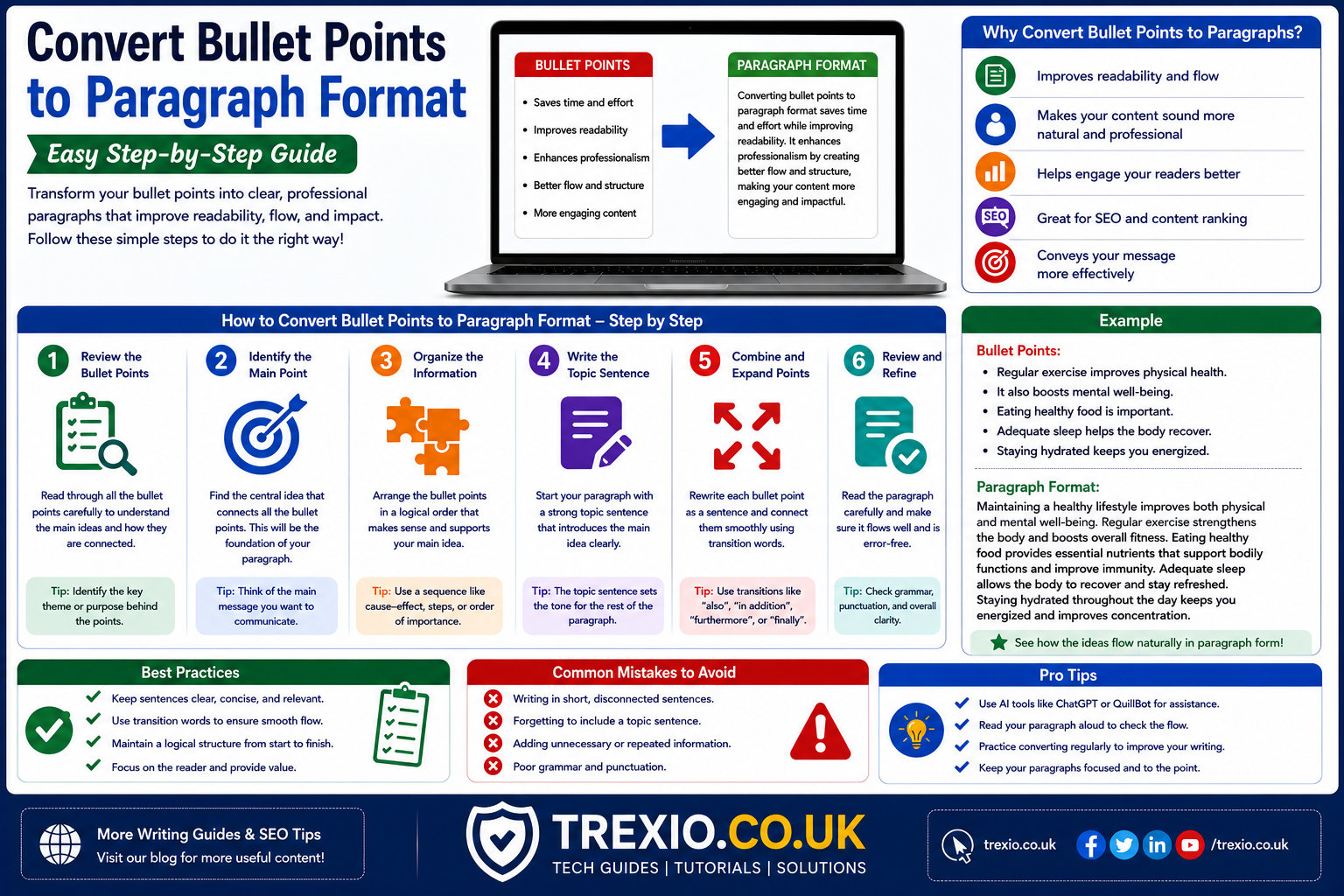
Many people organize information using bullet points because they are easy to scan and understand. While bullets work well for presentations, notes, checklists, and outlines, they are not always suitable for formal writing. Academic assignments, business reports, blog posts, research papers, and professional documents often require complete paragraphs instead of lists. Learning how to convert bullet points to paragraph format helps you create smoother, more engaging, and professional content. Instead of presenting disconnected ideas, paragraphs connect information logically, making it easier for readers to understand your message. Whether you’re a student, content writer, marketer, or office professional, mastering this writing skill can significantly improve your communication. This guide explains every important aspect of convert bullet points to paragraph format, including practical examples, formatting tips, and common mistakes to avoid. By following these techniques, you can turn short notes into polished, reader-friendly paragraphs that meet modern writing standards.
Quick Answer
If you want to convert bullet points to paragraph format, begin by identifying the main topic, arrange the bullet points in a logical order, connect related ideas with transition words, remove unnecessary repetition, and rewrite each point into complete, grammatically correct sentences. Finally, combine those sentences into a cohesive paragraph that flows naturally from beginning to end while maintaining the original meaning.
Why Convert Bullet Points to Paragraph Format?
Bullet points are excellent for summarizing information quickly, but they often lack detail, transitions, and context. In many professional and academic situations, readers expect complete paragraphs that explain ideas thoroughly rather than simply listing them. Knowing how to convert bullet points to paragraph format allows you to present information in a way that feels more natural and persuasive. Paragraphs guide readers through your ideas, helping them understand relationships between concepts instead of interpreting isolated statements. This writing style also demonstrates stronger communication skills because it shows that you can organize information logically rather than relying on fragmented notes. Search engines also tend to favor comprehensive, well-written content over pages made up entirely of lists, making paragraph writing beneficial for SEO. Whether you’re preparing documentation, articles, reports, or client proposals, paragraph formatting creates a more polished impression. Overall, converting bullets into paragraphs enhances readability, professionalism, and reader engagement.
Benefits of Converting Bullet Points into Paragraphs
Improved Readability
Readers generally understand complete explanations more easily than isolated bullet points. A paragraph naturally introduces ideas, develops them with supporting details, and concludes them logically. This organized structure improves comprehension and encourages readers to stay engaged throughout the content. Instead of jumping between separate points, readers experience a smoother flow of information. This is particularly useful in educational writing, technical documentation, and long-form articles where context is essential. Learning to convert bullet points to paragraph format ensures your ideas remain connected and meaningful. As a result, readers spend less effort interpreting fragmented notes and more time understanding your message.
Better Professional Appearance
Business documents, proposals, legal reports, and academic papers typically require paragraphs rather than bullet-heavy formatting. Paragraphs create a polished appearance that reflects professionalism and attention to detail. Clients, professors, managers, and colleagues often associate complete writing with stronger communication skills. When you convert bullet points to paragraph format, your work appears more refined and suitable for formal environments. Well-structured paragraphs also demonstrate that you’ve fully developed your ideas instead of simply listing them. This increases your credibility and improves the overall quality of your document. Professional writing standards almost always favor coherent paragraphs for detailed explanations.
Enhanced SEO Performance
Content written primarily in paragraph form often performs better in search engines because it provides more context, semantic relevance, and detailed information. Search engines analyze sentence relationships, topic depth, and natural language usage to understand page quality. When you convert bullet points to paragraph format, you naturally include transition words, supporting details, and related keywords that strengthen topical authority. Longer paragraphs also help answer user intent more effectively than short lists alone. Although bullet points remain useful for summaries, balanced paragraph content contributes to stronger SEO performance. This is especially important for blogs, guides, tutorials, and informational websites seeking higher search rankings.
When Should You Convert Bullet Points to Paragraph Format?
Academic Writing
Schools, colleges, and universities usually expect assignments to be written in paragraph form unless instructors specifically request lists. Essays, research papers, case studies, and reports require complete explanations supported by evidence and logical reasoning. Students who know how to convert bullet points to paragraph format can transform rough notes into polished academic writing much more efficiently. Rather than presenting disconnected facts, paragraphs demonstrate critical thinking and organized analysis. Professors also evaluate clarity, coherence, and writing quality, all of which improve through paragraph formatting. Additionally, proper paragraph development helps satisfy grading criteria related to organization and communication skills. Academic success often depends on presenting ideas clearly rather than simply listing information.
Business Communication
Professional emails, project reports, company documentation, proposals, and client communications often require detailed explanations instead of bullet-only summaries. Although bullet points remain valuable for highlighting key information, the main discussion should usually appear in paragraph form. Employees who consistently convert bullet points to paragraph format communicate more effectively with clients, executives, and coworkers. Complete paragraphs reduce misunderstandings by providing additional context and smoother transitions between ideas. They also demonstrate professionalism and thoughtful organization. Whether writing performance reports or project updates, paragraph formatting creates a stronger impression. Businesses value communication that is both informative and easy to understand.
Blog Writing
Successful blog articles balance bullet points with informative paragraphs. While lists improve scannability, search engines and readers also expect detailed explanations that answer questions comprehensively. Bloggers who regularly convert bullet points to paragraph format create richer content that satisfies user intent more effectively. Detailed paragraphs naturally incorporate related keywords, supporting examples, and transition phrases that improve both readability and SEO. Readers also appreciate content that explains concepts instead of simply listing them. Combining concise lists with well-developed paragraphs results in engaging, authoritative blog posts. This balanced writing style supports better rankings and higher reader satisfaction.
Understanding the Difference Between Bullet Points and Paragraphs
Bullet Points
Bullet points present information in a concise, easy-to-scan format. They emphasize key ideas without extensive explanation, making them ideal for presentations, meeting notes, feature lists, checklists, and quick summaries. Each bullet typically contains a single idea, allowing readers to locate important information quickly. However, bullet points often omit transitions, detailed reasoning, and contextual information. While they improve readability in short documents, relying exclusively on bullets can make longer content feel incomplete. Writers frequently begin with bullet-point outlines before expanding them into complete paragraphs. Understanding this purpose makes it easier to convert bullet points to paragraph format effectively.
Paragraphs
Paragraphs organize related ideas into complete, connected discussions. Each paragraph usually begins with a topic sentence, develops the main idea through supporting details, and concludes naturally before transitioning to the next section. Unlike bullet points, paragraphs explain relationships between ideas instead of simply listing them. This structure encourages readers to follow your reasoning from one sentence to the next. When you convert bullet points to paragraph format, you transform fragmented information into a cohesive narrative that improves understanding. Paragraphs also create a more conversational and engaging reading experience. Most formal documents rely primarily on paragraphs because they provide depth, clarity, and logical flow.
Step-by-Step Process to Convert Bullet Points to Paragraph Format
Step 1: Read Every Bullet Carefully
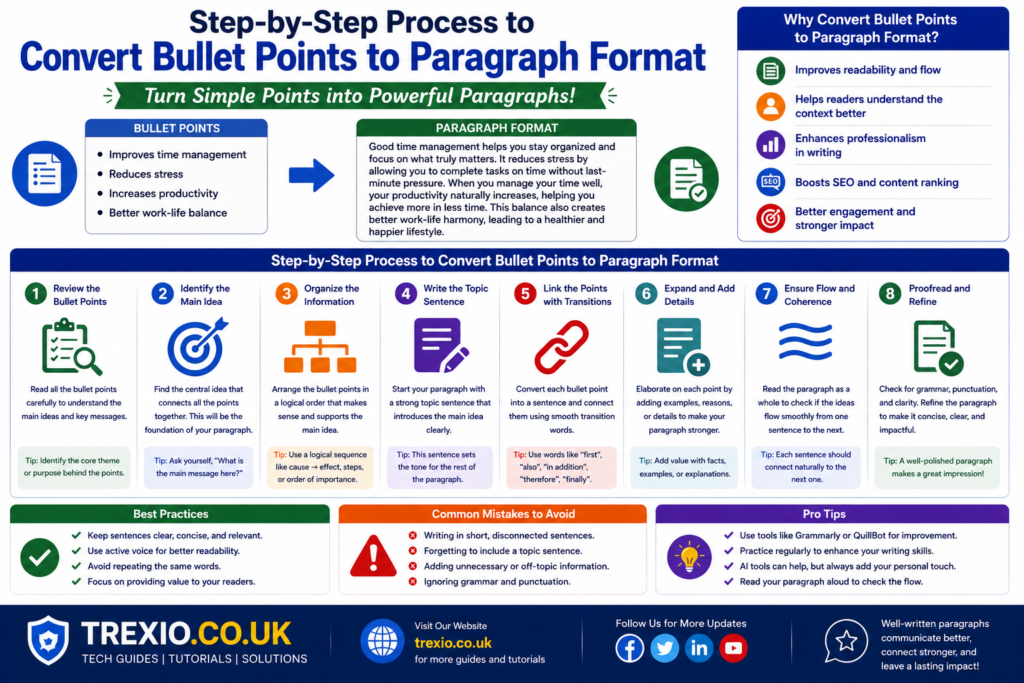
Before rewriting anything, examine each bullet point to understand its purpose and relationship to the surrounding information. Many bullet lists contain abbreviated phrases rather than complete thoughts, so it’s important to identify the intended meaning before expanding them into sentences. Consider which point introduces the topic, which ones provide supporting information, and which point concludes the discussion. Understanding this structure prevents accidental omission of important details during the conversion process. It also helps you identify duplicated information that can be combined into a single sentence. Taking time to analyze the original list results in clearer, more accurate paragraphs. This careful preparation forms the foundation of successful convert bullet points to paragraph format techniques.
Example Bullet List
- Improve productivity
- Save time
- Increase efficiency
- Reduce repetitive tasks
Converted Paragraph
Automation helps improve productivity by reducing the amount of manual work required to complete routine tasks. It saves valuable time, allowing employees to focus on more meaningful responsibilities that contribute to business growth. As repetitive activities become automated, overall efficiency increases because processes are completed more consistently and accurately. These improvements not only streamline daily operations but also enhance overall workplace performance.
Step 2: Identify the Main Topic
Every paragraph should revolve around a single central idea. Before combining bullet points, determine the primary message you want readers to understand. Supporting details should naturally expand upon that main topic instead of introducing unrelated concepts. This approach creates stronger organization and prevents confusing transitions between ideas. When learning how to convert bullet points to paragraph format, identifying the topic sentence is one of the most valuable skills you can develop. Once the central idea is established, every following sentence should reinforce or explain it. This method creates focused, coherent paragraphs that are easy to read and understand.
Step 3: Arrange the Information Logically
Bullet points may not always appear in the best reading order. Before converting them into paragraphs, reorganize the ideas into a logical sequence that introduces the topic, develops supporting details, and concludes naturally. Readers should never feel as though information jumps randomly between unrelated concepts. Smooth organization improves comprehension and creates a more enjoyable reading experience. When you convert bullet points to paragraph format, logical sequencing is just as important as sentence construction. Proper organization allows transition words and connecting phrases to flow naturally between ideas. Well-arranged paragraphs communicate information more effectively and leave a stronger impression.
Step 4: Expand Each Bullet into Complete Sentences
Once the ideas are organized, begin expanding each bullet into complete, meaningful sentences. A bullet often contains only a keyword or short phrase, so you need to explain what it means and why it matters. Start with a topic sentence, then add supporting details, examples, or explanations that naturally develop the idea. Use clear grammar and proper punctuation throughout the paragraph. Avoid simply copying the bullet text into sentence form without adding value, as this can make the writing feel repetitive and unnatural. When you convert bullet points to paragraph format, your goal is to provide context that helps readers understand the information without guessing its meaning. Well-developed sentences also improve readability and demonstrate stronger writing skills. This step transforms a basic outline into polished, informative content that is suitable for academic, professional, and online writing.
Example
Bullet Points
- Faster communication
- Better collaboration
- Easier file sharing
- Improved productivity
Paragraph
Modern collaboration tools improve workplace communication by allowing team members to exchange information quickly and efficiently. They also encourage better collaboration because employees can work together in real time, regardless of their location. Built-in file-sharing features simplify document management and reduce the need for multiple email attachments. As a result, organizations often experience improved productivity and smoother project execution.
Step 5: Add Transition Words
Transition words are essential when you convert bullet points to paragraph format because they connect ideas naturally. Words such as first, next, therefore, however, in addition, for example, meanwhile, and finally guide readers from one sentence to the next. Without transitions, paragraphs may sound like disconnected statements rather than a cohesive discussion. Effective transitions improve readability and help readers understand the relationship between ideas. They also create a conversational flow that feels more engaging. Professional writers use transitions strategically instead of inserting them randomly. Choosing the right transition depends on whether you are adding information, contrasting ideas, explaining a result, or providing an example. Mastering this technique makes paragraph writing significantly more polished.
Common Transition Words
| Purpose | Examples |
|---|---|
| Adding Information | Additionally, Furthermore, Moreover, Also |
| Showing Order | First, Next, Then, Finally |
| Giving Examples | For example, For instance, Such as |
| Showing Cause | Therefore, As a result, Consequently |
| Showing Contrast | However, Although, On the other hand |
Step 6: Review and Edit the Paragraph
Editing is the final step after you convert bullet points to paragraph format. Carefully read the paragraph aloud to check whether it flows naturally and sounds conversational. Look for repeated words, awkward phrasing, grammar mistakes, punctuation errors, or missing transitions. Verify that every sentence supports the main idea and that the paragraph stays focused on one topic. Remove unnecessary repetition while keeping important details intact. If possible, ask another person to review the writing for clarity and readability. Editing also gives you the opportunity to improve sentence variety by mixing short and long sentences. A carefully edited paragraph always appears more professional than a first draft.
Examples of Converting Bullet Points into Paragraphs
Example 1: Student Notes
Bullet Points
- Renewable energy reduces pollution.
- Solar power is sustainable.
- Wind energy lowers emissions.
- Governments encourage green energy.
Paragraph
Renewable energy plays an important role in reducing environmental pollution and supporting long-term sustainability. Solar power provides a clean source of electricity that can be used for many years without depleting natural resources. Wind energy also helps lower greenhouse gas emissions by replacing fossil fuel-based electricity generation. Because of these environmental benefits, many governments encourage the adoption of green energy through financial incentives, research funding, and public awareness campaigns.
Example 2: Meeting Notes
Bullet Points
- Project completed early.
- Budget remained under target.
- Client approved final design.
- Launch scheduled next month.
Paragraph
The project was completed ahead of schedule while remaining within the approved budget, demonstrating effective planning and resource management. After reviewing the final design, the client provided full approval without requesting major revisions. With development now complete, the team has shifted its focus toward preparing for the official launch next month. This successful outcome highlights the value of clear communication and efficient teamwork throughout the project.
Comparison Table Bullet Points vs Paragraph Format
| Feature | Bullet Points | Paragraph Format |
|---|---|---|
| Readability | Quick scanning | Detailed reading |
| Best For | Lists, notes, presentations | Reports, blogs, essays |
| Detail Level | Low | High |
| Context | Limited | Comprehensive |
| Flow | Fragmented | Smooth and connected |
| SEO Value | Moderate | Higher for long-form content |
| Professional Appearance | Good for summaries | Better for formal documents |
| Reader Engagement | Medium | High |
| Explanation | Minimal | Complete |
| Writing Style | Concise | Narrative and informative |
Best Practices for Converting Bullet Points to Paragraph Format
Keep One Main Idea per Paragraph
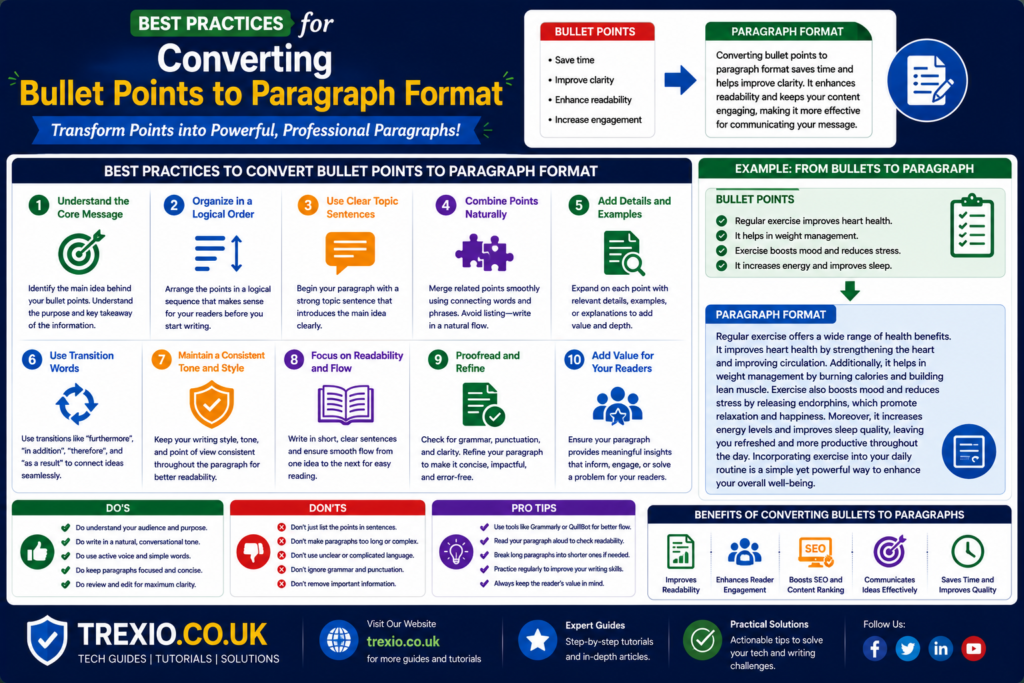
Each paragraph should focus on a single topic that readers can easily follow. Combining unrelated ideas into one paragraph often creates confusion and weakens the overall structure. A clear topic sentence followed by supporting details helps maintain logical organization. Readers appreciate content that develops one concept at a time instead of jumping between multiple subjects. This approach also improves comprehension and keeps the writing focused. Whether you are writing a report, article, or assignment, one central idea per paragraph remains an important writing principle. Applying this consistently will make every attempt to convert bullet points to paragraph format more effective. Strong organization reflects professionalism and improves reader satisfaction.
Use Natural Language
Avoid making the paragraph sound like a direct copy of the original bullet list. Instead, rewrite the information using natural, conversational language that flows smoothly. Readers should not feel that they are reading expanded notes. Vary sentence structure, use transition words, and include supporting explanations where appropriate. This makes the content more engaging and enjoyable to read. Natural language also aligns with Google’s Helpful Content principles by prioritizing the reader rather than search engines. A human-centered writing style builds trust and authority. The more naturally you write, the more valuable your content becomes.
Preserve the Original Meaning
Expanding bullet points should never change the intended message. Add supporting details only when they accurately reflect the original information. Avoid introducing unrelated facts or opinions that were not part of the source material. Maintaining accuracy is especially important in academic, legal, medical, and business writing. Readers depend on the writer to communicate information faithfully. Always compare the completed paragraph with the original bullets to ensure consistency. Accuracy strengthens credibility and supports EEAT principles. A well-written paragraph explains ideas without altering their meaning.
Common Mistakes to Avoid
Writing Extremely Long Paragraphs
One of the most common mistakes is combining too many bullet points into a single oversized paragraph. Long blocks of text overwhelm readers and reduce readability, especially on mobile devices. Instead, divide information into multiple paragraphs whenever a new subtopic begins. This improves visual appeal and helps readers absorb information more easily. Shorter paragraphs also encourage users to continue reading. Balance detail with readability for the best results. Well-structured content always performs better than dense, unbroken text. Remember that organization is just as important as grammar.
Ignoring Logical Flow
Another mistake is rewriting each bullet independently without considering how the ideas connect. This often produces paragraphs that feel choppy or repetitive. Arrange ideas in a logical sequence before writing complete sentences. Add transitions that show relationships between concepts and create smooth movement from one point to another. Logical flow improves comprehension and keeps readers engaged. Planning before writing saves time during editing. Organized thinking leads to organized writing. Strong flow is one of the defining features of quality paragraphs.
Overusing Transition Words
Although transitions improve readability, using them excessively can make writing sound artificial. Not every sentence requires a transition phrase. Instead, insert them only where they genuinely improve clarity or show a relationship between ideas. Variety also matters, so avoid repeating the same transition throughout the paragraph. Balanced use creates a natural rhythm that readers appreciate. Good writing feels effortless rather than forced. Read your paragraph aloud to identify unnecessary transitions. Simplicity often produces the strongest results.
Pro Tips
Start with an Outline
Creating a simple outline before writing helps organize ideas and reduces editing time. Even a short list of main points can guide the structure of the final paragraph.
Read the Paragraph Aloud
Reading aloud quickly reveals awkward wording, repetitive phrases, and missing transitions that may be overlooked during silent reading.
Use Active Voice
Active voice makes writing clearer, more direct, and easier to understand. It also improves engagement and creates a more confident tone.
Edit After a Short Break
Taking a brief break before proofreading helps you notice mistakes more easily. Fresh eyes often identify issues that were missed during drafting.
Use AI Responsibly
AI writing tools can help convert bullet points to paragraph format, but always review the output for accuracy, tone, grammar, and originality. Human editing remains essential for producing trustworthy, high-quality content.
Conclusion
Learning how to convert bullet points to paragraph format is an essential writing skill for students, professionals, content creators, and business teams. While bullet points are excellent for organizing ideas and presenting quick summaries, complete paragraphs provide the explanation, context, and logical flow that readers expect in formal writing. By identifying the main idea, organizing information logically, expanding each point into complete sentences, adding transitions, and carefully editing the final draft, you can create polished content that is both engaging and professional. This approach not only improves readability but also strengthens communication, enhances SEO performance, and aligns with Google’s EEAT and Helpful Content guidelines. Whether you are preparing an academic paper, business proposal, blog article, or technical document, mastering this skill will help you communicate ideas more effectively and leave a stronger impression on your audience.
Frequently Asked Questions
1. What does it mean to convert bullet points to paragraph format?
It means rewriting a list of bullet points into complete, connected sentences that form a logical and cohesive paragraph while preserving the original meaning.
2. Why is paragraph format preferred in formal writing?
Paragraphs provide context, improve readability, demonstrate logical thinking, and meet the formatting standards used in academic and professional documents.
3. Can I keep some bullet points in an article?
Yes. Bullet points are useful for summaries, checklists, and comparisons. However, the main explanations should usually be written in paragraph form.
4. How do I keep the original meaning when rewriting?
Read each bullet carefully, identify its purpose, and expand it without adding unrelated information or changing the intended message.
5. What transition words should I use?
Common choices include first, next, however, therefore, for example, in addition, meanwhile, and finally.
6. Is paragraph format better for SEO?
Yes. Detailed paragraphs provide more context, naturally include related keywords, and better satisfy user intent, which can improve search visibility.
7. Can AI tools convert bullet points into paragraphs?
Yes. Many AI tools can perform the conversion, but the output should always be reviewed for accuracy, clarity, originality, and tone.
8. How long should a paragraph be?
The ideal length depends on the audience and purpose, but most online paragraphs contain three to six sentences for easier reading, while academic writing may use longer paragraphs.
9. What types of documents benefit from paragraph formatting?
Essays, reports, research papers, blog posts, proposals, business emails, manuals, and case studies all benefit from well-developed paragraphs.
10. What is the biggest mistake when converting bullet points?
The biggest mistake is simply turning each bullet into a sentence without creating logical flow, adding context, or connecting ideas naturally.
Author Bio
About the Author
The author is an experienced SEO content writer and technical writing specialist with expertise in creating high-quality educational content, business documentation, and digital marketing resources. With a strong focus on Google’s EEAT principles and Helpful Content guidelines, the author produces clear, practical, and reader-focused articles that simplify complex topics while maintaining accuracy, originality, and search engine optimization.