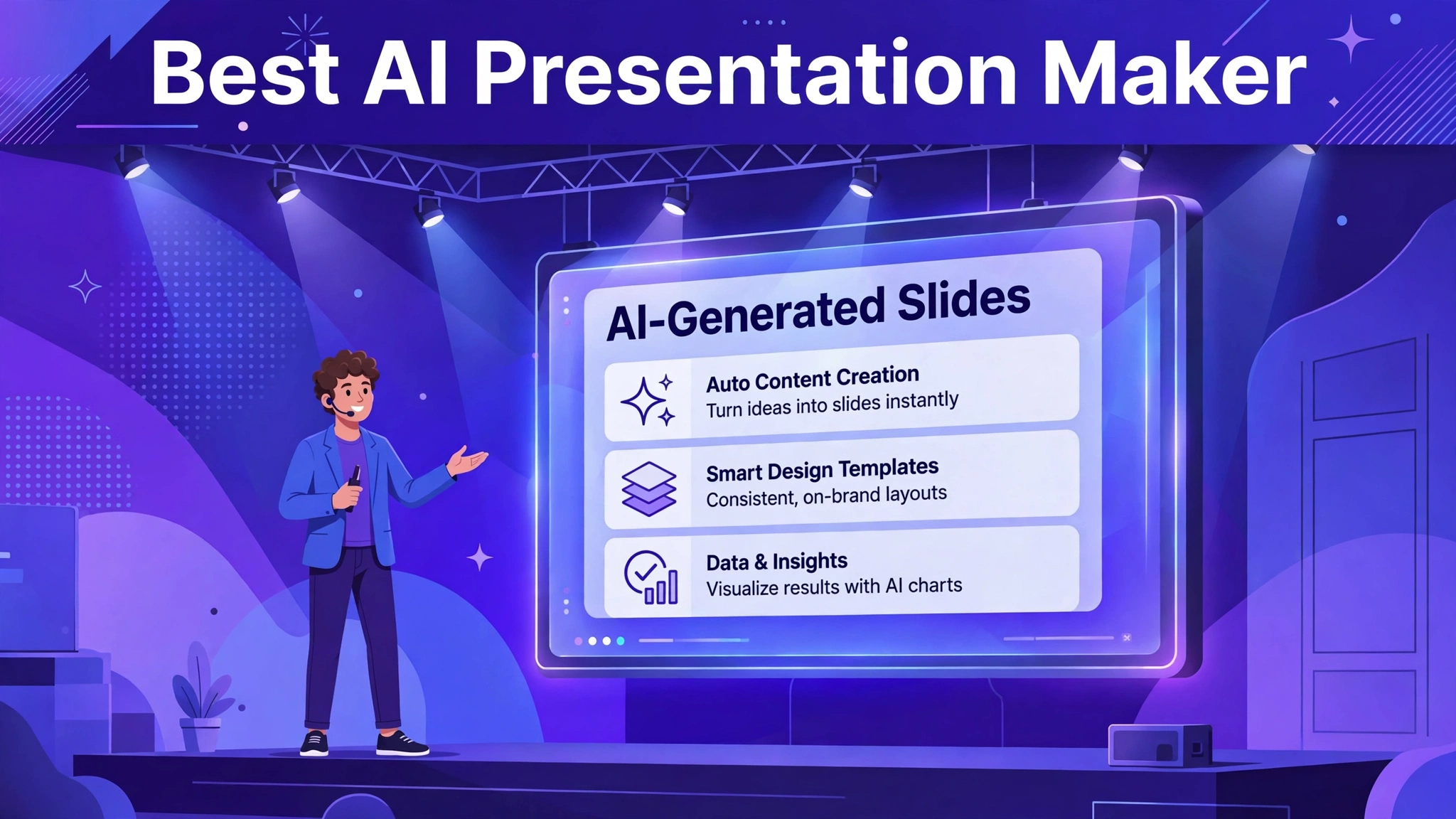
Building a presentation used to mean hours of blank slides, mismatched fonts, and layouts that never lined up. AI presentation makers change that completely: you type a prompt or paste a document, and the tool generates a full deck with titles, talking points, and designed slides in minutes.
Finding the best AI presentation maker depends on what you need: a quick free deck for class, a polished investor pitch, or slides your team edits together. Below, we review seven AI presentation tools with verified free plans or trials in 2026. Here is what each one does best.
What an AI Presentation Maker Actually Does
An AI presentation maker turns your words into slides. You give it a topic, a prompt, or an existing document, and it generates a structured deck with slide titles, content, and suggested visuals. The better tools handle design automatically too, choosing layouts, colors, and images so the deck looks professional without manual formatting.
Keep expectations realistic. These tools are excellent at producing structured first drafts quickly, often turning hours of work into minutes. They are not a replacement for a designer: longer decks can look repetitive, the imagery is usually generic stock, and any data points still need a human to verify them.
The practical approach is to treat the AI as a first-draft accelerator. Let it build the skeleton, then spend fifteen to sixty minutes refining the content, fixing the design, and checking the facts. Used this way, an AI presentation maker genuinely saves time on almost every deck.
Gamma: The Fastest Free AI Presentation Maker
Gamma is the best-known AI presentation maker, and its free tier is the most generous in the category. New accounts get 400 one-time AI credits, roughly ten full presentations, and you can publish decks to the web without paying. Generation is fast: a detailed prompt becomes a clean, modern deck in under a minute.
Design quality is Gamma’s biggest strength. Decks look contemporary by default, and the built-in AI assistant makes it easy to rewrite or restyle individual slides after generation. The catch is that free decks carry a small “Made with Gamma” badge, and PowerPoint exports are reserved for paid plans, which start at about $10 per month.
Gamma is the obvious first stop for trying an AI presentation maker for free. Just remember the 400 credits are a one-time grant, not a monthly refresh, so they will run out with heavy use.
Canva Magic Design: Best for Visual Decks
Canva’s Magic Design brings AI generation into the design platform millions of people already use. Describe your presentation and it produces designed slides you can edit with Canva’s huge template library and visual assets. The free plan includes a limited number of AI uses per month, enough for occasional decks.
The real advantage is creative control. Unlike prompt-to-deck tools that lock you into their layouts, Canva lets you rearrange everything with drag and drop, apply your brand kit, and pull from millions of photos and icons. Students also get an expanded free education plan covering multiple semester projects.
The downside is that the AI does less of the thinking for you, so expect more manual arranging than with Gamma. Free users can download decks as PDFs or share them via link. If you already live in Canva, Magic Design is the path of least resistance.
SlidesAI: Best for Google Slides Users
SlidesAI works as an add-on inside Google Slides and PowerPoint, which makes it unique on this list. Instead of generating decks on a separate website, it turns your pasted text into real, editable slides right where you already work. The free plan includes 12 presentations per year, making it the most sustainable long-term free option for light users.
Because the output lives natively in Google Slides, there are no export headaches or compatibility surprises. Your team can comment, edit, and present exactly as with any other deck. The design is simpler than Gamma’s, but the slides are clean and ready to present after light editing.
The yearly quota suits people who make a few decks per year rather than weekly presenters. If your workflow already centers on Google Slides and you want AI help without changing tools, it fits perfectly.
Visme: Best for Large Free Projects
Visme’s free plan stands out for sheer capacity: unlimited projects with up to 50 slides each, which dwarfs the credit-based limits of most rivals. It is a full visual design platform with AI-assisted generation, templates, charts, and interactive elements, suiting bigger decks like course materials or company overviews.
The generous slide allowance makes Visme the best free pick for long presentations. You will not hit a credit wall halfway through a forty-slide training deck. The trade-off is that published content on the free plan carries Visme branding, fine for internal or classroom use but less ideal for client pitches.
Visme is also stronger on data visualization than most AI presentation makers, with built-in charts and infographic tools. If your priority is making many slides for free and you can live with the branding, it is hard to beat.
Pitch: Best for Team Collaboration
Pitch is built for teams that create presentations together. The free plan supports up to five team members with unlimited presentations and a one-time grant of 100 AI credits for generation. Comments, version history, and link-based sharing are included, so the whole review process happens in one place.
The collaborative workflow is what sets Pitch apart. Multiple people can work on a deck at once, leave feedback on specific slides, and track changes without emailing files back and forth. For startups and small teams iterating on pitch decks together, this saves real time.
The 100 AI credits are one-time, and free exports carry a Pitch logo. Paid plans start at about $12 per month for more credits and clean exports. Solo presenters may prefer Gamma or Canva, but for team-built decks, Pitch is the strongest free option.
Beautiful.ai: Best for Polished Corporate Slides
Beautiful.ai takes a different approach: instead of generating content from a prompt, it enforces good design automatically. Its Smart Slides rebalance layouts as you add content, so text never overflows and spacing always looks intentional. The result is consistently polished corporate slides with minimal design effort.
There is no permanent free tier, which is the main caveat. Beautiful.ai offers a 14-day trial that requires a credit card, and paid plans start at $14.50 per month on annual billing. That makes it the priciest option here, aimed at professionals and teams rather than casual users.
For business presentations where brand consistency matters, the design discipline is worth it. If you only need a deck occasionally or you are on a tight budget, the free options above will serve you better. Beautiful.ai is for people who present often and want every deck to look sharp.
Plus AI: Best for Native PowerPoint Files
Plus AI generates presentations directly inside Google Slides and PowerPoint, solving the biggest pain point in this category: export fidelity. Decks from web-native tools often break when converted to PowerPoint, with shifted layouts and missing fonts. Plus AI avoids the problem entirely because the file is native from the start.
The trade-off is pricing. There is no free plan, only a 7-day trial, and paid plans start at $15 per month, or $10 per month on annual billing. That positions Plus AI as a professional tool for people whose deliverable must be a real PowerPoint file, such as consultants and corporate teams.
If your company runs on PowerPoint and you cannot afford formatting surprises, Plus AI is worth the trial. For everyone else, the free tiers of Gamma, Canva, or SlidesAI will get you further without spending anything.
How to Choose the Right AI Presentation Maker
Start with your export needs, because they decide this category more than AI quality does. If your deck must be an editable PowerPoint file, pick a tool that generates natively. If a web link or PDF works, you have far more free options.
Next, check how the free plan actually works. A one-time credit grant is a trial wearing a different name, while a monthly refresh or yearly quota lasts longer. Also look for watermarks and branding on free exports, which matter for client work but rarely for internal updates.
Finally, match the tool to how you work. Solo creators do well with Gamma or Canva, Google Slides loyalists should try SlidesAI, and teams should look at Pitch. Test two tools with the same prompt and keep the one whose output needs the least editing.
If inbox overload is also on your list, read our review of the best AI email writer free for 2026. And if you need short videos to go with your decks, don’t miss our guide to the best AI video generator.
For most people in 2026, the best AI presentation maker is Gamma, thanks to its generous free tier and fast, clean output. Canva wins for visual control, SlidesAI for Google Slides users, Visme for big free projects, and Pitch for teams. Let the AI draft, then spend a few minutes editing and fact-checking. That combination beats either approach alone.