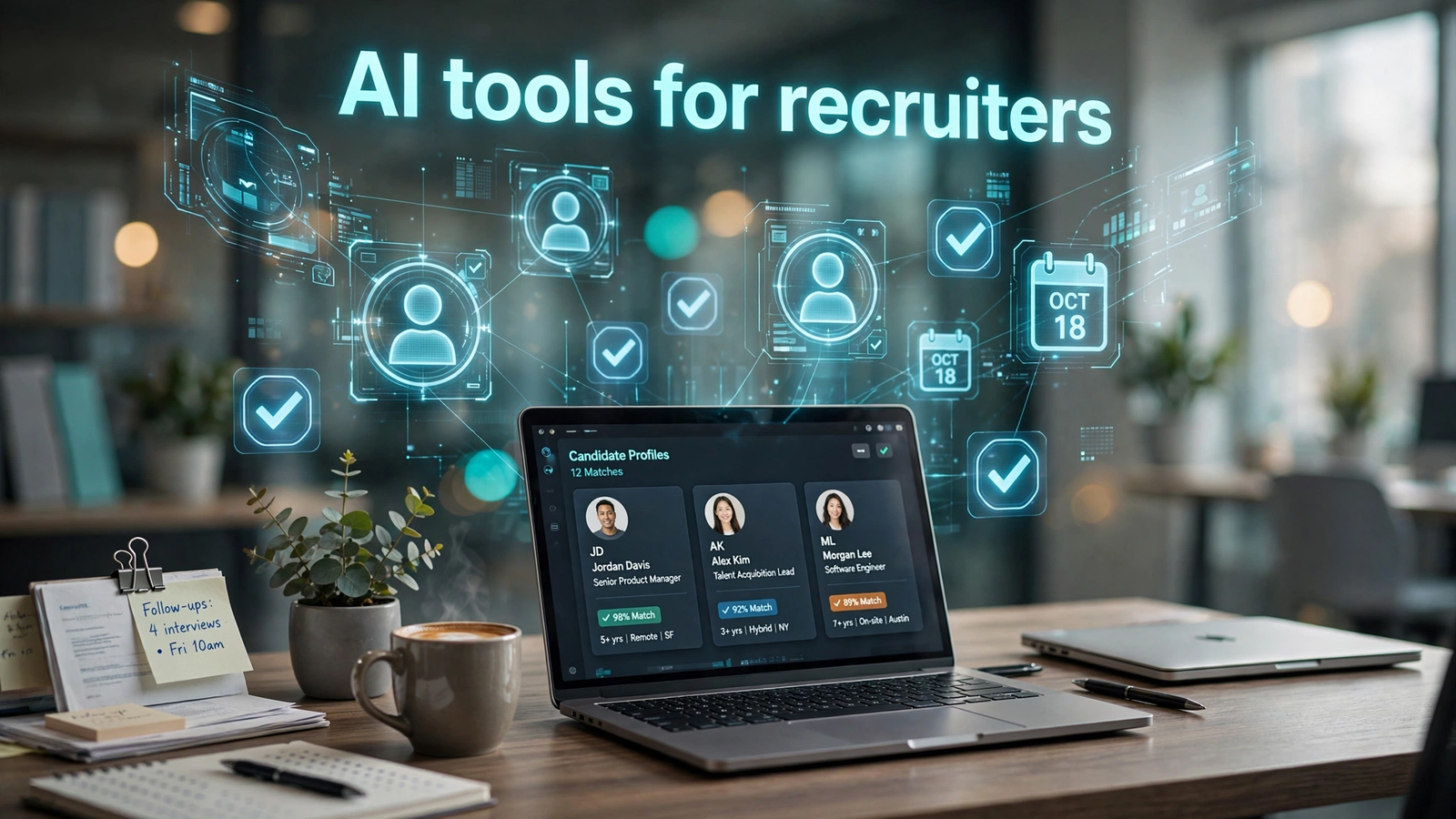
Recruiting has always been a race against time and information, and in 2026 AI is changing how that race is run. AI tools for recruiters now find passive candidates, screen resumes, schedule interviews, and write job descriptions. Surveys suggest well over half of recruiters use some form of AI, up sharply from a few years ago. The question is no longer whether to use AI, but which tools genuinely improve hiring. This guide covers the tools worth your attention, with real pricing and honest trade-offs.
Why Recruiters Cannot Afford to Ignore AI in 2026
The math behind AI recruiting is hard to argue with. Benchmarks report AI workflows can cut average time-to-hire from around thirty-six days to roughly twenty-three. Meanwhile application volumes keep rising, partly because job seekers use AI tools of their own. Manual screeners are drowning while AI-assisted teams process the same volume far faster. The question is not whether AI belongs in recruiting, but how fast you can adopt it responsibly.
There is also a quality argument. Modern AI tools for recruiters go beyond keyword matching: they analyze skills, career trajectories, and context to surface candidates a human search might miss. Businesses using AI for matching report better accuracy — meaning less turnover and stronger hires. Nothing replaces recruiter judgment; the best teams treat AI as a tireless assistant. But ignoring these tools in 2026 is like refusing email in 2005.
SeekOut: Deep Sourcing Across a Billion Profiles
When your biggest problem is finding people rather than filtering applicants, SeekOut is among the strongest AI tools for recruiters in 2026. It indexes more than a billion professional profiles and matches candidates against your requirements with unusual depth — technical skills, diversity signals, even candidates already in your ATS. Its entry tier, Recruit Lite, costs around two thousand dollars per year, putting it within reach of solo recruiters and small agencies.
What sets SeekOut apart is talent-intelligence quality. Instead of returning everyone with a matching keyword, it weighs skills, experience depth, and engagement likelihood, so outreach lists are shorter and more relevant. It also supports structured, skills-based evaluation for compliance-conscious hiring. The trade-off: it is a sourcing specialist, not a scheduler or pipeline manager. Paired with a solid ATS, it becomes the discovery engine of an effective hiring stack.
HireEZ and Juicebox: Search for Candidates in Plain English
One of the most practical advances in AI recruiting is natural-language search: describe your ideal candidate in plain English and let AI search hundreds of millions of profiles. Juicebox, built on its PeopleGPT engine, is a leading example — recruiters type what they need as if explaining it to a colleague, and get ranked candidates with AI-generated summaries. At around one hundred dollars per seat per month with dozens of ATS integrations, it delivers speed without complex search syntax. Agencies love how fast a vague brief becomes a shortlist.
HireEZ takes a similar approach, sourcing across more than seven hundred and fifty million profiles on dozens of platforms, with an automation mode handling outreach sequences. Solo plans start at several hundred dollars per month. It excels at outbound recruiting: finding passive candidates, personalizing first messages, and warming pipelines. Juicebox wins on search simplicity; HireEZ offers deeper automation. Choose based on whether your bottleneck is finding people or engaging them.
Both reflect a broader shift: sourcing is becoming conversational. Instead of Boolean strings, recruiters describe outcomes and let AI build the query — lowering the barrier for newcomers and speeding up veterans. The caution remains: verify candidates yourself, since no model understands your hiring bar perfectly. As a first pass, plain-English sourcing is among the highest-leverage AI tools for recruiters today.
Paradox and Olivia: Conversational AI for High-Volume Hiring
If you hire hourly or frontline workers at scale, your bottleneck is rarely sourcing — it is the endless back-and-forth of screening and scheduling. Paradox, whose assistant Olivia talks to candidates over text message, is built for exactly this. Candidates apply, answer screening questions, and book interviews in one chat, often within minutes and outside office hours. For retailers, restaurants, warehouses, and clinics hiring hundreds, conversational AI removes the friction that loses candidates to faster competitors.
The results explain its adoption: faster scheduling, fewer no-shows, and recruiters freed from calendar ping-pong. Pricing is custom and enterprise-oriented with a meaningful floor — not a casual purchase for a ten-person startup. But where hiring volume is the constraint, conversational AI scheduling pays for itself quickly. It shows AI tools for recruiters delivering value not through smarter search, but by removing operational drag.
Greenhouse and Ashby: The AI-Native ATS Backbone
Every recruiting stack needs a system of record, and in 2026 the ATS itself has become an AI tool. Greenhouse is now an AI-native platform generating interview questions against team rubrics, running AI-assisted phone screens, and forecasting offer outcomes — inside the structured workflow mid-market and enterprise teams trust. Pricing is custom, with small-team plans estimated in the several-thousand-dollar annual range. For AI woven through every stage, Greenhouse is the established choice.
Ashby offers startups and mid-market companies one system combining ATS, CRM, scheduling, and analytics with AI throughout. It is a favorite among fast-growing tech firms wanting one platform instead of five subscriptions, with pricing gated by company size. The lesson from both: AI works best where recruiters already work — inside the system of record, not in a forgotten tab.
The choice comes down to stage and philosophy. Greenhouse suits organizations wanting rigorous structured hiring at scale. Ashby suits teams wanting speed and consolidation. Either way, modernizing the ATS is often the highest-impact first step in adopting AI tools for recruiters, since everything else integrates with it.
HireVue: AI Video Interviews and Skills Assessments
For regulated industries and enterprises running high-volume assessments, HireVue remains the reference for AI-assisted video interviewing. Candidates record structured interviews and complete validated skills assessments, with AI evaluating responses consistently against defined criteria. This matters where decisions face legal scrutiny or thousands must be evaluated fairly. Enterprise pricing reflects that, with annual contracts estimated in the tens of thousands of dollars.
HireVue has addressed bias concerns by moving toward static, explainable AI models and third-party validated assessments rather than black-box scoring. That distinction matters: responsible AI tools for recruiters can explain their reasoning and prove fairness. For smaller teams it is more than needed — lighter tools cover video screening far cheaper. But at enterprise scale with compliance on the line, it remains a serious contender.
Workable and Recruiterflow: Practical AI for Growing Teams
Not every team needs enterprise software. Workable, from around three hundred dollars per month, gives SMBs AI-powered sourcing, semantic resume scanning, and AI-written job descriptions in one approachable platform. A fifty-person company can set it up in days: less resume reading, better shortlists, faster outreach. For growing teams taking a first step into AI recruiting, it is one of the most balanced options available.
Recruiterflow, popular with search firms and staffing agencies, focuses AI on ranking candidates, summarizing resumes, and automating pipeline busywork — from around one hundred and nineteen dollars per user per month with strong ratings. Agencies live on speed, and its automation of interview questions, summaries, and follow-ups serves that directly. Together these tools prove some of the best AI value for recruiters sits in the mid-market.
Textio and ChatGPT: Better Job Descriptions and Hiring Content
Some of the highest-return AI in recruiting is not about finding candidates — it is about the words attracting them. Textio analyzes job descriptions and suggests real-time improvements for inclusivity and appeal, drawing on millions of hiring outcomes. Enterprise plans run several thousand dollars per six-month block of postings — steep until you realize a better description widens your entire candidate pool. For companies serious about diversity and quality of hire, it has a clear purpose.
Then there is the tool almost every recruiter already has: ChatGPT. Free to start, twenty dollars monthly for Plus, it drafts job descriptions, interview questions, outreach messages, and onboarding content in seconds. It will not source candidates or run pipelines, but as a writing assistant it punches far above its price. Smart teams combine both: ChatGPT for everyday content, Textio where language measurably affects who applies.
Conclusion: Build an AI Hiring Stack That Fits Your Team
The best AI tools for recruiters in 2026 are not one-size-fits-all — start from your biggest bottleneck. Cannot find candidates? Invest in SeekOut, HireEZ, or Juicebox. Scheduling eats your week? Paradox removes it. Broken process? Greenhouse or Ashby gives an AI-native foundation. Small team? Workable or Recruiterflow delivers practical AI without enterprise overhead. Add Textio or ChatGPT for content, and HireVue only when scale and compliance demand it.
Whatever you choose, keep the human in the loop. AI should inform recruiter judgment, never replace it — audit tools for bias, verify AI shortlists, and remember candidates are people, not profiles. Adopted thoughtfully, these tools make hiring not just faster but fairer and more effective. Pick the tool solving your hardest problem first, measure the difference, and build from there. Creators turning hiring content into video can also use a free AI voice generator to narrate training material.