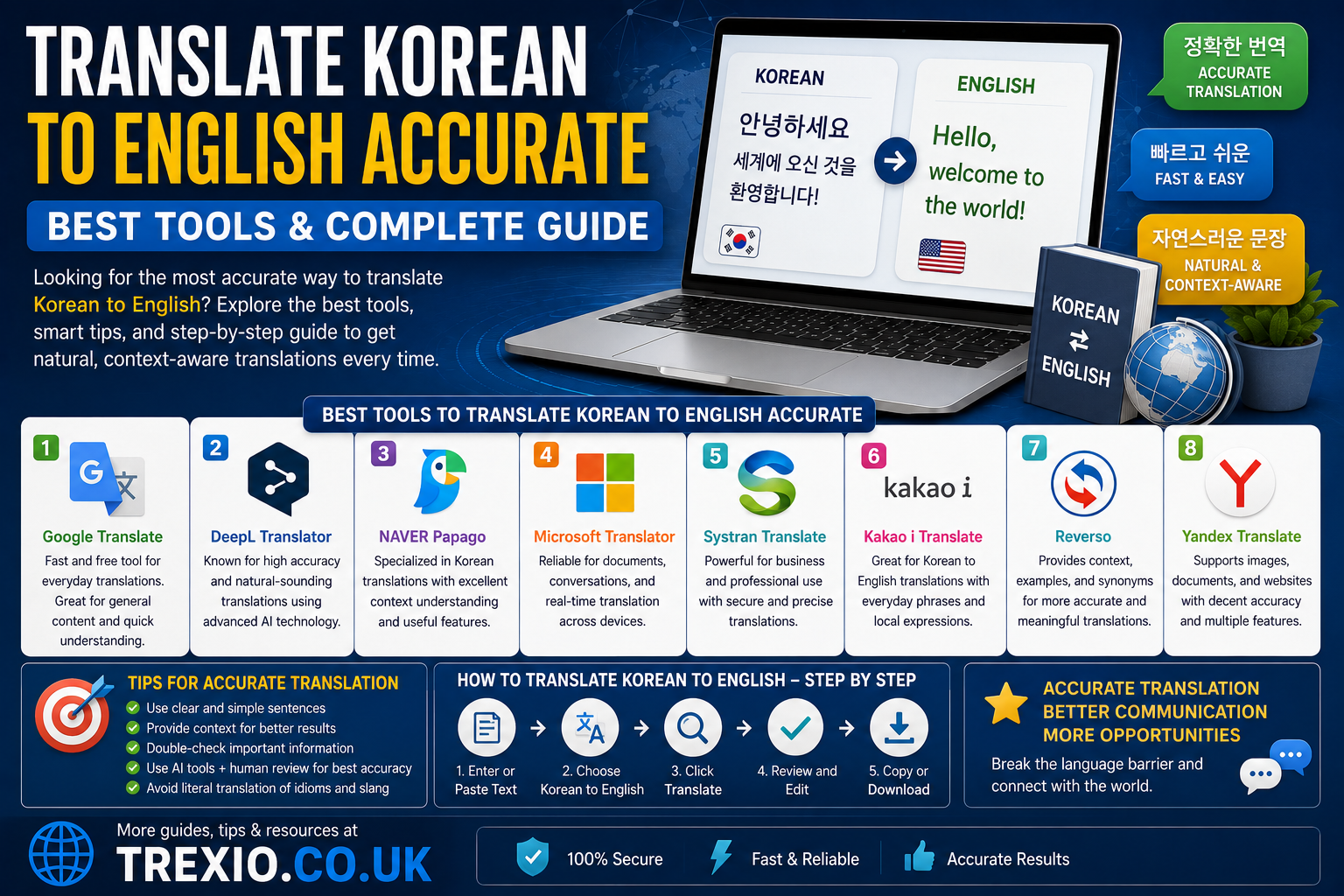
If you’ve ever tried to translate korean to english accurate, you’ve probably noticed that direct word-for-word translation rarely works. Korean grammar, honorifics, cultural expressions, and sentence structure differ greatly from English. Whether you’re translating business documents, K-dramas, webtoons, academic papers, websites, or everyday conversations, choosing the right translation tool can make a significant difference.
Today, AI-powered translation software has dramatically improved. Modern tools use neural machine translation and large language models to translate korean to english accurate while preserving context, tone, and meaning. However, not every translator performs equally well. Some excel in casual conversations, while others are better suited for legal, technical, or professional content.
In this guide, you’ll discover how to translate korean to english accurate, learn what features matter most, compare the leading translation software, and understand how to select the best option for your specific needs.
Quick Summary
If your goal is to translate korean to english accurate, keep these key points in mind:
- AI translation is more accurate than traditional machine translation.
- Context matters more than literal word translation.
- Honorifics and formal speech require specialized translation engines.
- Human editing is still recommended for legal and business documents.
- The best software offers contextual translation, grammar correction, OCR, and speech recognition.
- Choose software based on your translation purpose rather than popularity.
How to Translate Korean to English Accurate
Accurate translation involves much more than replacing Korean words with English equivalents. Korean relies heavily on context, sentence endings, politeness levels, and omitted subjects that English requires explicitly.
To translate korean to english accurate, quality translation software analyzes the complete sentence rather than translating individual words. Modern AI models recognize grammar patterns, idioms, slang, and cultural references, producing translations that sound natural instead of robotic.
Another important factor is understanding the intended audience. A translation suitable for casual conversation may not work well for contracts, business emails, research papers, or technical documentation. Selecting the right translation software significantly improves overall accuracy.
Why Accurate Korean Translation Matters
Understanding Context
Korean sentences often omit subjects because they’re understood from context. An effective tool can translate korean to english accurate by identifying implied meaning instead of creating awkward English sentences.
Preserving Natural English
Literal translations often sound unnatural. Advanced translation engines rewrite sentences so native English speakers can understand them effortlessly while maintaining the original meaning.
Maintaining Honorifics
Korean contains multiple speech levels depending on age, status, and relationships. A high-quality translator recognizes these nuances to translate korean to english accurate without losing the intended tone.
Features to Look for in Translation Software
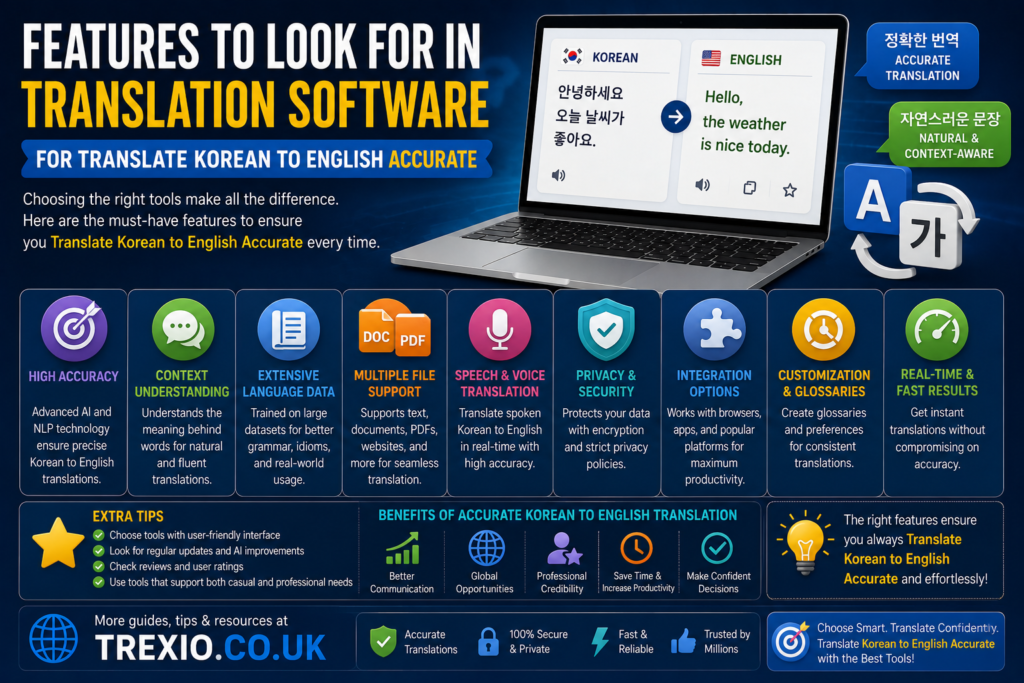
AI Context Recognition
The software should understand entire sentences rather than translating word by word.
Grammar Correction
Automatic grammar improvements create more readable English output.
OCR Image Translation
Useful for translating menus, signs, textbooks, screenshots, and scanned documents.
Voice Translation
Speech recognition enables real-time conversations between Korean and English speakers.
Document Support
Professional users often need PDF, DOCX, PPT, and spreadsheet translation.
Multiple Translation Styles
Some tools offer formal, casual, academic, or business translation modes.
Best Software to Translate Korean to English Accurate
| Software | Best For | Key Features | Free Version | Starting Price |
|---|---|---|---|---|
| Google Translate | Everyday translations | Neural AI, voice input, OCR, conversation mode, website translation | Yes | Free |
| DeepL Translator | Natural writing | Advanced contextual AI, highly fluent English output, document translation | Yes | Paid plans available |
| Microsoft Translator | Business users | Office integration, speech translation, multi-device sync, offline mode | Yes | Free for most users |
| Papago | Korean language specialists | Excellent Korean context, slang recognition, image translation, conversation mode | Yes | Free |
| ChatGPT | Contextual translation | AI explanations, cultural context, rewriting, grammar refinement, long-form translation | Yes | Free & premium plans |
Benefits of Using AI Translation Software
Faster Results
Modern AI tools can translate korean to english accurate in seconds, making them ideal for students, travelers, professionals, and businesses.
Better Context Understanding
Unlike older translators, AI models evaluate surrounding sentences before producing translations.
Improved Productivity
Instead of manually rewriting awkward translations, users receive polished English immediately.
Cost Savings
Many reliable translation platforms offer generous free plans suitable for personal use.
Common Translation Challenges
Korean Honorifics
Respectful speech levels can be difficult to convert naturally into English.
Cultural Expressions
Idioms and sayings often require interpretation rather than direct translation.
Technical Vocabulary
Medical, legal, engineering, and academic documents require specialized terminology.
Informal Internet Language
Korean social media slang changes rapidly, making continuous AI updates essential to translate korean to english accurate effectively.
| Software | Best For | Key Features | Free Version | Starting Price |
|---|---|---|---|---|
| Smartcat | Teams and businesses | AI translation, CAT tools, translation memory, team collaboration, document management | Yes | Custom pricing |
| SYSTRAN Translate | Enterprise translation | Industry-specific AI, secure translation, API integration, multilingual support | Trial Available | Paid plans |
| Reverso | Language learners | Context examples, grammar suggestions, pronunciation, vocabulary building | Yes | Premium plans available |
| iTranslate | Travelers | Voice translation, camera translation, offline language packs, website translation | Yes | Subscription plans |
| Lingvanex | Offline and business users | Offline translation, speech recognition, document translation, API access | Trial Available | Paid plans |
Feature Comparison Table
| Feature | Google Translate | DeepL | Microsoft Translator | Papago | ChatGPT | Smartcat | SYSTRAN | Reverso | iTranslate | Lingvanex |
|---|---|---|---|---|---|---|---|---|---|---|
| AI Context Translation | Good | Excellent | Very Good | Excellent | Excellent | Excellent | Excellent | Good | Good | Very Good |
| Korean Language Accuracy | Very Good | Excellent | Good | Excellent | Excellent | Very Good | Excellent | Good | Good | Very Good |
| Voice Translation | Yes | No | Yes | Yes | No | No | Limited | Yes | Yes | Yes |
| OCR/Image Translation | Yes | Limited | Yes | Yes | No | No | Limited | No | Yes | Yes |
| Document Translation | Yes | Yes | Yes | Yes | Yes | Yes | Yes | Limited | Limited | Yes |
| API Access | Yes | Yes | Yes | Yes | API Available | Yes | Yes | No | Limited | Yes |
| Offline Mode | Limited | No | Yes | Limited | No | No | Enterprise | No | Yes | Yes |
| Business Collaboration | No | Limited | Yes | No | Limited | Excellent | Excellent | No | No | Yes |
Pricing Comparison Table
| Software | Free Plan | Monthly Starting Price | Best Value For |
|---|---|---|---|
| Google Translate | Yes | Free | Everyday users |
| DeepL | Yes | Around $8–9 | Professional translators |
| Microsoft Translator | Yes | Free (API charges may apply) | Microsoft ecosystem users |
| Papago | Yes | Free | Korean language translation |
| ChatGPT | Yes | Premium subscription available | AI-assisted translation and rewriting |
| Smartcat | Yes | Custom pricing | Translation agencies |
| SYSTRAN | Trial | Custom pricing | Enterprises |
| Reverso | Yes | Around $7 | Students and learners |
| iTranslate | Yes | Around $6–8 | Travelers |
| Lingvanex | Trial | Varies by plan | Businesses needing offline translation |
How to Choose the Best Software
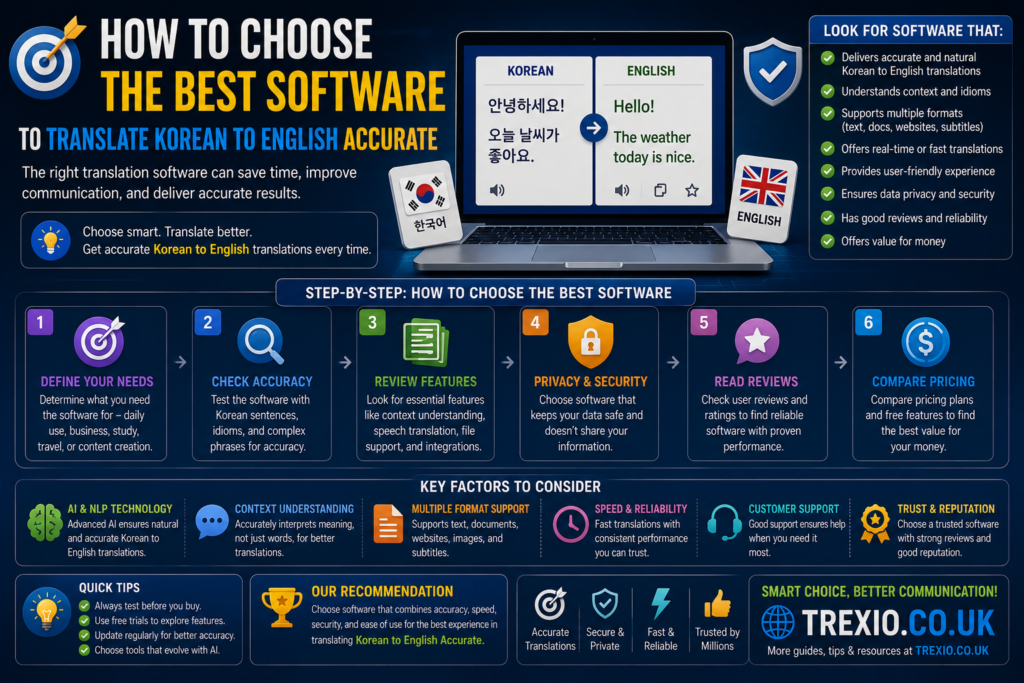
Choosing the right tool to translate korean to english accurate depends on your specific needs. While all modern AI translators offer impressive capabilities, each excels in different situations.
For Everyday Translation
Google Translate and Papago are excellent choices for translating conversations, signs, websites, and short documents. They are free, fast, and easy to use.
For Professional Documents
DeepL provides some of the most natural English translations available. It is well suited for business reports, research papers, contracts, and formal writing.
For Korean-Specific Accuracy
Papago is designed with Korean language expertise in mind. It handles slang, honorifics, idioms, and everyday Korean expressions particularly well.
For AI-Assisted Translation
ChatGPT is ideal if you want more than a direct translation. It can translate korean to english accurate, explain difficult phrases, improve grammar, rewrite text in different tones, and clarify cultural meanings.
For Businesses
Organizations handling large volumes of multilingual content should consider Smartcat, SYSTRAN, or Lingvanex due to their collaboration features, APIs, and enterprise-grade security.
Our Recommendation
If your primary goal is to translate korean to english accurate, the best choice depends on the type of content:
- Best Overall: ChatGPT
- Best Free Translator: Google Translate
- Best for Korean Accuracy: Papago
- Best Professional Translation: DeepL
- Best for Business Teams: Smartcat
For the highest quality results, many professionals combine two tools—for example, using Papago or DeepL for the initial translation and ChatGPT to refine the English into a natural, fluent version.
Conclusion
Finding the best way to translate korean to english accurate has become much easier thanks to advances in artificial intelligence. Modern translation software can understand grammar, context, honorifics, and cultural nuances far better than traditional machine translation systems.
Whether you’re translating business documents, academic papers, K-dramas, websites, or personal conversations, selecting the right tool can dramatically improve both accuracy and readability. Free options like Google Translate and Papago are excellent for everyday use, while DeepL, ChatGPT, Smartcat, and SYSTRAN offer advanced capabilities for professionals and organizations.
Remember that even the best AI translators may occasionally require human review for sensitive legal, medical, or highly technical documents. Combining AI translation with careful proofreading remains the most reliable approach for producing clear, natural English.
Frequently Asked Questions
1. What is the most accurate Korean to English translator?
DeepL, Papago, and ChatGPT are widely considered among the most accurate tools for Korean-to-English translation, depending on the content type.
2. Can AI translate Korean to English accurately?
Yes. Modern AI models can translate korean to english accurate by understanding context, grammar, and sentence structure instead of translating individual words.
3. Is Google Translate accurate for Korean?
Google Translate performs well for general translations, although Papago often provides better results for Korean-specific expressions and honorifics.
4. Which translator is best for K-drama subtitles?
Papago and ChatGPT are excellent choices because they better interpret conversational Korean and cultural expressions.
5. Can I translate Korean documents?
Yes. Many translation tools support Word documents, PDFs, PowerPoint presentations, and other file formats.
6. Is DeepL available for Korean?
DeepL supports Korean and delivers highly natural English translations, particularly for professional writing.
7. Are free translation tools reliable?
Free tools are suitable for everyday communication, travel, and learning. Important legal or business documents should always be reviewed before publication.
8. Why do Korean translations sometimes sound unnatural?
Korean grammar differs significantly from English. Literal translations often ignore context, omitted subjects, and honorifics, resulting in awkward sentences.
Quick Bio
Trexio.co.uk publishes practical technology guides, AI software reviews, productivity tutorials, and digital resources to help readers choose the right tools for work, education, business, and everyday tasks. Our content focuses on clear explanations, unbiased comparisons, and actionable recommendations so users can confidently select the best software for their needs.