
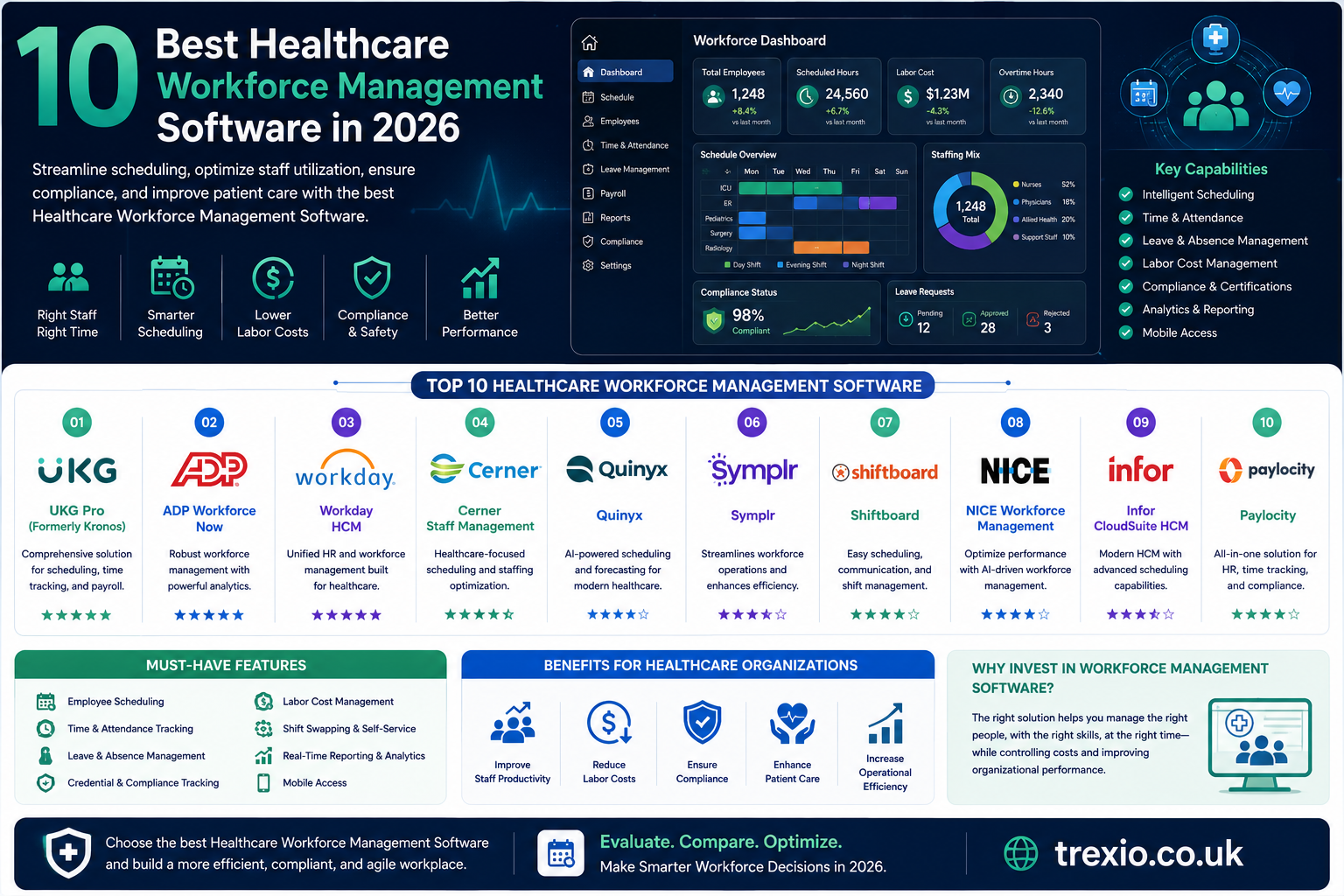
Healthcare organizations face constant challenges in managing staff schedules, controlling labor costs, maintaining compliance, and ensuring quality patient care. Choosing the right healthcare workforce management software has become essential for hospitals, clinics, long-term care facilities, and healthcare networks that want to streamline workforce operations.
Modern healthcare workforce management software helps automate scheduling, time tracking, credential management, shift planning, payroll integration, workforce analytics, and employee self-service. Whether you manage a small clinic or a multi-location hospital system, investing in reliable healthcare workforce management software can reduce administrative work while improving employee satisfaction.
This comprehensive guide explores the best healthcare workforce management software available today, compares their strengths, features, pricing, and ideal use cases, helping you make an informed decision.
Quick Summary
If you’re searching for the best healthcare workforce management software, consider factors like automated scheduling, compliance management, payroll integration, mobile accessibility, forecasting, reporting, and scalability.
This guide compares ten leading healthcare workforce management software platforms used by healthcare organizations worldwide. You’ll also find comparison tables, pricing insights, feature analysis, buying advice, FAQs, and expert recommendations.
Best Healthcare Workforce Management Software
Comparison Table
| Software | Best For | Key Features | Deployment | Free Trial | Starting Price | Overall Rating |
|---|---|---|---|---|---|---|
| UKG Pro Workforce Management | Large hospitals | AI scheduling, staffing optimization, workforce analytics, compliance | Cloud | No | Custom Quote | ⭐ 4.8/5 |
| Workday Healthcare | Enterprise healthcare systems | HR, payroll, workforce planning, talent management | Cloud | No | Custom Quote | ⭐ 4.8/5 |
| Infor Workforce Management | Complex healthcare organizations | Scheduling, labor forecasting, attendance, compliance | Cloud | No | Custom Quote | ⭐ 4.7/5 |
| Oracle Health Workforce Management | Integrated healthcare enterprises | Staff scheduling, workforce analytics, HR integration | Cloud | No | Custom Quote | ⭐ 4.7/5 |
| ShiftWizard | Nurse scheduling | Shift management, communication, credential tracking | Cloud | Demo Available | Custom Quote | ⭐ 4.6/5 |
Why Healthcare Workforce Management Software Matters
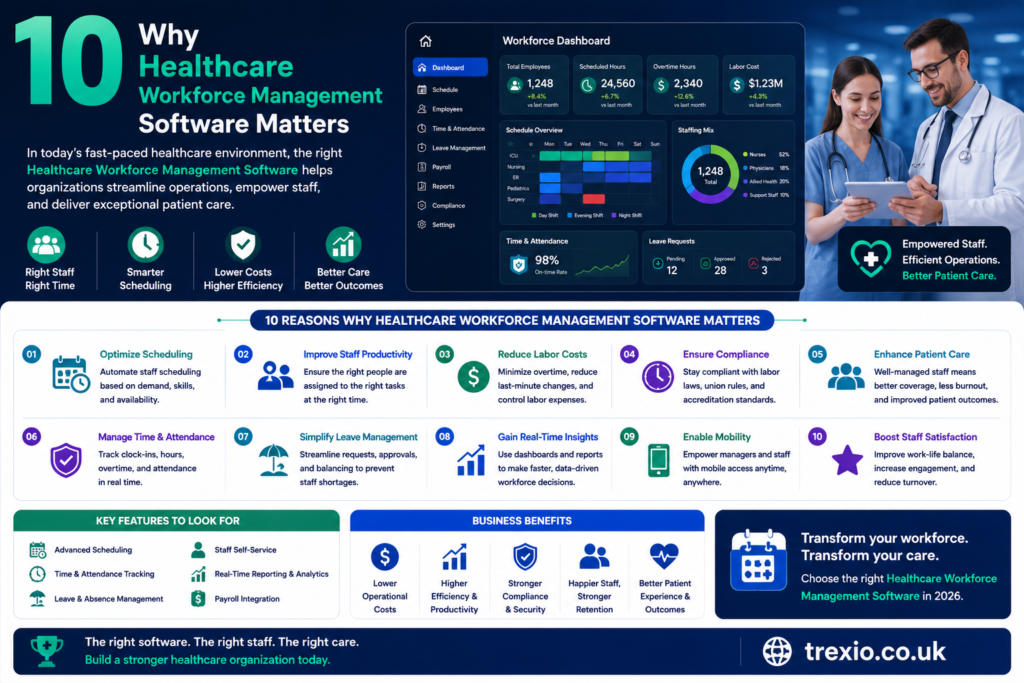
Healthcare organizations operate around the clock, making workforce planning far more complex than in most industries. Effective healthcare workforce management software simplifies scheduling, minimizes overtime, supports regulatory compliance, and improves workforce visibility. Hospitals also benefit from better staffing decisions based on real-time workforce data.
Without reliable healthcare workforce management software, administrators often rely on manual scheduling methods that increase payroll costs, create staffing shortages, and reduce employee satisfaction. Automated workforce management allows healthcare providers to focus more on patient care while reducing administrative workload.
Core Benefits
- Automated employee scheduling
- Shift optimization
- Labor cost reduction
- Attendance management
- Credential tracking
- Compliance monitoring
- Payroll integration
- Workforce forecasting
- Mobile employee access
- Real-time reporting
Essential Features to Look For
Selecting the right healthcare workforce management software requires understanding which features deliver the greatest operational value. Modern platforms combine scheduling automation with workforce analytics, compliance management, and employee engagement tools.
Organizations should also evaluate integration capabilities with HR systems, payroll platforms, electronic health records, and financial software. Scalable healthcare workforce management software supports long-term growth while maintaining regulatory compliance.
Must-Have Features
- AI-powered scheduling
- Shift swapping
- Mobile workforce apps
- Employee self-service
- Leave management
- Time and attendance
- Overtime control
- Skills-based staffing
- Compliance alerts
- Workforce analytics
Who Should Use Healthcare Workforce Management Software?
Nearly every healthcare provider can benefit from implementing healthcare workforce management software. From small outpatient clinics to nationwide healthcare systems, workforce automation improves efficiency while reducing administrative burden.
Facilities with rotating shifts, multiple departments, union requirements, or strict staffing regulations often achieve the greatest return on investment after adopting healthcare workforce management software.
Ideal Organizations
- Hospitals
- Clinics
- Nursing homes
- Rehabilitation centers
- Home healthcare agencies
- Medical laboratories
- Emergency care centers
- Specialty healthcare networks
| Software | Best For | Key Features | Deployment | Free Trial | Starting Price | Overall Rating |
|---|---|---|---|---|---|---|
| QGenda | Physician and provider scheduling | Automated physician scheduling, on-call management, workforce analytics, mobile access | Cloud | Demo Available | Custom Quote | ⭐ 4.7/5 |
| Smart Square by AMN Healthcare | Hospital staffing optimization | Predictive staffing, scheduling automation, labor forecasting, productivity analytics | Cloud | No | Custom Quote | ⭐ 4.7/5 |
| Symplr Workforce | Compliance-focused healthcare organizations | Workforce scheduling, credential management, compliance tracking, reporting | Cloud | Demo Available | Custom Quote | ⭐ 4.6/5 |
| Deputy | Small clinics and healthcare practices | Employee scheduling, attendance, shift swapping, mobile app, payroll integration | Cloud | Yes | From $4.50/user/month | ⭐ 4.6/5 |
| TCP Workforce Management (TimeClock Plus) | Mid-sized healthcare providers | Time tracking, scheduling, payroll integration, compliance management, workforce analytics | Cloud & On-Premise | Demo Available | Custom Quote | ⭐ 4.5/5 |
Feature Comparison Table
| Feature | UKG | Workday | Infor | Oracle Health | ShiftWizard | QGenda | Smart Square | Symplr | Deputy | TCP Workforce |
|---|---|---|---|---|---|---|---|---|---|---|
| AI Scheduling | ✅ | ✅ | ✅ | ✅ | Limited | ✅ | ✅ | Limited | ❌ | Limited |
| Shift Swapping | ✅ | ✅ | ✅ | ✅ | ✅ | ✅ | ✅ | ✅ | ✅ | ✅ |
| Mobile App | ✅ | ✅ | ✅ | ✅ | ✅ | ✅ | ✅ | ✅ | ✅ | ✅ |
| Time & Attendance | ✅ | ✅ | ✅ | ✅ | ✅ | Limited | ✅ | ✅ | ✅ | ✅ |
| Payroll Integration | ✅ | ✅ | ✅ | ✅ | Limited | Limited | Limited | Limited | ✅ | ✅ |
| Workforce Analytics | Advanced | Advanced | Advanced | Advanced | Moderate | Advanced | Advanced | Good | Basic | Good |
| Compliance Tracking | ✅ | ✅ | ✅ | ✅ | ✅ | ✅ | ✅ | ✅ | Basic | ✅ |
| Credential Management | Limited | Limited | Limited | Limited | ✅ | ✅ | Limited | ✅ | ❌ | Limited |
| Forecasting | ✅ | ✅ | ✅ | ✅ | Limited | Good | Advanced | Good | Basic | Good |
| Employee Self-Service | ✅ | ✅ | ✅ | ✅ | ✅ | ✅ | Limited | ✅ | ✅ | ✅ |
Pricing Comparison Table
| Software | Pricing Model | Best For | Free Trial |
|---|---|---|---|
| UKG Pro Workforce Management | Custom Quote | Large enterprises | No |
| Workday Healthcare | Custom Quote | Enterprise healthcare systems | No |
| Infor Workforce Management | Custom Quote | Hospitals | No |
| Oracle Health Workforce Management | Custom Quote | Integrated healthcare organizations | No |
| ShiftWizard | Custom Quote | Nurse scheduling | Demo |
| QGenda | Custom Quote | Physician scheduling | Demo |
| Smart Square | Custom Quote | Hospital staffing | No |
| Symplr Workforce | Custom Quote | Compliance management | Demo |
| Deputy | Subscription | Small organizations | Yes |
| TCP Workforce Management | Custom Quote | Mid-sized healthcare providers | Demo |
How to Choose Healthcare Workforce Management Software
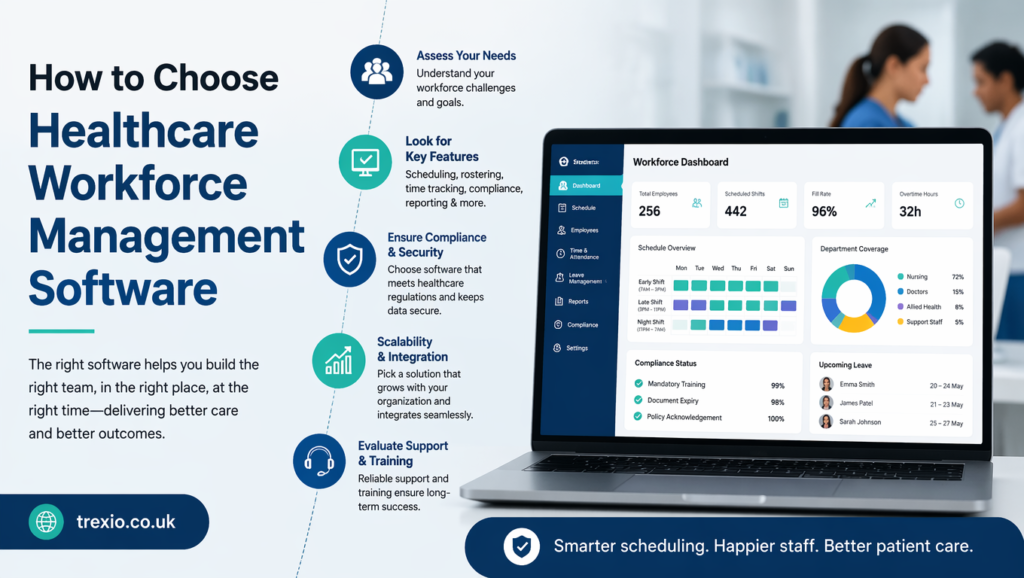
Selecting the best healthcare workforce management software depends on your organization’s size, staffing complexity, budget, and compliance requirements. Before making a decision, evaluate both your current workforce challenges and future growth plans.
Consider these important factors:
- Organization size and number of employees
- AI-powered scheduling capabilities
- Healthcare compliance support
- Payroll and HR integration
- Mobile accessibility
- Workforce forecasting tools
- Employee self-service options
- Reporting and analytics
- Customer support quality
- Total cost of ownership
The right healthcare workforce management software should simplify scheduling, improve labor efficiency, reduce overtime, and help healthcare providers maintain regulatory compliance without increasing administrative work.
Our Recommendation
After comparing today’s leading solutions, these stand out for different healthcare environments:
Best Overall: UKG Pro Workforce Management
- Excellent AI scheduling
- Enterprise-grade workforce analytics
- Strong compliance tools
- Highly scalable
Best for Large Healthcare Systems: Workday Healthcare
- Complete HR and workforce ecosystem
- Advanced reporting
- Excellent payroll integration
Best for Physician Scheduling: QGenda
- Built specifically for provider scheduling
- Strong automation
- Easy mobile access
Best Budget-Friendly Option: Deputy
- Affordable monthly pricing
- Easy implementation
- Ideal for smaller clinics and medical practices
Best for Nurse Scheduling: ShiftWizard
- Nurse-centric scheduling
- Credential tracking
- Simple communication tools
Conclusion
Choosing the right healthcare workforce management software can significantly improve scheduling accuracy, employee satisfaction, compliance, and operational efficiency. Whether you manage a regional clinic or a nationwide hospital network, modern workforce management platforms help reduce manual administrative work while ensuring the right staff are available when patients need care.
Enterprise organizations may benefit most from platforms such as UKG Pro Workforce Management, Workday Healthcare, or Oracle Health Workforce Management, while smaller healthcare providers can achieve excellent results with Deputy or ShiftWizard. Evaluate features, integration capabilities, pricing, and scalability before making your final decision to ensure your investment supports both current and future workforce needs.
Frequently Asked Questions (FAQs)
1. What is healthcare workforce management software?
Healthcare workforce management software is a digital solution that helps healthcare organizations manage employee scheduling, attendance, compliance, payroll integration, workforce forecasting, and labor optimization.
2. Who uses healthcare workforce management software?
Hospitals, clinics, nursing homes, rehabilitation centers, laboratories, home healthcare agencies, and healthcare systems use these platforms.
3. Does healthcare workforce management software support compliance?
Yes. Most leading platforms include compliance monitoring, credential tracking, labor law management, and staffing requirement alerts.
4. Can it integrate with payroll systems?
Yes. Most enterprise solutions integrate with payroll, HR, ERP, and other healthcare management systems.
5. Is cloud-based software better than on-premise?
Cloud-based solutions offer easier updates, remote access, lower infrastructure costs, and better scalability for most healthcare organizations.
6. Which software is best for hospitals?
UKG Pro Workforce Management, Workday Healthcare, Infor Workforce Management, Oracle Health Workforce Management, and Smart Square are among the strongest choices for hospitals.
7. Which option is best for small clinics?
Deputy is often a strong choice for smaller healthcare practices because of its affordable pricing, ease of use, and scheduling capabilities.
8. How much does healthcare workforce management software cost?
Pricing varies widely. Enterprise platforms typically require custom quotes, while smaller business solutions may start at around $4–10 per user per month.
Quick Bio
About the Author
The author specializes in enterprise software, healthcare technology, HR systems, and digital workplace solutions. With extensive experience reviewing workforce management platforms and business software, they provide practical, research-based comparisons that help healthcare organizations choose technology aligned with their operational needs, compliance requirements, and long-term growth goals.