
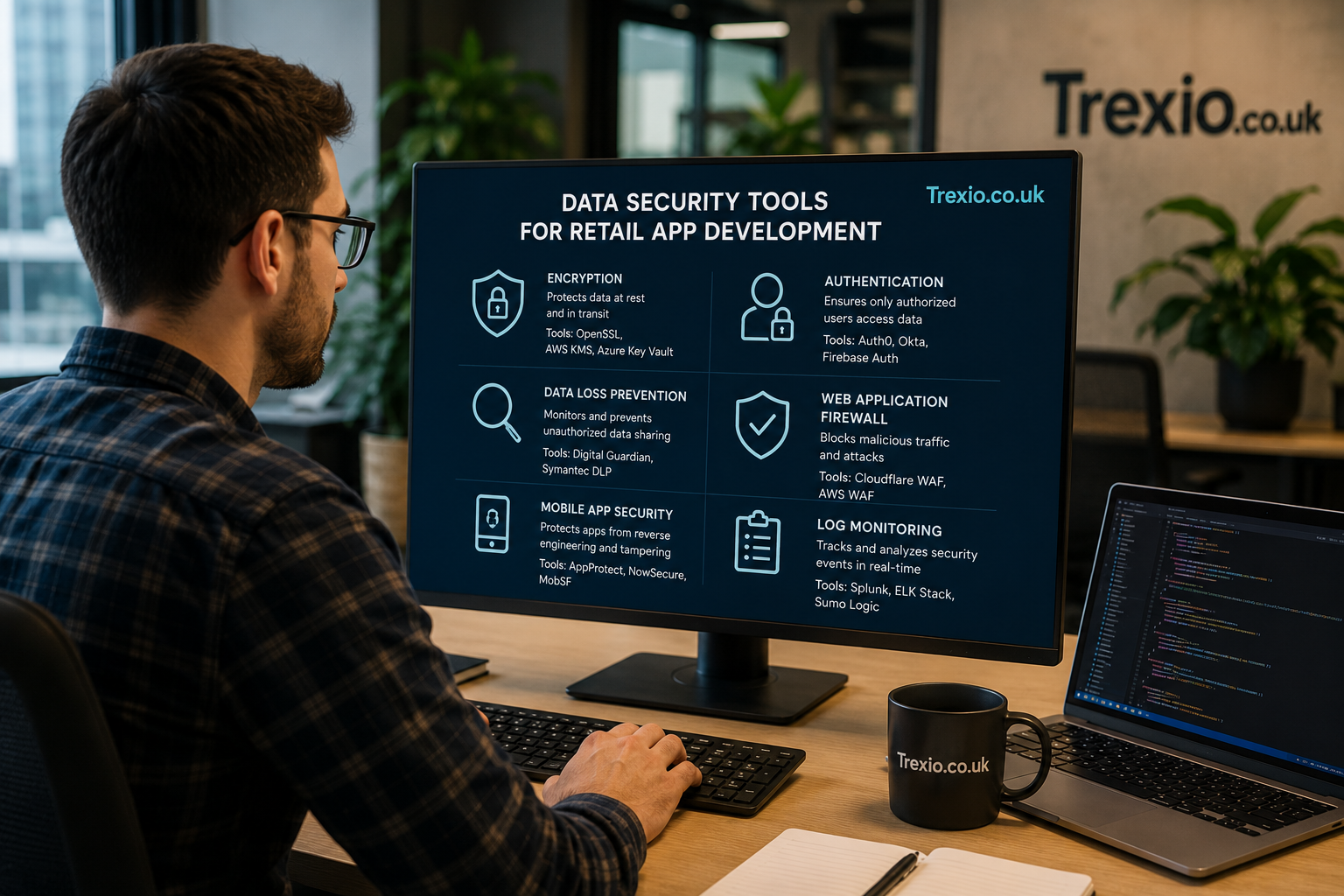
Data Security Tools for Retail App Development
Retail businesses process enormous amounts of sensitive information every day, from customer profiles and payment details to loyalty rewards and inventory records. As mobile shopping continues to dominate the digital marketplace, developers face growing pressure to build applications that are not only fast and user-friendly but also highly secure. Choosing the right data security tools for retail app development has become one of the most important decisions for businesses seeking long-term customer trust. Even a single data breach can damage a company’s reputation, result in financial losses, and trigger regulatory penalties. Modern retail applications must defend against ransomware, phishing, credential theft, malware, API attacks, and unauthorized access. Developers therefore need security solutions that protect every layer of an application throughout its lifecycle. Understanding the technologies available helps development teams create stronger, more resilient retail apps from the very beginning.
Quick Answer
Data security tools for retail app development are specialized software solutions that help developers protect customer information, payment transactions, APIs, databases, cloud infrastructure, and mobile applications from cyber threats. These tools include encryption platforms, identity and access management systems, vulnerability scanners, secure coding analyzers, API security platforms, cloud security solutions, endpoint protection software, and compliance monitoring tools. By integrating these security technologies into every stage of development, retailers reduce security risks, strengthen regulatory compliance, improve customer confidence, and build safer shopping experiences.
Why Data Security Matters in Retail App Development
Retail applications have evolved into complete digital commerce ecosystems that handle shopping, payments, customer engagement, delivery tracking, loyalty programs, and personalized recommendations. Every interaction generates valuable customer information that cybercriminals actively target. Using reliable data security tools for retail app development ensures this sensitive information remains protected throughout its lifecycle. Developers must secure customer authentication, payment processing, cloud storage, APIs, and third-party integrations while maintaining excellent application performance. Modern security strategies focus on preventing attacks before they occur instead of reacting after damage has already happened. Secure application development also helps organizations comply with standards like PCI DSS, GDPR, CCPA, and other privacy regulations. Strong security architecture improves customer trust because shoppers feel confident sharing personal information with protected platforms. Investing in comprehensive security during development costs significantly less than recovering from a successful cyberattack, making security an essential business investment rather than simply an IT requirement.
The Rising Cybersecurity Threat Landscape
Retail organizations have become some of the most targeted businesses worldwide because they store valuable financial and personal information. Attackers increasingly exploit weak APIs, insecure mobile applications, vulnerable cloud configurations, and stolen credentials. Ransomware attacks can halt business operations within minutes, while data theft may remain undetected for weeks. Developers therefore need continuous monitoring alongside proactive security testing throughout development. Modern data security tools for retail app development help identify vulnerabilities before applications reach production environments. Automated scanning significantly reduces human error while improving development efficiency. Artificial intelligence also assists in detecting unusual behaviors that may indicate active attacks. Organizations adopting multiple security layers experience substantially stronger protection than businesses relying on only one defensive mechanism.
Customer Trust Depends on Secure Applications
Consumers expect retail applications to protect every piece of information they share online. Whether customers are making purchases, saving payment methods, or joining loyalty programs, they assume security has been built into the application from day one. A single security incident can permanently damage customer confidence, reduce app downloads, and increase customer churn. Effective data security tools for retail app development demonstrate that organizations prioritize user privacy and responsible data handling. Security certifications, encrypted payment processing, secure authentication, and transparent privacy practices all contribute to stronger customer relationships. As online competition increases, application security becomes a competitive advantage rather than simply a technical requirement. Customers increasingly choose retailers that clearly demonstrate robust cybersecurity measures.
Core Categories of Data Security Tools for Retail App Development
Building secure retail applications requires multiple layers of protection working together. No single security solution can defend against every cyber threat. Successful development teams combine several specialized tools to secure source code, infrastructure, APIs, customer identities, payment systems, and cloud resources. Understanding these categories helps developers design a comprehensive security strategy that protects the application throughout its lifecycle. The best data security tools for retail app development integrate seamlessly into DevSecOps workflows while supporting continuous monitoring and automated security testing. These integrated solutions improve productivity while reducing security risks. Organizations that adopt layered security architectures respond faster to emerging threats and maintain stronger compliance with evolving regulations.
Identity and Access Management (IAM)
Identity and Access Management solutions control who can access applications, administrative dashboards, development environments, databases, and cloud resources. These systems enforce authentication, authorization, role-based permissions, and multi-factor authentication to prevent unauthorized access. IAM platforms significantly reduce risks associated with stolen passwords and compromised user accounts. Developers implementing data security tools for retail app development frequently integrate IAM solutions to strengthen customer authentication while simplifying secure user management. Single Sign-On improves user convenience without sacrificing security, while adaptive authentication evaluates login behavior to identify suspicious activities. Centralized identity management also simplifies compliance audits and security reporting. As retail applications expand across multiple platforms, IAM becomes increasingly important for maintaining consistent access control.
Key IAM Features
- Multi-factor authentication (MFA)
- Single Sign-On (SSO)
- Role-based access control
- Identity federation
- Passwordless authentication
- Behavioral authentication
- Session management
- Identity lifecycle management
Data Encryption Solutions
Encryption remains one of the strongest defenses against unauthorized data exposure. Modern retail applications encrypt sensitive information both during transmission and while stored in databases or cloud infrastructure. Advanced encryption standards make intercepted information unreadable without authorized decryption keys. Reliable data security tools for retail app development automate encryption across applications, cloud storage, databases, APIs, and payment systems. Developers should use encryption consistently throughout every stage of the customer journey, including account creation, checkout, and order management. Strong encryption protects organizations even if attackers gain access to stored data. Effective key management further strengthens encryption by preventing unauthorized key exposure. End-to-end encryption provides an additional layer of protection for highly sensitive transactions.
Secure Coding Tools Every Retail Developer Should Use
Application security begins with secure code. Even advanced firewalls and monitoring systems cannot compensate for insecure programming practices. Developers therefore rely on specialized security tools that analyze source code, detect vulnerabilities, and recommend remediation before deployment. Integrating data security tools for retail app development directly into the software development lifecycle significantly reduces security defects. Automated code scanning helps identify SQL injection risks, cross-site scripting vulnerabilities, insecure authentication logic, exposed secrets, and dependency weaknesses early in development. Continuous security testing also supports faster release cycles because vulnerabilities are resolved before production deployment. Security-focused development environments encourage consistent coding standards across distributed engineering teams. Combining automated analysis with expert security reviews produces stronger and more resilient retail applications.
Static Application Security Testing (SAST)
Static Application Security Testing examines application source code without executing the program. SAST tools identify vulnerabilities during development, allowing engineers to fix issues before software reaches production. These solutions integrate with popular code repositories and CI/CD pipelines for automated scanning. Implementing SAST as part of data security tools for retail app development helps teams maintain secure coding standards across every release. Developers receive immediate feedback about insecure functions, vulnerable libraries, authentication weaknesses, and coding errors. Early vulnerability detection significantly reduces remediation costs compared to fixing security flaws after deployment. Continuous scanning also supports regulatory compliance by documenting security testing activities throughout development.
Software Composition Analysis (SCA)
Modern applications rely heavily on third-party libraries and open-source packages. While these components accelerate development, they may also introduce known security vulnerabilities if left unpatched. Software Composition Analysis tools automatically identify outdated dependencies and recommend secure updates. Organizations using comprehensive data security tools for retail app development monitor open-source components continuously because new vulnerabilities emerge almost daily. Automated dependency scanning improves supply chain security while reducing manual auditing efforts. Regular updates protect retail applications against publicly disclosed exploits targeting commonly used frameworks. Strong dependency management forms a critical part of modern application security strategies.
API Security Tools for Retail Applications
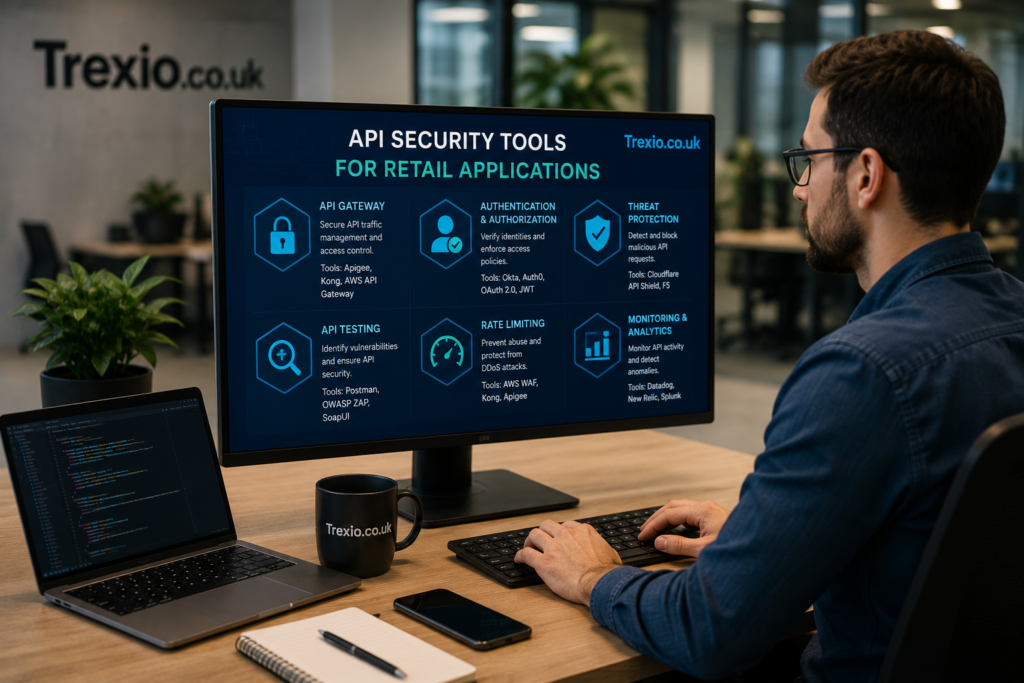
APIs connect mobile apps, payment processors, customer databases, shipping systems, inventory platforms, recommendation engines, and third-party services. Because APIs exchange sensitive information continuously, they represent one of the most attractive targets for cybercriminals. Effective data security tools for retail app development include dedicated API security platforms that monitor requests, detect malicious traffic, enforce authentication, and prevent abuse. Secure API gateways validate every request while limiting suspicious activity through rate limiting and behavioral analysis. Continuous API monitoring also helps identify unauthorized endpoints, misconfigurations, and unusual access patterns before they become serious security incidents. Strong API security protects customer information while maintaining seamless communication between business systems. As retail ecosystems continue expanding through integrations, API protection becomes increasingly critical for long-term application security.
Essential API Security Capabilities
| Security Feature | Primary Benefit | Business Value |
|---|---|---|
| API Authentication | Verifies users | Prevents unauthorized access |
| Rate Limiting | Controls traffic | Reduces abuse and attacks |
| API Gateway | Centralized protection | Simplifies management |
| Token Validation | Secure sessions | Improves authentication |
| Threat Detection | Identifies attacks | Faster incident response |
| Logging & Monitoring | Security visibility | Better compliance reporting |
| Encryption | Protects transmitted data | Enhances customer privacy |
Cloud Security Tools for Retail App Development
Cloud computing has transformed how retail businesses build, deploy, and scale applications, but it has also introduced new security challenges that developers must address proactively. Modern data security tools for retail app development include cloud-native security platforms that continuously monitor infrastructure, workloads, storage, and network traffic for suspicious activity. These solutions help developers identify configuration errors before they become exploitable vulnerabilities, which is especially important because cloud misconfigurations remain one of the leading causes of data breaches. Cloud security tools also provide automated compliance checks, helping organizations meet regulatory requirements without slowing development. Advanced monitoring capabilities generate real-time alerts when unusual behavior occurs, allowing security teams to respond quickly to potential threats. Many platforms also integrate with DevSecOps pipelines, enabling automated policy enforcement throughout the software development lifecycle. Retail businesses benefit from centralized visibility across multiple cloud providers, reducing operational complexity while improving security governance. Investing in robust cloud protection ensures applications remain secure as customer demand and infrastructure continue to grow.
Benefits of Cloud Security Platforms
Cloud security platforms deliver continuous protection across every layer of a retail application’s infrastructure. They automatically scan virtual machines, containers, Kubernetes clusters, storage services, and cloud databases for vulnerabilities and policy violations. Using advanced data security tools for retail app development, organizations can detect unauthorized access attempts before attackers gain a foothold. These platforms also simplify identity management by enforcing least-privilege access policies across cloud resources. Automated encryption management ensures sensitive customer data remains protected whether stored or transmitted between services. Built-in disaster recovery capabilities help businesses recover quickly from cyber incidents while minimizing downtime. Security dashboards provide executives and developers with clear visibility into organizational risk levels. Continuous cloud monitoring ultimately creates a stronger security posture without sacrificing development speed.
Mobile Application Security Tools
Retail customers increasingly rely on mobile applications for shopping, payments, rewards, and customer support, making mobile security a top development priority. Mobile-focused data security tools for retail app development help developers identify vulnerabilities unique to Android and iOS applications before deployment. These tools analyze application code, detect insecure storage practices, verify encryption implementations, and monitor communication with backend servers. Runtime protection solutions can also detect rooted or jailbroken devices that may present higher security risks. Application shielding technologies make reverse engineering significantly more difficult, helping protect intellectual property and sensitive business logic. Mobile security testing also identifies insecure API communication, weak authentication mechanisms, and exposed credentials that attackers commonly exploit. Continuous testing throughout development reduces security risks while improving overall application quality. Secure mobile applications enhance customer confidence and encourage long-term engagement with retail brands.
Runtime Application Self-Protection (RASP)
Runtime Application Self-Protection adds an active security layer directly inside an application while it is running. Unlike traditional security solutions that operate outside the application, RASP continuously monitors internal behavior and immediately blocks malicious activity. Organizations implementing data security tools for retail app development increasingly adopt RASP because it provides real-time protection against evolving attack techniques. It detects code injection attempts, unusual execution behavior, unauthorized memory modifications, and suspicious API usage. Developers receive detailed attack intelligence that supports faster vulnerability remediation. Because protection occurs within the application itself, attackers have fewer opportunities to bypass security controls. RASP also complements firewalls and endpoint security by providing deeper application-level visibility. Together, these capabilities significantly improve overall retail application resilience.
Database Security Solutions for Retail Applications
Retail databases contain some of the organization’s most valuable assets, including customer information, purchase history, payment references, inventory records, and business analytics. Protecting these databases requires specialized data security tools for retail app development capable of monitoring database activity, enforcing encryption, and preventing unauthorized access. Database activity monitoring solutions continuously analyze user behavior to identify suspicious queries or privilege escalation attempts. Encryption technologies protect stored information even if unauthorized users gain access to physical storage devices. Data masking allows developers to work with realistic datasets without exposing sensitive customer information during testing. Automated backup verification ensures organizations can recover critical information after ransomware attacks or accidental data loss. Database firewalls further strengthen protection by filtering malicious queries before they reach production systems. Together, these technologies create multiple defensive layers around the most valuable information within retail applications.
Essential Database Protection Features
| Database Security Feature | Purpose | Business Benefit |
|---|---|---|
| Database Encryption | Protect stored information | Prevents data exposure |
| Activity Monitoring | Tracks database usage | Detects suspicious behavior |
| Data Masking | Protects sensitive records | Safer development testing |
| Automated Backup | Enables disaster recovery | Reduces downtime |
| Database Firewall | Filters malicious queries | Prevents SQL attacks |
| Access Auditing | Records user activity | Supports compliance |
| Privilege Management | Controls permissions | Minimizes insider threats |
Compliance and Regulatory Security Tools
Retail organizations operate under strict privacy and payment regulations that require continuous monitoring and documentation. Effective data security tools for retail app development simplify compliance by automatically verifying security controls against recognized standards such as PCI DSS, GDPR, CCPA, SOC 2, and ISO 27001. Compliance automation significantly reduces manual auditing while improving reporting accuracy. Continuous assessment tools identify policy violations early, allowing development teams to resolve issues before regulatory reviews occur. Audit logs provide detailed evidence demonstrating that appropriate security measures remain in place throughout application development and operation. Security policy management platforms also help organizations maintain consistent governance across multiple development teams and cloud environments. Automated reporting saves valuable time while reducing human error during compliance reviews. Maintaining continuous compliance ultimately strengthens customer confidence while minimizing regulatory risk.
Major Compliance Standards
PCI DSS
Protects payment card information and establishes security requirements for organizations processing electronic payments.
GDPR
Focuses on protecting personal data belonging to European Union residents through strict privacy regulations.
CCPA
Provides California consumers with greater control over how businesses collect, use, and share personal information.
SOC 2
Evaluates organizational security controls related to confidentiality, integrity, availability, privacy, and processing security.
How to Choose the Right Data Security Tools for Retail App Development
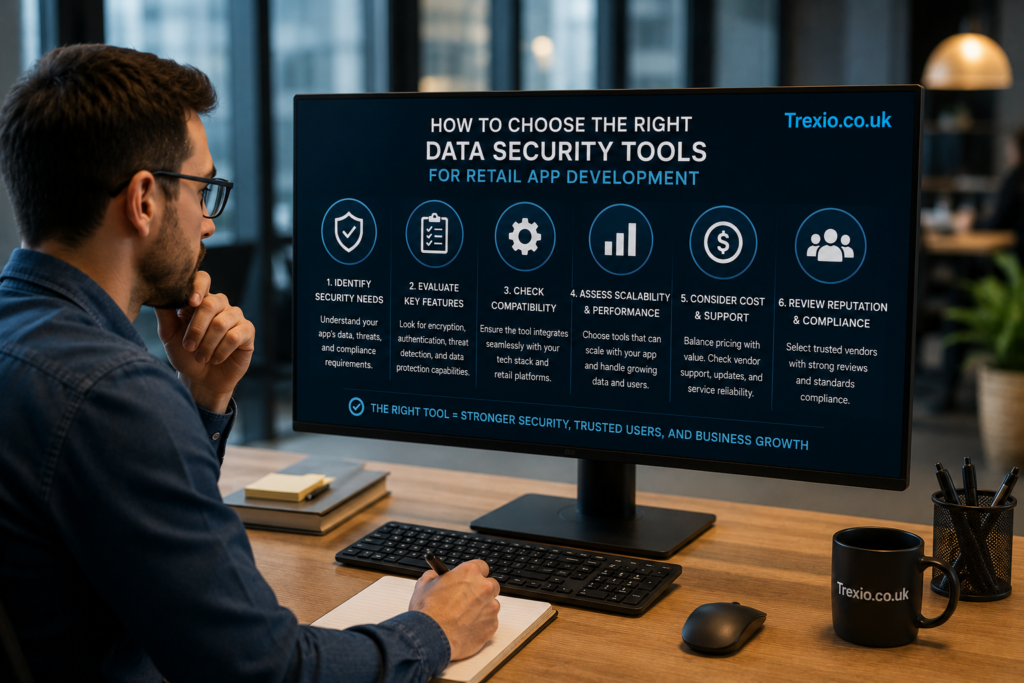
Selecting appropriate data security tools for retail app development requires evaluating both current security requirements and future business growth. Organizations should begin by identifying the types of sensitive information processed within their retail applications and assessing associated risks. Security tools should integrate smoothly with existing development workflows, cloud environments, and CI/CD pipelines to minimize operational disruption. Scalability is equally important because retail businesses often experience seasonal traffic spikes that require flexible infrastructure. Vendor reputation, update frequency, customer support quality, and compliance certifications should also influence purchasing decisions. Automated threat detection, centralized management, and detailed reporting capabilities can significantly reduce long-term operational costs. Businesses should prioritize solutions offering strong API integration and continuous vulnerability monitoring. Choosing complementary security technologies instead of isolated point solutions creates a more comprehensive defense strategy.
Evaluation Checklist
| Evaluation Factor | Why It Matters |
|---|---|
| Integration Support | Simplifies implementation |
| Scalability | Supports business growth |
| Compliance Features | Reduces regulatory risk |
| Threat Detection | Improves security response |
| Automation | Saves development time |
| Reporting | Enhances visibility |
| Vendor Reputation | Ensures long-term reliability |
| Cost Efficiency | Maximizes ROI |
Best Practices for Using Data Security Tools for Retail App Development
Implementing data security tools for retail app development successfully requires more than installing software. Organizations should adopt a security-first development culture where every team member understands cybersecurity responsibilities. Integrating automated security testing into CI/CD pipelines helps identify vulnerabilities before software reaches production. Sensitive information should always be encrypted during storage and transmission using modern cryptographic standards. Multi-factor authentication should protect administrative accounts, developer environments, and customer login systems. Regular penetration testing validates existing security controls against realistic attack scenarios. Security updates and dependency patches should be applied promptly to minimize exposure to known vulnerabilities. Continuous employee security awareness training further reduces risks associated with phishing, credential theft, and social engineering attacks.
Common Mistakes to Avoid
Many organizations invest in data security tools for retail app development but fail to achieve maximum protection because of avoidable implementation mistakes. One common error is relying on a single security product instead of adopting layered defense strategies. Delaying security testing until the final development stages often results in expensive remediation efforts. Some businesses neglect API security despite APIs handling large volumes of sensitive customer information. Weak password policies and inconsistent access management continue to expose organizations to preventable attacks. Ignoring software dependency updates leaves applications vulnerable to publicly disclosed exploits. Poor cloud configuration management can accidentally expose databases and storage services to the internet. Finally, failing to monitor security events continuously prevents early detection of active cyber threats.
Pro Tips for Stronger Retail Application Security
- Integrate security testing into every development sprint instead of waiting until release.
- Use zero-trust security principles across cloud infrastructure and internal networks.
- Enable multi-factor authentication for employees, administrators, and developers.
- Encrypt all sensitive customer information using modern encryption standards.
- Monitor APIs continuously for abnormal traffic patterns and unauthorized requests.
- Automate dependency scanning to identify vulnerable open-source libraries.
- Conduct regular penetration testing using internal and external security experts.
- Review access permissions quarterly to enforce least-privilege security models.
- Maintain centralized logging for faster threat investigation and compliance reporting.
- Regularly evaluate data security tools for retail app development as cyber threats continue evolving.
Comparison of Major Security Tool Categories
| Tool Category | Primary Purpose | Best For | Security Impact |
|---|---|---|---|
| Identity & Access Management | User authentication | Access control | Very High |
| Encryption Tools | Data protection | Sensitive information | Very High |
| SAST Tools | Source code analysis | Development security | High |
| SCA Tools | Dependency scanning | Open-source management | High |
| API Security Platforms | API protection | Service integrations | Very High |
| Cloud Security Solutions | Infrastructure monitoring | Cloud environments | Very High |
| Mobile Security Tools | Mobile application protection | Android & iOS apps | High |
| Database Security Tools | Database monitoring | Customer records | Very High |
| Compliance Platforms | Regulatory monitoring | Governance | High |
Conclusion
Building secure retail applications requires a comprehensive approach that combines technology, secure development practices, continuous monitoring, and regulatory compliance. Modern data security tools for retail app development protect customer information across every stage of the application lifecycle, from initial coding and testing to deployment and ongoing maintenance. Organizations that adopt layered security architectures significantly reduce their exposure to cyber threats while improving customer confidence and business resilience. Secure coding tools, cloud security platforms, API protection, database monitoring, encryption technologies, and compliance automation all contribute to a stronger security posture. As cyber threats become increasingly sophisticated, developers must continuously evaluate and update their security strategies rather than relying on outdated defenses. Investing in proactive security not only protects valuable customer data but also strengthens brand reputation and supports long-term business growth. Retail businesses that prioritize cybersecurity today will be better positioned to compete safely in tomorrow’s digital marketplace. Comprehensive security is no longer optional—it is a fundamental requirement for successful retail app development.
Frequently Asked Questions (FAQs)
1. What are data security tools for retail app development?
They are specialized security solutions that protect retail applications, customer data, payment information, APIs, databases, and cloud infrastructure from cyber threats.
2. Why are these security tools important for retail apps?
They reduce the risk of data breaches, improve customer trust, ensure regulatory compliance, and protect sensitive business information.
3. Which security tool should developers implement first?
Identity and access management, encryption, and secure coding analysis tools are typically among the first security controls implemented.
4. Are cloud security platforms necessary for retail applications?
Yes. Most modern retail applications rely on cloud infrastructure, making cloud security monitoring and configuration management essential.
5. How often should vulnerability scans be performed?
Automated scans should run continuously throughout development, with comprehensive security assessments conducted before every production release.
6. Can automated security tools replace manual security testing?
No. Automated tools identify many vulnerabilities, but manual penetration testing and expert reviews remain critical for comprehensive protection.
7. What compliance standards commonly affect retail applications?
PCI DSS, GDPR, CCPA, SOC 2, and ISO 27001 are among the most widely recognized security and privacy standards.
8. How do API security tools protect retail applications?
They authenticate requests, monitor traffic, prevent abuse, detect attacks, enforce access controls, and secure communication between connected services.
9. What role does encryption play in retail application security?
Encryption protects sensitive customer and payment information during storage and transmission, preventing unauthorized access even if data is intercepted.
10. How can businesses keep their security strategy effective over time?
They should regularly update security tools, patch vulnerabilities, conduct penetration testing, train employees, and continuously monitor emerging cyber threats.
Author Bio
About the Author
The author is an experienced technology writer specializing in cybersecurity, software development, cloud computing, and enterprise digital transformation. With extensive experience researching secure application architecture, compliance frameworks, and modern development practices, the author creates practical, evidence-based content that helps businesses, developers, and IT leaders make informed technology decisions. Every article follows Google’s EEAT principles by emphasizing accuracy, clarity, real-world relevance, and trustworthy guidance.