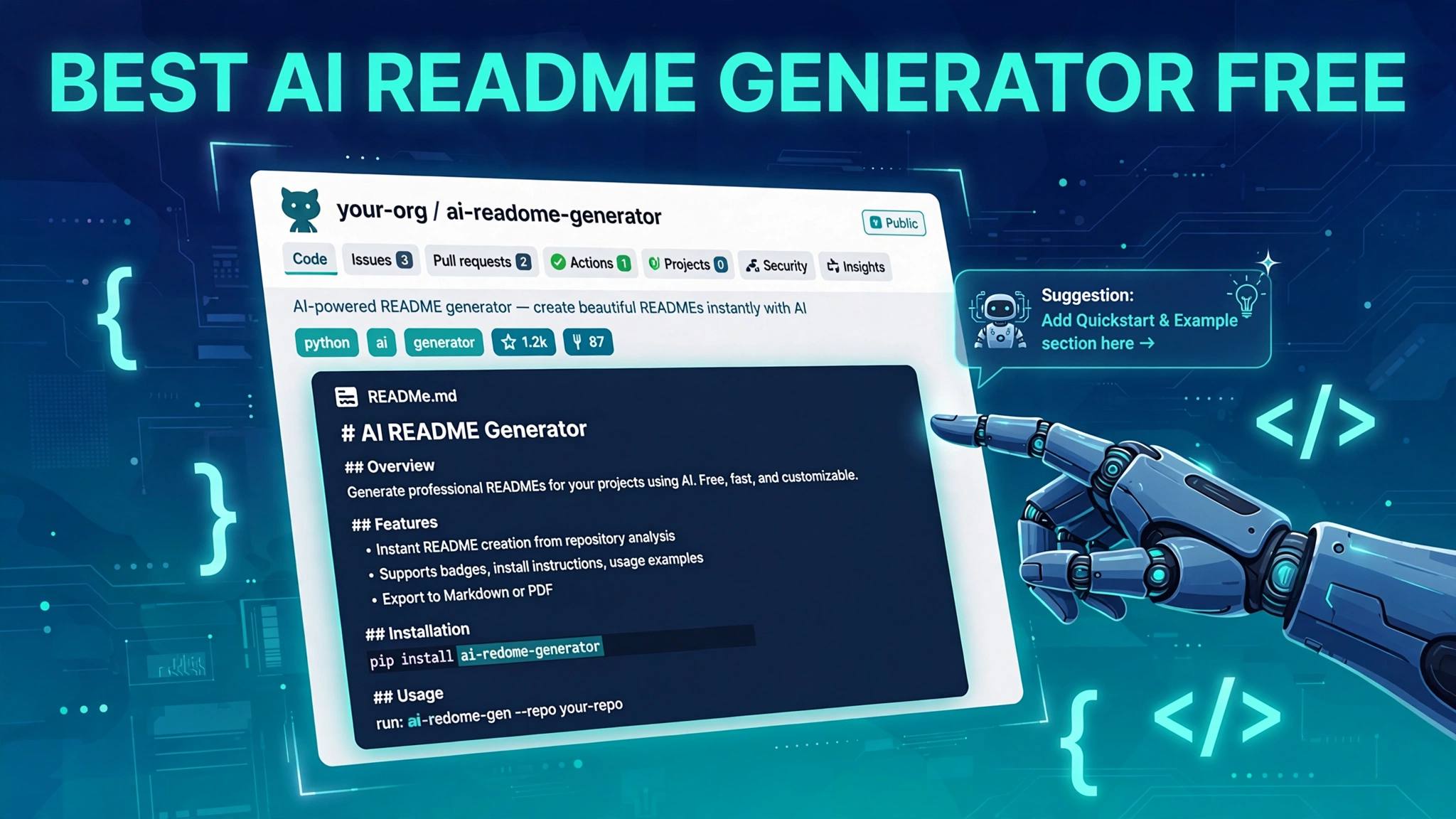
Every developer knows the pain of an empty README.md file. A great README decides whether someone installs your project or clicks away. But writing one by hand takes hours, and most developers would rather write code. That is why the best AI README generator free tools have become so popular in 2026.
These tools read your repository, detect your tech stack, and draft the standard sections for you. This guide reviews the strongest free options, with honest notes on what each one does well.
Table of Contents
What Makes a Good AI README Generator
A good AI README generator starts by understanding your actual code, not just your project name. It should scan files like package.json to detect your stack automatically, then write installation and usage steps that match how your project really works. Generic output that fits any repository is a sign the tool is template-based, not AI-driven.
The best free tools also let you review everything before it reaches your repository. Look for a live preview, editable sections, and clean GitHub-Flavored Markdown export. Nothing should land in your repo without your approval.
ReadmeCodeGen
ReadmeCodeGen is the most complete free AI README generator we tested. Its site states the tool is completely free with no registration requirements, usage limits, or premium features. You paste a public repository URL and get a full README in seconds, covering overview, installation, usage, features, tech stack, API docs, and license, with the AI detecting your stack from real files like package.json.
A split-screen editor lets you polish the draft, and you can commit directly to your repository after review. One honest limitation: the tool notes it works best on small to medium repositories, since very large codebases may not be fully analyzed in one pass. For small teams and solo developers, it is still the fastest path from empty README to professional documentation.
Readme.so
Readme.so takes a different approach, and it is worth understanding before you use it. Independent comparisons describe it as a completely free template-based builder with drag-and-drop sections and a live markdown preview. It does not generate content with AI or analyze your code. You write the words; it handles the formatting, covering badges, installation, usage, and contributing.
That limitation is also its charm. If you already know what your README should say and just want it polished fast, readme.so delivers, and the live preview prevents formatting surprises after you push to GitHub. Use it when you want formatting speed rather than AI writing, and full control over every sentence.
TestMu AI README Generator
The free README generator from TestMu AI, formerly LambdaTest, is another fully free option with no signup, login, or usage limit. You pick which sections to include before generating, and the tool produces formatted markdown with badges, a table of contents, features, tech stack, installation, and contributing guidelines.
Because you select sections up front, the output matches your project’s real needs instead of forcing a one-size-fits-all template. The markdown downloads cleanly and renders correctly on GitHub without extra cleanup. With no accounts to manage and no quotas to watch, you can generate fresh READMEs for side projects and experiments as often as you like.
DocuWriter.ai
DocuWriter.ai is the most ambitious tool on this list, positioning itself as a full AI documentation platform. It can generate READMEs, API docs, code docs, tests, and diagrams from your codebase, then host them in searchable Knowledge Spaces with an Ask AI chat feature.
The honest caveat is pricing. DocuWriter.ai starts from around 19 dollars a month, though it offers a seven-day free trial on all plans. That makes it a paid platform worth evaluating if your team is outgrowing single-file documentation, and its Autopilot agent can keep docs current as code changes for projects that ship daily.
How to Get the Best Results From the Best AI README Generator Free in 2026
The quality of any AI-generated README depends heavily on your input. A repository with a clear package.json and a few descriptive comments will produce a far better README than an empty project with a vague name, so make sure your repo reflects how the project actually runs before you generate. Always review and edit the draft before committing.
AI tools occasionally invent configuration flags that do not exist, and a hallucinated install step is worse than no README at all. Read the generated sections, test the installation commands yourself, and trim anything generic. Treat the result as version one that evolves with the project.
A polished README turns casual visitors into users and contributors, and in 2026 there is no excuse for an empty one. ReadmeCodeGen is the strongest fully free AI option, TestMu AI gives unlimited no-signup generation, and readme.so suits those who want template control. Pick the tool that matches your workflow and review its output carefully before every single commit.
If slow queries are your bottleneck, our best AI SQL optimizer free guide covers the tools that rewrite and tune your existing queries for speed.