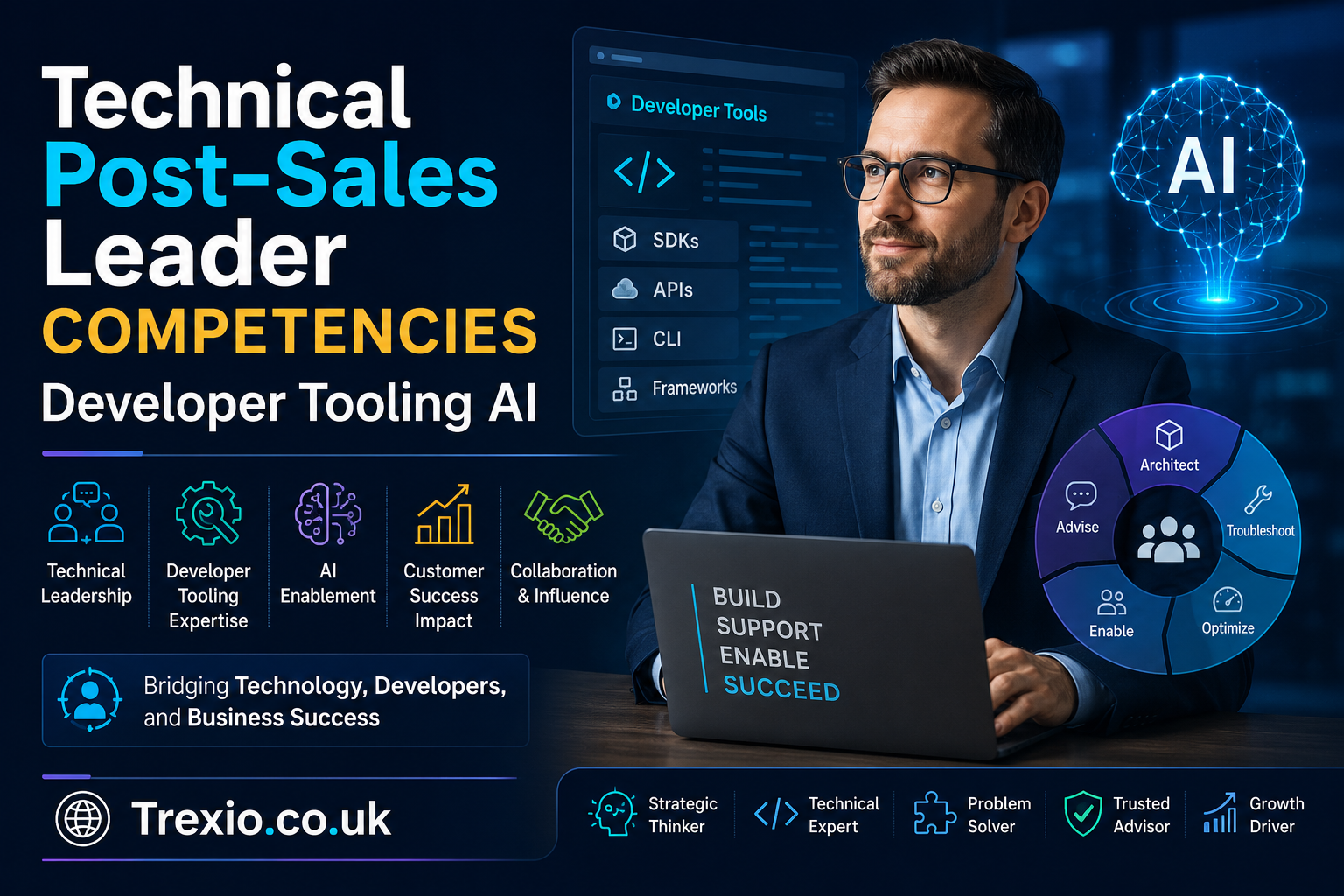
The role of a technical post-sales leader competencies developer tooling AI expert has evolved dramatically over the past few years. Organizations no longer expect post-sales leaders to simply manage customer onboarding or solve technical issues. Instead, they are expected to become strategic advisors who bridge engineering teams, product organizations, customer success departments, and executive stakeholders. As artificial intelligence becomes deeply integrated into software development, developer tooling, automation, and customer workflows, technical leaders must continuously expand their knowledge while helping customers maximize business value. Companies increasingly look for professionals who combine technical expertise with leadership, communication, and AI adoption skills. This combination enables organizations to improve customer retention, accelerate product adoption, and reduce implementation risks. The modern technical post-sales leader competencies developer tooling AI landscape demands continuous learning, cross-functional collaboration, and an understanding of emerging technologies. Leaders who master these competencies position both their customers and organizations for long-term success.
Quick Answer
A technical post-sales leader competencies developer tooling AI professional combines technical expertise, customer relationship management, AI knowledge, developer tooling experience, strategic leadership, and business communication skills. Their responsibilities include guiding customer implementations, improving developer productivity, optimizing AI-powered workflows, supporting engineering teams, driving product adoption, managing technical escalations, and ensuring customers achieve measurable business outcomes through modern software solutions.
Understanding Technical Post-Sales Leadership
What Is Technical Post-Sales Leadership?
Technical post-sales leadership focuses on everything that happens after a customer purchases a software platform, cloud service, AI solution, or developer tool. Unlike traditional sales roles, post-sales leaders remain engaged throughout implementation, optimization, adoption, expansion, and long-term customer success. They work closely with solution architects, support engineers, product managers, DevOps teams, developers, and executive stakeholders to ensure customers realize the full value of their investment. Within the growing technical post-sales leader competencies developer tooling AI environment, these professionals often coordinate complex implementations involving APIs, cloud infrastructure, automation pipelines, AI models, developer platforms, and security frameworks. Their responsibilities require balancing technical depth with business strategy while maintaining strong customer relationships. Modern organizations rely on these leaders to identify adoption barriers, reduce technical risk, and create scalable implementation strategies. Successful technical post-sales leadership directly contributes to customer retention, recurring revenue, and product innovation.
Why the Role Is Becoming More Strategic
Organizations increasingly recognize that customer success depends on more than product quality alone. Customers expect continuous guidance, technical expertise, proactive recommendations, and measurable outcomes throughout the product lifecycle. AI-powered software platforms introduce new implementation challenges, making experienced leaders even more valuable. The expanding technical post-sales leader competencies developer tooling AI ecosystem requires professionals who understand machine learning integrations, developer workflows, cloud-native applications, CI/CD pipelines, security compliance, and automation frameworks. These leaders also collect customer feedback that influences future product development and roadmap planning. By connecting customer experiences with engineering priorities, they help organizations deliver solutions that remain competitive in rapidly changing markets. Their strategic contributions often extend beyond technical support into executive consulting, digital transformation planning, and long-term customer partnership development.
Core Competencies Every Technical Post-Sales Leader Needs
Technical Expertise
A strong technical foundation remains one of the most important elements of technical post-sales leader competencies developer tooling AI success. Leaders should understand cloud computing platforms, APIs, REST services, authentication methods, containerization, Kubernetes, CI/CD processes, infrastructure automation, software architecture, and modern programming practices. While they may not write production code every day, they should comfortably discuss technical concepts with developers, architects, and engineering executives. Knowledge of developer tooling enables them to troubleshoot implementation challenges, recommend workflow improvements, and identify integration opportunities. Technical credibility builds customer confidence and allows leaders to communicate effectively across multiple departments. It also improves collaboration with product engineering teams during feature development and issue resolution. Maintaining current knowledge through certifications, hands-on experimentation, and industry research remains essential in today’s rapidly evolving technology landscape.
Business Understanding
Technical knowledge alone is insufficient for modern leadership roles. Successful professionals understand how software investments impact revenue, operational efficiency, customer satisfaction, and business growth. Within the technical post-sales leader competencies developer tooling AI framework, leaders must connect technical recommendations with measurable business outcomes. Customers often prioritize return on investment, operational scalability, compliance, and competitive advantage rather than technical specifications alone. Leaders who understand financial objectives can better prioritize implementation strategies and communicate value to executive stakeholders. Business awareness also enables stronger cross-functional collaboration between engineering, finance, customer success, and product management. This balanced perspective helps organizations create customer-centric solutions that support long-term strategic goals.
AI Knowledge for Modern Technical Leaders
Why AI Competencies Matter
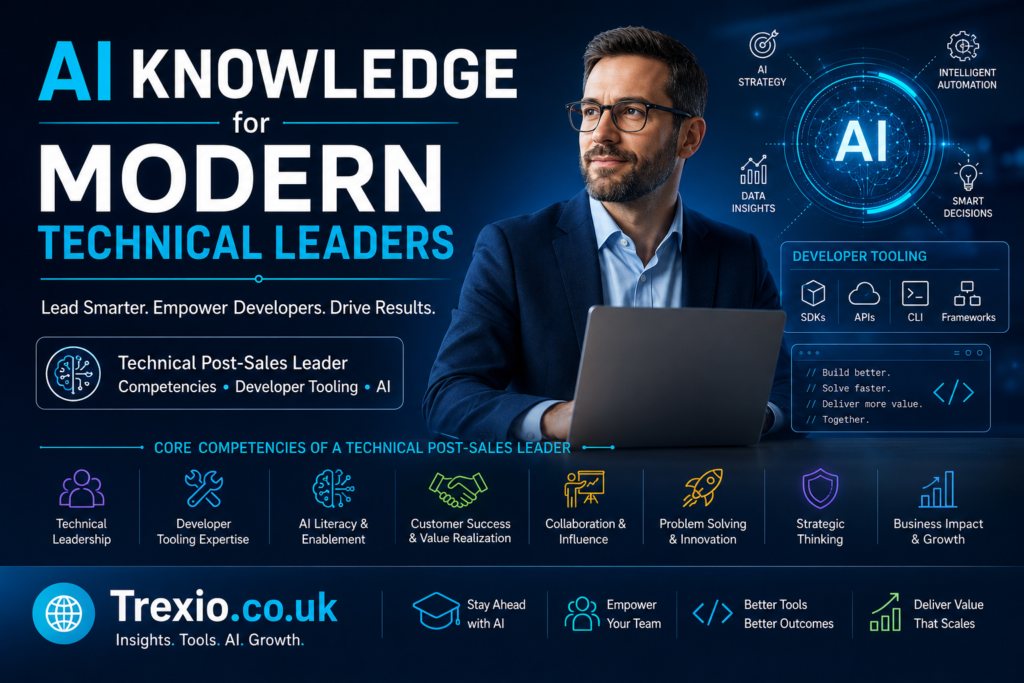
Artificial intelligence has become a central component of modern software platforms, making AI literacy essential for today’s post-sales leaders. Organizations increasingly deploy AI assistants, intelligent automation, predictive analytics, recommendation engines, natural language processing, and machine learning models across business operations. The evolving technical post-sales leader competencies developer tooling AI environment requires leaders who understand both AI capabilities and implementation limitations. Customers frequently ask about responsible AI usage, model performance, governance, data privacy, scalability, and integration strategies. Leaders who can confidently explain these concepts build stronger customer trust while reducing implementation uncertainty. AI knowledge also helps organizations identify opportunities to automate repetitive processes, improve developer productivity, and enhance customer experiences. Staying informed about emerging AI technologies ensures technical leaders remain valuable strategic advisors.
Responsible AI Leadership
Responsible AI extends beyond implementing machine learning models. Leaders should understand ethical considerations, bias mitigation, transparency, explainability, security, regulatory compliance, and human oversight. Within technical post-sales leader competencies developer tooling AI, responsible leadership includes helping customers establish governance frameworks that support reliable AI deployment. Organizations increasingly expect technical advisors to recommend best practices for protecting customer data while ensuring AI-generated outputs remain accurate and accountable. Leaders also coordinate with legal, compliance, and security teams to address evolving regulations affecting AI technologies. Building trust through responsible AI guidance strengthens long-term customer relationships and reduces organizational risk. This balanced approach allows businesses to innovate confidently while maintaining compliance with industry standards.
Developer Tooling Expertise
Understanding Modern Developer Ecosystems
Developer tooling has become increasingly sophisticated, requiring post-sales leaders to understand a broad range of technologies that support software delivery. The modern technical post-sales leader competencies developer tooling AI landscape includes integrated development environments, source control systems, CI/CD pipelines, testing frameworks, container orchestration, cloud deployment platforms, observability solutions, and infrastructure automation tools. Customers rely on technical leaders to recommend best practices that improve developer productivity while minimizing operational complexity. Understanding how these tools interact enables leaders to identify workflow bottlenecks and recommend scalable improvements. They also help organizations integrate AI-powered coding assistants, automated testing, and intelligent deployment pipelines into existing development environments. Strong developer tooling knowledge allows leaders to collaborate effectively with engineering teams while accelerating customer success initiatives.
Collaboration Between Engineering and Customers
One of the most valuable responsibilities within technical post-sales leader competencies developer tooling AI involves serving as the communication bridge between engineering teams and customers. Technical leaders translate customer requirements into actionable engineering feedback while explaining product capabilities in language that business stakeholders understand. Effective collaboration reduces misunderstandings, accelerates issue resolution, and improves product adoption. Leaders also coordinate feature requests, prioritize technical escalations, and ensure implementation milestones remain aligned with customer expectations. Regular communication builds trust among all stakeholders while supporting continuous product improvement. Organizations that foster strong collaboration typically experience higher customer satisfaction, increased retention, and more successful software deployments.
Leadership Skills That Drive Customer Success
Strategic Communication
Excellent communication distinguishes exceptional technical leaders from purely technical specialists. Modern technical post-sales leader competencies developer tooling AI professionals regularly communicate with executives, architects, developers, project managers, customer success teams, and product leaders. Each audience requires different messaging, technical depth, and business context. Strategic communication involves simplifying complex technical topics without sacrificing accuracy while ensuring customers understand implementation decisions and expected outcomes. Leaders also facilitate workshops, executive briefings, architecture reviews, roadmap discussions, and technical planning sessions. Clear communication minimizes project delays, improves stakeholder alignment, and strengthens customer confidence throughout implementation. Organizations benefit significantly when technical leaders consistently deliver transparent, proactive, and solution-focused communication.
Problem-Solving Mindset
Technical environments inevitably present unexpected challenges, making structured problem-solving a critical leadership competency. Professionals operating within the technical post-sales leader competencies developer tooling AI space analyze root causes, evaluate multiple solutions, prioritize customer impact, and coordinate cross-functional responses during complex technical situations. Rather than focusing solely on immediate fixes, successful leaders identify underlying process improvements that prevent recurring issues. They leverage data, customer feedback, engineering insights, and AI-powered analytics to make informed decisions. A disciplined approach to problem-solving improves operational efficiency while increasing customer confidence in the organization’s ability to deliver reliable solutions. Over time, this mindset contributes to stronger customer relationships and more predictable implementation outcomes.
Building High-Performing Cross-Functional Teams
The most effective technical post-sales leader competencies developer tooling AI professionals understand that exceptional customer outcomes are achieved through collaboration rather than individual effort. Technical post-sales leaders regularly work alongside solution architects, software engineers, product managers, technical account managers, customer success managers, security specialists, DevOps engineers, and executive sponsors. Each team contributes unique expertise that supports successful customer implementations and long-term adoption. Strong leaders establish clear communication channels, define ownership early, and ensure every stakeholder understands project goals and customer expectations. They also encourage knowledge sharing across departments to reduce silos and improve operational efficiency. When technical teams work together effectively, implementation timelines become more predictable and customer satisfaction increases significantly. Cross-functional leadership also enables organizations to respond quickly to changing customer requirements while maintaining product quality. This collaborative mindset is a defining characteristic of successful technical post-sales leader competencies developer tooling AI professionals.
Establishing Clear Ownership and Accountability
Successful post-sales organizations rely on clearly defined responsibilities throughout the customer lifecycle. Technical leaders create structured implementation plans that assign ownership for onboarding, integrations, documentation, testing, training, performance optimization, and ongoing support. By establishing accountability from the beginning, projects experience fewer delays and communication gaps. Regular status meetings, shared dashboards, and measurable milestones help every participant understand project progress and potential risks. Leaders also encourage transparent reporting so issues can be identified before they affect customer outcomes. AI-powered project management tools increasingly assist teams by providing automated progress tracking, predictive risk analysis, and intelligent task prioritization. These practices strengthen customer confidence while improving internal operational consistency. Strong accountability frameworks remain a core component of technical post-sales leader competencies developer tooling AI success.
Measuring Success Through Key Performance Indicators
Metrics That Matter
Effective leaders measure success using meaningful business and technical metrics rather than relying on assumptions. Within the technical post-sales leader competencies developer tooling AI environment, important KPIs include customer onboarding time, implementation success rate, product adoption, feature utilization, customer health scores, support ticket trends, renewal rates, expansion revenue, technical issue resolution time, and Net Promoter Score (NPS). These measurements provide valuable insights into customer engagement and operational performance. Leaders analyze data regularly to identify opportunities for process improvements and proactive customer support. AI-powered analytics platforms can detect usage patterns, forecast churn risks, and recommend optimization strategies before problems escalate. Consistent measurement enables organizations to continuously improve service quality while demonstrating measurable business value to customers. Data-driven leadership is increasingly essential in competitive technology markets.
Continuous Improvement Through Feedback
Customer feedback plays a critical role in strengthening both products and services. High-performing leaders establish structured feedback loops that capture insights during onboarding, implementation, training, quarterly business reviews, and ongoing customer interactions. This information helps engineering teams prioritize new features while allowing customer success organizations to refine their support strategies. AI tools further enhance this process by analyzing customer sentiment across support tickets, surveys, community forums, and communication channels. Leaders transform this information into actionable improvements that benefit both current and future customers. Continuous improvement also involves reviewing internal workflows, documentation quality, automation opportunities, and developer tooling effectiveness. Organizations that embrace feedback-driven decision-making consistently outperform competitors in customer retention and satisfaction. This capability further strengthens technical post-sales leader competencies developer tooling AI expertise.
AI-Driven Developer Tooling Trends
The Future of Intelligent Development Platforms
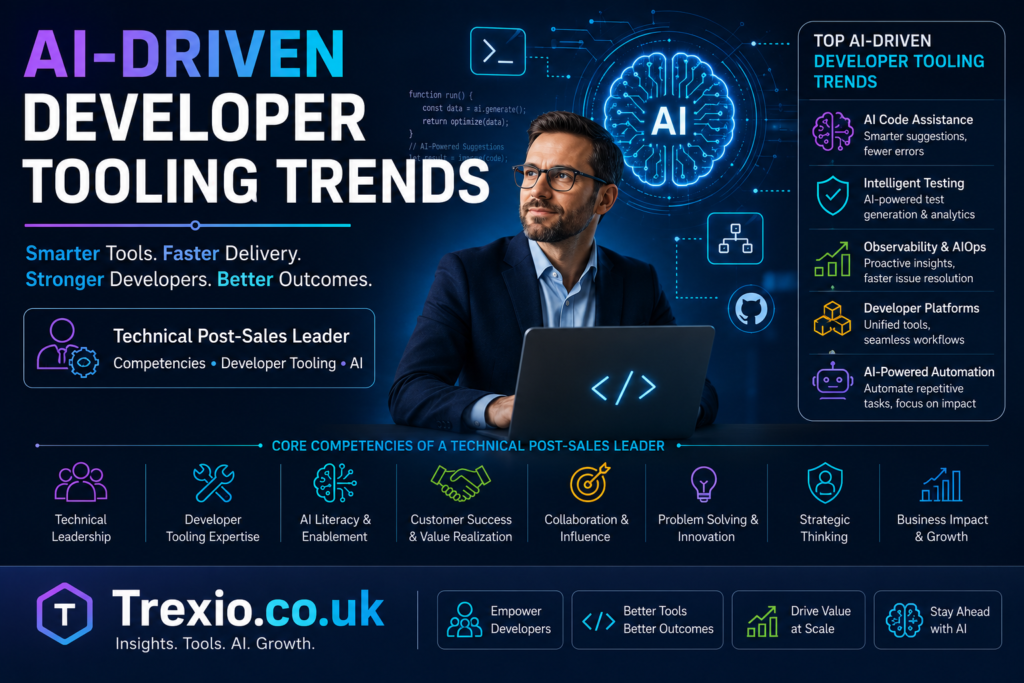
Artificial intelligence continues to reshape software engineering by introducing smarter developer tools and more efficient workflows. Modern development platforms increasingly include AI-powered code generation, automated documentation, intelligent debugging, security analysis, performance optimization, and deployment recommendations. For professionals focused on technical post-sales leader competencies developer tooling AI, understanding these technologies is becoming essential rather than optional. Customers expect guidance on selecting AI-enabled developer platforms that improve productivity without compromising software quality or security. Leaders also evaluate how AI integrates with existing CI/CD pipelines, cloud infrastructure, and enterprise governance policies. As these tools mature, technical leaders must balance innovation with responsible implementation practices. Staying informed about emerging technologies enables leaders to provide strategic recommendations that align with customer goals. Future-ready organizations depend on knowledgeable advisors who understand both current capabilities and upcoming trends.
Preparing Teams for AI Adoption
Successfully implementing AI requires more than deploying new software. Leaders invest in training programs, technical workshops, documentation, and change management initiatives that help teams confidently adopt new technologies. Employees must understand AI capabilities, limitations, ethical considerations, and security requirements before integrating these tools into production environments. Technical post-sales leaders frequently coordinate educational sessions that demonstrate practical AI use cases while addressing customer concerns about reliability and governance. They also encourage experimentation through pilot programs that allow organizations to evaluate AI solutions with minimal operational risk. Continuous learning ensures technical teams remain competitive as AI technologies evolve. Building AI readiness across departments is a defining aspect of modern technical post-sales leader competencies developer tooling AI leadership.
Comparison of Traditional vs AI-Enabled Post-Sales Leadership
| Area | Traditional Post-Sales Leadership | AI-Enabled Post-Sales Leadership |
|---|---|---|
| Customer Support | Reactive assistance | Predictive and proactive support |
| Data Analysis | Manual reporting | AI-powered analytics |
| Developer Productivity | Standard workflows | AI-assisted development |
| Customer Health Monitoring | Periodic reviews | Real-time monitoring |
| Documentation | Manual creation | AI-generated documentation |
| Risk Detection | Human observation | Predictive intelligence |
| Project Management | Static planning | Intelligent task automation |
| Decision Making | Experience-based | Data-driven insights |
| Customer Success | Service-focused | Outcome-focused |
| Scalability | Limited by team size | Enhanced through automation |
Essential Leadership Skills Comparison
| Competency | Importance | Business Impact |
|---|---|---|
| Technical Expertise | Very High | Improves implementation quality |
| AI Knowledge | Very High | Accelerates innovation |
| Communication | Very High | Strengthens stakeholder trust |
| Developer Tooling Knowledge | High | Enhances engineering productivity |
| Customer Success Management | High | Improves retention |
| Strategic Thinking | High | Supports long-term growth |
| Problem Solving | Very High | Reduces implementation risks |
| Collaboration | High | Improves cross-functional alignment |
| Business Acumen | High | Demonstrates customer value |
| Continuous Learning | Essential | Keeps skills current |
Best Practices
- Develop both technical expertise and business strategy skills simultaneously.
- Stay updated on AI technologies, cloud platforms, and modern developer tooling.
- Build strong relationships with engineering, product, and customer success teams.
- Use measurable KPIs to evaluate customer outcomes and operational performance.
- Encourage continuous customer feedback throughout every implementation phase.
- Promote responsible AI adoption with governance and security best practices.
- Document implementation processes to improve consistency and scalability.
- Invest regularly in professional certifications and technical education.
- Automate repetitive operational tasks where appropriate.
- Focus every customer interaction on delivering measurable business value through technical post-sales leader competencies developer tooling AI expertise.
Common Mistakes
- Focusing only on technical implementation while ignoring business objectives.
- Underestimating the importance of executive communication.
- Neglecting customer feedback after successful deployment.
- Implementing AI tools without governance or security planning.
- Poor collaboration between engineering and customer-facing teams.
- Relying on outdated developer workflows instead of modern automation.
- Measuring success using only support metrics instead of customer outcomes.
- Avoiding continuous learning as technologies rapidly evolve.
- Overcomplicating technical explanations for non-technical stakeholders.
- Treating post-sales support as reactive rather than strategic.
Pro Tips
Invest in Continuous Learning
Technology changes rapidly, making ongoing education essential. Attend industry conferences, complete cloud certifications, participate in AI workshops, and gain hands-on experience with emerging developer tools. Continuous learning strengthens your credibility with both customers and engineering teams while preparing you for future technology trends.
Build Strong Executive Relationships
Technical leaders should communicate confidently with executives as well as engineers. Present technical recommendations using measurable business outcomes, financial benefits, operational improvements, and customer success metrics. Executive-level communication often influences long-term partnerships and strategic account growth.
Use AI Responsibly
Leverage AI to automate repetitive tasks, improve analytics, generate documentation, and increase developer productivity. However, always combine AI recommendations with human expertise, governance policies, and security reviews. Responsible implementation builds customer trust while reducing operational risks.
Encourage Knowledge Sharing
Create internal documentation, technical workshops, mentoring programs, and collaborative learning sessions. Organizations that share expertise across departments improve innovation, reduce onboarding time, and strengthen long-term operational excellence.
Conclusion
The responsibilities associated with technical post-sales leader competencies developer tooling AI continue to expand as organizations embrace artificial intelligence, cloud-native architectures, and increasingly sophisticated developer ecosystems. Today’s leaders are expected to combine technical depth, strategic thinking, customer advocacy, business understanding, and AI expertise into a single leadership role that delivers measurable outcomes. Success depends on the ability to guide customers through complex implementations while collaborating effectively with engineering, product, and executive teams. Strong communication, continuous learning, responsible AI adoption, and data-driven decision-making have become essential competencies rather than optional advantages. Leaders who embrace these capabilities create stronger customer relationships, improve developer productivity, and contribute directly to sustainable business growth. As AI continues transforming software development and customer engagement, organizations will increasingly depend on skilled professionals who can bridge technology and business strategy. Developing these competencies today prepares technical leaders to deliver greater value, adapt to future innovations, and remain indispensable in an evolving technology landscape.
Frequently Asked Questions (FAQs)
1. What is a technical post-sales leader?
A technical post-sales leader helps customers successfully implement, adopt, optimize, and expand their software solutions after purchase while coordinating with engineering, customer success, and product teams.
2. Why is AI important for technical post-sales leadership?
AI improves customer insights, developer productivity, automation, predictive analytics, documentation, and implementation efficiency, making it an essential competency for modern leaders.
3. What developer tools should post-sales leaders understand?
They should understand version control systems, CI/CD pipelines, cloud platforms, APIs, containerization, monitoring tools, testing frameworks, infrastructure automation, and AI-assisted development platforms.
4. Which soft skills are most valuable?
Communication, leadership, collaboration, strategic thinking, problem-solving, stakeholder management, and customer relationship building are among the most valuable soft skills.
5. How do technical post-sales leaders improve customer retention?
They provide proactive guidance, resolve implementation challenges, optimize product adoption, monitor customer health metrics, and align technical solutions with business objectives.
6. How does developer tooling support customer success?
Modern developer tooling improves deployment speed, software quality, collaboration, automation, and operational efficiency, allowing customers to realize value faster.
7. What metrics should technical leaders monitor?
Key metrics include onboarding completion, feature adoption, implementation success, renewal rates, support response time, customer satisfaction, NPS, expansion revenue, and customer health scores.
8. How can professionals develop these competencies?
Continuous education, hands-on technical experience, AI training, leadership development, certifications, mentoring, and cross-functional collaboration all contribute to long-term growth.
9. What industries need technical post-sales leaders?
Technology companies, SaaS providers, cloud platforms, cybersecurity vendors, AI startups, enterprise software organizations, fintech companies, healthcare technology firms, and DevOps solution providers all benefit from these professionals.
10. What is the future of technical post-sales leadership?
The future centers on AI-powered automation, intelligent developer tooling, predictive customer success, stronger cross-functional leadership, and greater alignment between technical implementation and measurable business outcomes.
Author Bio
About the Author
The author is an experienced technology and SEO content writer specializing in artificial intelligence, cloud computing, developer tooling, software engineering, enterprise technology, and customer success. With a strong focus on Google’s EEAT principles and helpful content guidelines, the author creates in-depth, research-driven articles that simplify complex technical topics into practical, actionable insights for professionals, business leaders, and technology enthusiasts.