
Affordable Developer Workflow Optimization Tools for Small Engineering Teams
Small engineering teams often face the challenge of delivering high-quality software with limited budgets, fewer developers, and tight deadlines. Unlike large enterprises, startups and growing businesses cannot always invest in expensive enterprise development platforms. Fortunately, today’s market offers many affordable developer workflow optimization tools for small engineering teams that provide enterprise-level capabilities at a fraction of the cost. These tools simplify project planning, automate repetitive development tasks, improve collaboration, and reduce deployment delays. Instead of spending valuable hours on manual processes, developers can focus on writing clean, scalable code and solving real business problems. Choosing the right software stack also reduces communication gaps between developers, designers, QA engineers, and project managers. Modern workflow optimization solutions integrate seamlessly with popular version control systems, CI/CD pipelines, and cloud platforms. As a result, even a five-person engineering team can achieve productivity levels once reserved for much larger organizations.
Quick Answer
Affordable developer workflow optimization tools for small engineering teams help software developers automate repetitive tasks, manage code efficiently, improve communication, accelerate deployments, and reduce operational costs. Popular workflow categories include project management, Git collaboration, continuous integration, code review, documentation, monitoring, and automation tools. By selecting budget-friendly platforms that integrate well together, small engineering teams can significantly increase development speed, software quality, and team collaboration without investing in expensive enterprise software.
Why Small Engineering Teams Need Affordable Developer Workflow Optimization Tools
Small software teams operate under unique constraints that make efficiency more important than team size. Every developer typically handles multiple responsibilities, including coding, testing, reviewing pull requests, fixing bugs, documenting features, and sometimes even deploying production releases. Without affordable developer workflow optimization tools for small engineering teams, these responsibilities quickly become overwhelming, creating bottlenecks that slow product delivery. Workflow optimization tools reduce unnecessary manual work by automating repetitive processes while keeping everyone aligned on project goals. They also provide centralized visibility into ongoing development tasks, making it easier to prioritize work and identify blockers before they become major issues. Better organization allows developers to spend more time creating features instead of searching for information or coordinating manually. As projects grow, optimized workflows help maintain consistency without requiring additional management overhead. Ultimately, affordable solutions empower lean engineering teams to compete with much larger software organizations.
Another important reason to invest in workflow optimization is scalability. Many startups begin with only a handful of engineers, but as products gain users, development complexity increases rapidly. Affordable workflow platforms provide standardized development practices that continue working as teams expand. Features such as automated testing, issue tracking, documentation management, sprint planning, and deployment automation create repeatable processes that reduce human error. Team members also onboard faster because documentation, repositories, and development standards remain organized in one place. Budget-friendly software often includes cloud-based collaboration features that support hybrid and remote work environments. Rather than replacing existing tools, many optimization platforms integrate with current workflows, making adoption much easier. This combination of affordability and flexibility makes these solutions an excellent investment for growing engineering organizations.
Key Features to Look for in Affordable Developer Workflow Optimization Tools
Selecting affordable developer workflow optimization tools for small engineering teams involves more than comparing monthly subscription prices. The best platforms deliver measurable productivity improvements while remaining easy to implement and maintain. Teams should evaluate whether a tool simplifies existing workflows instead of introducing unnecessary complexity. Integration capabilities, automation features, reporting dashboards, and collaboration options are all critical considerations. Software that connects with Git repositories, cloud services, messaging platforms, and project management systems provides greater long-term value. Scalability also matters because changing platforms during rapid business growth can become costly and disruptive. Looking beyond pricing helps teams identify tools that generate the highest return on investment through improved engineering efficiency. Choosing the right feature set early prevents workflow fragmentation later.
Automation Capabilities
Automation is one of the biggest advantages offered by affordable developer workflow optimization tools for small engineering teams. Automated workflows eliminate repetitive activities such as running tests, checking code quality, assigning reviewers, creating deployments, updating issue statuses, and sending notifications. Developers no longer waste time performing repetitive administrative work that software can complete automatically. Continuous integration pipelines detect issues immediately after code commits, reducing debugging time later in the release cycle. Automated dependency updates improve software security while minimizing maintenance efforts. Scheduled reporting keeps stakeholders informed without requiring manual progress updates. Smart automation also minimizes deployment risks through standardized release processes. Even small automation improvements can save hundreds of engineering hours over a year.
Collaboration and Communication
Efficient communication is essential for distributed engineering teams. Workflow optimization platforms centralize discussions, code reviews, documentation, sprint planning, and issue tracking within connected systems. Instead of searching through multiple communication channels, developers access project information from one location. Real-time collaboration improves transparency while reducing misunderstandings about requirements or implementation details. Shared dashboards help everyone understand project priorities and development progress. Integration with messaging applications allows automated alerts whenever builds fail or pull requests require review. Improved collaboration shortens development cycles while reducing duplicated work across engineering teams. Strong communication ultimately leads to higher software quality and better customer satisfaction.
Categories of Affordable Developer Workflow Optimization Tools

The software development ecosystem contains numerous workflow solutions designed for different engineering activities. Instead of relying on one application to perform every task, successful teams often combine specialized tools that integrate seamlessly. This approach creates a complete development ecosystem while keeping software expenses manageable. Understanding the primary categories helps engineering leaders build efficient workflows that match their team’s size and technical requirements. Each category contributes differently to overall productivity, making thoughtful selection essential. Budget-conscious teams should prioritize tools that solve their largest workflow bottlenecks first before expanding their software stack. Incremental adoption minimizes disruption while maximizing return on investment. Over time, these integrated solutions create a highly optimized engineering workflow.
Project Management Platforms
Project management software organizes development tasks, sprint planning, feature prioritization, bug tracking, and release schedules. Affordable project management solutions provide visual boards, customizable workflows, backlog management, reporting dashboards, and collaboration tools that simplify software planning. Teams gain greater visibility into project progress while maintaining accountability for assigned tasks. Sprint planning becomes more predictable because workloads are easier to estimate and monitor. Integration with development repositories links code changes directly to project tasks, improving traceability. These platforms also support Agile, Scrum, Kanban, and hybrid project management methodologies. Small engineering teams benefit from increased organization without requiring dedicated project coordinators. Well-managed projects consistently deliver software faster and with fewer delays.
Version Control and Code Collaboration
Version control remains the foundation of every modern software development workflow. Affordable developer workflow optimization tools for small engineering teams often integrate directly with Git repositories to simplify branching, pull requests, merge reviews, release management, and code collaboration. Centralized repositories preserve development history while preventing accidental code loss. Code review workflows encourage knowledge sharing and maintain coding standards across the organization. Developers collaborate more confidently because changes remain fully traceable throughout the software lifecycle. Automated merge checks improve code quality before deployment. Repository integrations also simplify rollback procedures whenever production issues occur. Strong version control practices significantly reduce development risks while improving team productivity.
Continuous Integration and Continuous Delivery
Continuous Integration and Continuous Delivery have become essential components of modern engineering workflows. CI/CD solutions automatically build, test, validate, and deploy applications whenever developers submit code changes. Small engineering teams particularly benefit because automation replaces repetitive manual deployment procedures. Faster testing identifies bugs earlier when they are less expensive to fix. Deployment consistency improves software reliability while minimizing production downtime. Automated release pipelines also increase developer confidence because every deployment follows standardized quality checks. Frequent releases become practical, enabling organizations to respond quickly to customer feedback. Affordable CI/CD platforms provide enterprise-grade automation without enterprise-level pricing.
Benefits of Using Affordable Developer Workflow Optimization Tools
Adopting affordable developer workflow optimization tools for small engineering teams produces measurable improvements across nearly every stage of software development. Teams experience faster releases, better collaboration, fewer manual errors, stronger code quality, and improved resource utilization. Developers spend less time managing administrative tasks and more time solving technical challenges that create customer value. Automated testing and deployment reduce production incidents while increasing release confidence. Workflow visibility enables managers to allocate engineering resources more effectively based on real project data rather than assumptions. Documentation remains organized, making onboarding easier for new developers joining the team. Cross-functional collaboration also improves because everyone shares consistent project information. These combined advantages allow smaller organizations to compete successfully with significantly larger engineering departments.
Increased Developer Productivity
Developer productivity extends beyond writing code quickly. Productive engineers spend more time solving meaningful problems rather than waiting for approvals, searching documentation, configuring environments, or repeating manual deployment steps. Affordable workflow optimization tools remove these inefficiencies through intelligent automation and centralized collaboration. Developers experience fewer interruptions because information becomes easier to locate. Code reviews progress more smoothly thanks to integrated approval workflows. Faster build systems reduce waiting time during testing cycles. Automated notifications eliminate unnecessary follow-up communication. Higher productivity ultimately enables engineering teams to deliver greater business value using the same available resources.
How Small Engineering Teams Can Choose the Right Workflow Optimization Tools
Selecting the right affordable developer workflow optimization tools for small engineering teams requires more than comparing pricing plans. Every engineering team has unique workflows, development methodologies, technical stacks, and collaboration preferences. Before investing in any platform, teams should identify their biggest bottlenecks, whether they involve communication, deployment delays, project tracking, documentation, or code reviews. Mapping the current development lifecycle helps reveal where productivity is being lost and which processes can benefit most from automation. Teams should also prioritize tools that integrate easily with their existing software ecosystem to minimize implementation challenges. Scalability is another important factor because the tools chosen today should continue supporting the team as projects and developer headcount grow. Vendors offering generous free plans or affordable startup pricing often provide excellent value without sacrificing essential functionality. A thoughtful evaluation process ensures the selected workflow optimization tools improve productivity while remaining cost-effective for long-term use.
Evaluate Your Existing Development Workflow
Before adopting new software, engineering leaders should carefully analyze how their current development process operates. Understanding each stage—from planning and coding to testing, deployment, and monitoring—makes it easier to identify unnecessary manual tasks. Small engineering teams frequently discover repetitive work that can be automated using affordable developer workflow optimization tools for small engineering teams. Conducting workflow audits also uncovers communication gaps, duplicated effort, and inconsistent documentation practices that slow project delivery. Team feedback plays an essential role because developers experience workflow inefficiencies firsthand. Collecting measurable metrics such as deployment frequency, bug rates, and lead times provides valuable benchmarks for future improvements. Once pain points are documented, choosing the right tools becomes significantly easier. This structured approach reduces implementation risks while maximizing productivity gains.
Prioritize Integration Capabilities
One of the most valuable characteristics of affordable developer workflow optimization tools for small engineering teams is their ability to connect with other development platforms. Engineering teams rarely rely on a single application, making integrations critical for creating a seamless workflow. Tools that synchronize with Git repositories, cloud hosting services, project management software, documentation platforms, communication channels, and CI/CD systems eliminate manual data transfers between applications. Integrated environments improve data consistency while reducing administrative work. Developers can monitor builds, review code, manage tasks, and deploy applications without constantly switching between disconnected systems. Better integrations also improve reporting by consolidating development data into unified dashboards. As engineering operations become more automated, overall software quality and team efficiency continue improving. Selecting highly compatible tools creates a future-proof workflow capable of supporting business growth.
Essential Workflow Automation Strategies
Automation is one of the strongest reasons organizations invest in affordable developer workflow optimization tools for small engineering teams. Instead of relying on manual approvals and repetitive administrative work, engineering teams can automate routine activities while maintaining consistent development standards. Automated workflows reduce delays, minimize human error, and accelerate software delivery without increasing operational complexity. Every automated process saves valuable engineering time that can be redirected toward innovation and feature development. Workflow automation also provides predictable release cycles, making project planning more reliable for stakeholders. As automation expands across the software development lifecycle, teams gain greater confidence in deployment quality and operational stability. Modern optimization platforms make automation accessible even for organizations with limited technical resources. These improvements translate directly into higher productivity and lower development costs.
Automating Code Quality Checks
Maintaining consistent code quality becomes increasingly difficult as projects expand. Fortunately, affordable developer workflow optimization tools for small engineering teams often include automated linting, static analysis, formatting, and security scanning features that evaluate code before it reaches production. Automated code validation ensures every commit meets predefined quality standards without requiring constant manual reviews. Developers receive immediate feedback whenever coding issues are detected, allowing problems to be corrected earlier in the development cycle. Early detection significantly reduces debugging costs and improves overall software reliability. Standardized code quality also simplifies collaboration because developers follow consistent coding conventions. Over time, automated quality controls contribute to more maintainable and scalable software architectures. Consistency ultimately benefits both engineering teams and end users.
Streamlining Deployment Pipelines
Deployment automation removes one of the most stressful phases of software development. Instead of manually preparing releases, teams using affordable developer workflow optimization tools for small engineering teams can configure automated deployment pipelines that build, validate, test, and release applications with minimal human intervention. Automated deployments reduce configuration errors while ensuring every release follows identical quality assurance procedures. Rollback capabilities allow teams to recover quickly from unexpected production issues. Frequent deployments also become practical because automated pipelines reduce operational overhead. Faster releases enable businesses to respond rapidly to customer feedback and changing market requirements. Reliable deployment automation supports continuous improvement while maintaining application stability. Small engineering teams benefit from enterprise-grade release processes without requiring dedicated DevOps specialists.
Comparing Popular Workflow Optimization Tool Categories
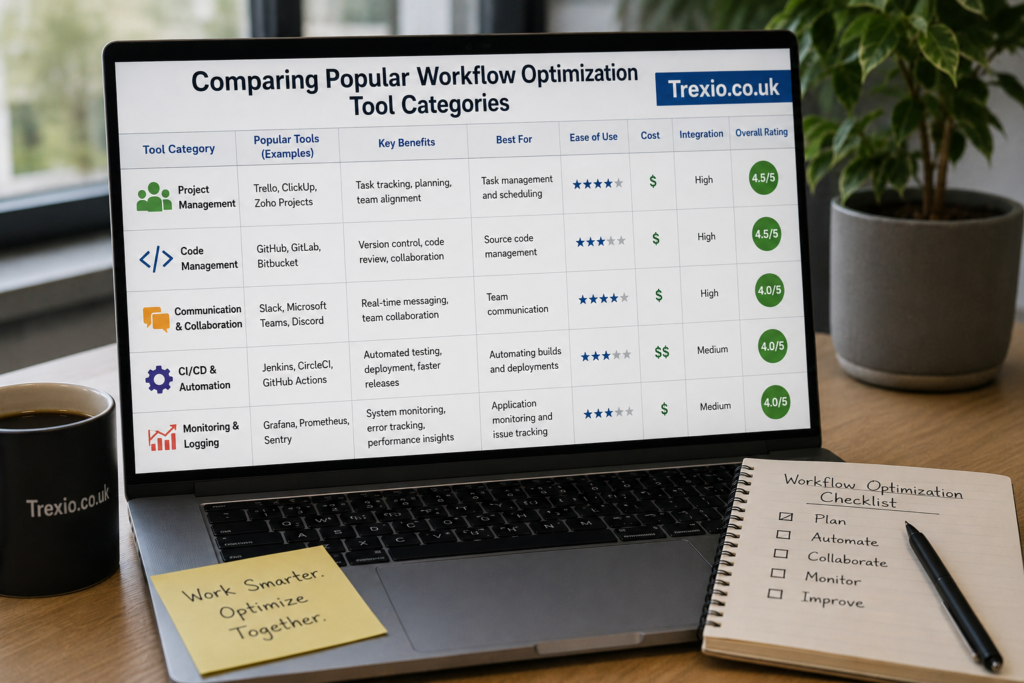
Although every organization has unique requirements, understanding the strengths of different workflow categories helps engineering teams make informed decisions when selecting affordable developer workflow optimization tools for small engineering teams.
| Tool Category | Primary Purpose | Best For | Budget Friendliness | Productivity Impact |
|---|---|---|---|---|
| Project Management | Sprint planning, task tracking | Agile teams | High | Excellent |
| Version Control | Source code collaboration | All development teams | High | Excellent |
| CI/CD Platforms | Automated testing and deployment | Growing teams | High | Very High |
| Documentation Tools | Knowledge management | Remote teams | High | High |
| Communication Platforms | Team collaboration | Distributed developers | High | High |
| Monitoring & Logging | Application performance | Production systems | Medium | Very High |
| Automation Platforms | Workflow automation | Lean engineering teams | High | Excellent |
The comparison above demonstrates that no single solution addresses every engineering challenge. Instead, successful organizations combine complementary tools that integrate effectively while remaining affordable. Small engineering teams should prioritize categories addressing their largest workflow bottlenecks before expanding their software ecosystem. This phased implementation strategy reduces adoption challenges while delivering measurable productivity improvements quickly. Over time, integrated workflow optimization tools create a connected engineering environment that supports faster development cycles, stronger collaboration, and more reliable software delivery.
Best Practices for Using Affordable Developer Workflow Optimization Tools for Small Engineering Teams
Implementing affordable developer workflow optimization tools for small engineering teams successfully requires thoughtful planning rather than simply installing new software. Following proven best practices helps organizations maximize productivity while minimizing disruption.
Best Practices
- Identify workflow bottlenecks before selecting tools.
- Automate repetitive development tasks whenever possible.
- Choose software with strong integration capabilities.
- Standardize coding guidelines across the engineering team.
- Maintain clear and up-to-date project documentation.
- Review workflow performance regularly using measurable metrics.
- Encourage developers to provide continuous feedback.
- Start with essential tools before expanding the software stack.
- Train every team member on workflow standards.
- Periodically remove unused applications that create unnecessary complexity.
Common Mistakes to Avoid
Many organizations invest in affordable developer workflow optimization tools for small engineering teams but fail to achieve expected productivity improvements because of avoidable implementation mistakes. Recognizing these common issues helps teams create sustainable workflow improvements.
Common Mistakes
| Mistake | Impact |
|---|---|
| Selecting tools based only on price | Missing important functionality |
| Ignoring integration compatibility | Workflow fragmentation |
| Over-automating every process | Reduced flexibility |
| Poor documentation practices | Slower onboarding |
| Lack of developer training | Low adoption rates |
| Using too many overlapping tools | Increased complexity |
| Ignoring workflow metrics | Limited optimization opportunities |
| Delaying process standardization | Inconsistent development practices |
Avoiding these mistakes enables engineering teams to gain maximum value from workflow optimization investments. Careful planning, continuous evaluation, and developer involvement contribute significantly to successful long-term adoption.
Pro Tips for Maximizing Workflow Efficiency
Engineering teams looking to get the most from affordable developer workflow optimization tools for small engineering teams should continuously refine their development processes instead of treating workflow optimization as a one-time project. Small improvements implemented consistently often generate larger long-term productivity gains than major system overhauls. Regularly reviewing engineering metrics helps identify new optimization opportunities as projects evolve. Developers should automate repetitive work whenever possible while preserving flexibility for creative problem-solving. Maintaining high-quality documentation improves onboarding and reduces recurring questions across the team. Periodic workflow reviews also help eliminate outdated tools that no longer provide meaningful value. Encouraging collaboration between engineering, QA, operations, and product teams strengthens communication while reducing unnecessary delays. Continuous learning and incremental optimization create sustainable productivity improvements over time.
Advanced Optimization Tips
Measure Before Optimizing
Track deployment frequency, lead time, pull request review duration, bug resolution speed, and build success rates before introducing new workflow tools. Baseline measurements make it easier to evaluate improvements objectively.
Keep Tooling Simple
Avoid creating overly complicated development environments. Small engineering teams usually achieve better results with a focused set of integrated applications rather than dozens of disconnected tools.
Review Workflows Quarterly
Engineering priorities change as products mature. Reviewing workflow performance every few months ensures tools continue supporting business objectives efficiently.
Conclusion
Choosing the right affordable developer workflow optimization tools for small engineering teams can dramatically improve software development efficiency without requiring enterprise-level budgets. Modern workflow platforms provide automation, collaboration, project management, deployment, documentation, and monitoring capabilities that help smaller engineering organizations compete with much larger teams. By carefully evaluating workflow bottlenecks, prioritizing integrations, and implementing automation strategically, businesses can reduce manual work while increasing software quality and delivery speed. Consistent documentation, standardized development practices, and continuous performance monitoring further strengthen engineering operations over time. Rather than adopting every available platform, successful teams focus on building a streamlined ecosystem that supports their unique development processes. Continuous improvement, developer feedback, and measurable workflow optimization ensure long-term productivity gains. Investing in affordable workflow optimization is ultimately an investment in faster innovation, better collaboration, and sustainable business growth.
Frequently Asked Questions (FAQs)
1. What are affordable developer workflow optimization tools for small engineering teams?
These are budget-friendly software solutions that improve coding, collaboration, project management, automation, testing, deployments, and documentation while helping small development teams work more efficiently.
2. Why are workflow optimization tools important?
They reduce repetitive work, improve communication, automate deployments, increase productivity, and help teams deliver higher-quality software faster.
3. Can startups benefit from workflow optimization tools?
Yes. Startups often have limited resources, making affordable developer workflow optimization tools for small engineering teams especially valuable for maximizing productivity.
4. Do these tools require DevOps expertise?
Not always. Many modern platforms provide intuitive interfaces, templates, and automation features suitable for teams without dedicated DevOps engineers.
5. How do workflow optimization tools improve code quality?
They automate testing, code reviews, linting, formatting, security scanning, and deployment validation to identify issues earlier in development.
6. Are cloud-based workflow tools secure?
Most reputable providers offer encryption, access controls, audit logs, and compliance certifications that help protect development environments.
7. How many workflow tools should a small engineering team use?
The ideal number depends on project complexity, but most teams benefit from a small collection of well-integrated tools instead of numerous disconnected applications.
8. What should teams evaluate before selecting workflow software?
Consider integrations, scalability, automation capabilities, pricing, security, ease of use, reporting, vendor support, and long-term business requirements.
9. Can workflow optimization reduce software development costs?
Yes. By automating repetitive processes, reducing bugs, improving collaboration, and shortening release cycles, workflow optimization lowers operational expenses.
10. How often should engineering workflows be reviewed?
Quarterly workflow reviews help ensure tools remain aligned with changing business objectives, technical requirements, and team growth.
Author Bio
Author: Tech Editorial Team
The Tech Editorial Team specializes in software development, cloud technologies, DevOps, developer productivity, and engineering management. With extensive experience researching modern software workflows, the team produces practical, EEAT-focused content that helps businesses, startups, and engineering professionals adopt reliable, cost-effective technologies for long-term success.