
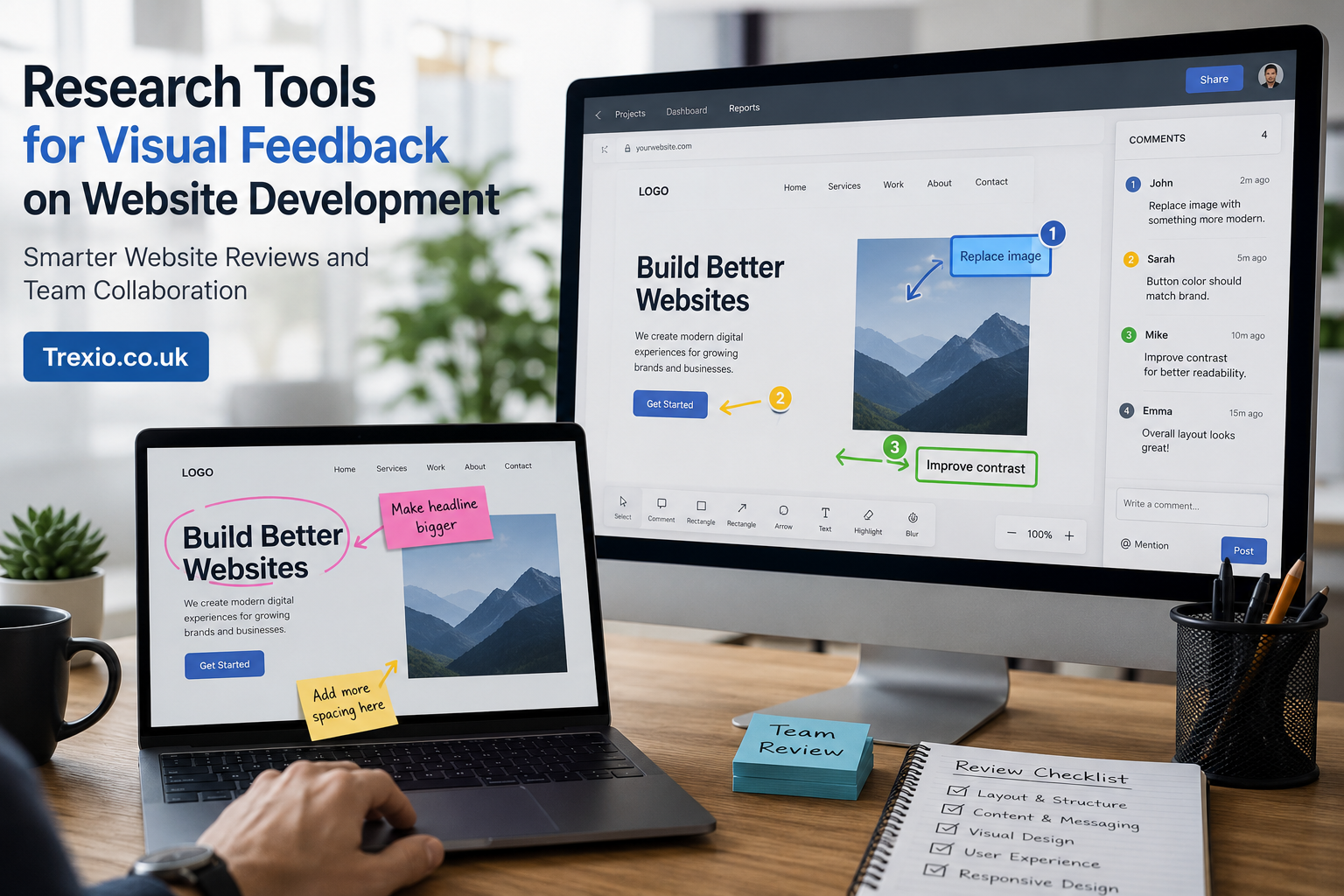
Research Tools for Visual Feedback on Website Development
Modern website projects involve multiple stakeholders, including designers, developers, clients, marketers, SEO specialists, and quality assurance teams. Every person has different expectations, making website reviews more challenging than ever before. This is where research tools for visual feedback on website development become incredibly valuable. Instead of sending long email threads or confusing spreadsheets, these platforms allow users to leave comments directly on webpages. Team members can click on any page element, attach screenshots, report issues, and provide suggestions without misunderstanding the exact location of a problem. This approach dramatically improves communication while reducing development delays. Companies of all sizes are now adopting research tools for visual feedback on website development because they streamline collaboration, increase transparency, and create better digital products. Whether you’re building a corporate website, SaaS platform, ecommerce store, or landing page, visual feedback software helps everyone stay aligned throughout the project lifecycle.
Quick Answer
Research tools for visual feedback on website development are specialized collaboration platforms that allow designers, developers, clients, and testers to provide contextual comments directly on a website or prototype. These tools simplify bug reporting, improve communication, accelerate design reviews, reduce misunderstandings, and help teams deliver higher-quality websites faster. They also integrate with popular project management systems, making issue tracking more organized and efficient.
Why Research Tools for Visual Feedback on Website Development Matter
Website development has evolved far beyond writing code and publishing pages. Modern websites require continuous collaboration between designers, frontend developers, backend engineers, SEO professionals, UX researchers, content creators, and clients. Each contributor reviews different aspects of the project, from layout consistency to performance and accessibility. Without research tools for visual feedback on website development, valuable suggestions often become scattered across emails, messaging apps, spreadsheets, or phone calls, making issues difficult to prioritize. Visual collaboration platforms centralize every comment within the actual webpage, ensuring everyone understands exactly what requires attention. Developers spend less time searching for problems, while clients enjoy a simpler review experience that requires little technical knowledge. This organized workflow improves project visibility and minimizes unnecessary revisions. As websites become increasingly interactive, using research tools for visual feedback on website development has become a practical necessity rather than an optional enhancement.
These tools also support continuous improvement after launch. Marketing teams can identify conversion issues, UX specialists can analyze user behavior, QA testers can report interface bugs, and SEO experts can highlight content or technical improvements. Since every suggestion remains attached to the corresponding webpage element, development teams receive clear and actionable tasks instead of vague descriptions. This reduces communication gaps and accelerates decision-making throughout the project. Businesses adopting research tools for visual feedback on website development frequently experience faster approval cycles, better customer satisfaction, improved usability, and more efficient collaboration across distributed teams.
Understanding Research Tools for Visual Feedback on Website Development
Research tools for visual feedback on website development are collaborative software solutions designed to collect comments, suggestions, bug reports, annotations, and usability observations directly on websites or prototypes. Unlike traditional communication methods, these platforms allow reviewers to click on specific elements, highlight sections, attach screenshots, record videos, and explain improvements visually. The result is much clearer communication between everyone involved in the project. Development teams no longer need to interpret lengthy descriptions because every issue includes exact visual context. This significantly reduces confusion during website revisions and speeds up implementation. Organizations working remotely especially benefit from research tools for visual feedback on website development, as they eliminate geographic barriers and support asynchronous collaboration. Many platforms also include version history, approval workflows, task assignments, and integrations with project management software.
Another important advantage is accessibility for non-technical stakeholders. Clients often struggle to describe website issues using technical terminology, but visual commenting tools simplify the process into a point-and-click experience. Marketing managers can suggest content improvements, executives can approve layouts, and customers can participate in usability testing without learning development terminology. As a result, feedback becomes more accurate and actionable. Businesses investing in research tools for visual feedback on website development often discover that projects progress more smoothly because communication is more visual, transparent, and organized from initial wireframes through final deployment.
Core Functions of Visual Feedback Platforms
Most modern research tools for visual feedback on website development provide a comprehensive collection of collaborative features that simplify website reviews. Users can place comments anywhere on a webpage, capture screenshots, annotate interface elements, assign tasks to developers, set priorities, and track issue status from open to resolved. Many solutions also include browser extensions, mobile testing capabilities, video recording, responsive testing, and collaborative dashboards. These capabilities create a centralized environment where every stakeholder contributes without disrupting existing workflows. Since feedback remains connected to specific webpage elements, developers avoid ambiguity and reduce unnecessary clarification meetings. This ultimately increases productivity while improving website quality across multiple iterations.
Industries That Benefit Most
Nearly every industry building digital experiences can benefit from research tools for visual feedback on website development. Software companies use them during sprint reviews and feature testing. Ecommerce businesses identify checkout issues before launch. Marketing agencies accelerate client approvals and campaign landing page revisions. Educational institutions review accessibility compliance across online learning platforms. Healthcare organizations verify user-friendly patient portals, while financial institutions improve online banking interfaces. Government agencies also use collaborative review platforms to ensure digital services remain accessible and easy to navigate. Because website quality directly impacts customer satisfaction, organizations across industries increasingly rely on visual collaboration tools throughout development.
Key Features to Look for in Research Tools for Visual Feedback on Website Development
Choosing the right research tools for visual feedback on website development requires evaluating several important capabilities rather than simply selecting the most popular platform. An effective solution should make collaboration easier while integrating naturally into existing workflows. Features such as visual annotations, screenshot capture, browser compatibility, responsive testing, user permissions, issue tracking, integrations, and reporting significantly influence long-term usability. Teams should also consider scalability, security, ease of onboarding, and support for multiple reviewers. A platform that balances simplicity with powerful collaboration features delivers better long-term value than software overloaded with unnecessary complexity. Organizations should prioritize tools that reduce communication friction while improving project transparency across every development stage.
The ability to integrate with project management systems is another critical consideration. When comments automatically become development tasks, teams eliminate duplicate work and maintain consistent project documentation. Notifications, approval workflows, and version tracking further improve accountability while ensuring every issue receives appropriate attention. Mobile compatibility also allows stakeholders to review responsive designs across different devices. Since many businesses operate internationally, multilingual support and cloud accessibility become increasingly valuable. Selecting comprehensive research tools for visual feedback on website development ensures smoother collaboration regardless of team size or project complexity.
Essential Collaboration Features
Visual Comments
Visual comments allow reviewers to click directly on interface elements instead of describing locations manually. This dramatically reduces misunderstandings and accelerates issue resolution.
Screenshot Annotation
Annotated screenshots highlight design issues with arrows, boxes, labels, and notes, making bug reporting significantly more accurate.
Task Assignment
Assigning comments directly to developers, designers, or QA specialists improves accountability and simplifies project management.
Issue Tracking
Issue tracking enables teams to monitor progress from report creation through verification and final resolution.
Responsive Testing
Responsive testing ensures reviewers evaluate desktop, tablet, and mobile versions without switching between multiple applications.
Advanced Features
Many premium research tools for visual feedback on website development also include session recording, browser diagnostics, console logs, user permission management, API integrations, workflow automation, client approval systems, analytics dashboards, version comparison, accessibility reporting, and AI-assisted issue categorization. These advanced capabilities become especially valuable for enterprise organizations managing multiple simultaneous website projects. Instead of manually organizing hundreds of comments, intelligent automation prioritizes issues based on severity, project stage, or assigned team members. This creates more efficient review cycles while improving software quality and development speed.
Benefits of Using Research Tools for Visual Feedback on Website Development

Organizations implementing research tools for visual feedback on website development quickly notice measurable improvements across communication, productivity, and project quality. Visual collaboration dramatically reduces confusion because every suggestion references an exact webpage location. Designers receive clearer revision requests, developers understand reported issues immediately, and clients feel more engaged throughout the review process. This transparency shortens approval cycles while reducing costly misunderstandings that often delay website launches. Teams also spend less time organizing feedback because comments remain centralized within one collaborative workspace. These efficiencies contribute to faster development timelines and improved project outcomes.
Beyond productivity, visual feedback software also supports higher-quality user experiences. UX researchers identify usability problems earlier, accessibility experts document compliance issues more effectively, and QA teams verify bug fixes with greater confidence. Marketing professionals can review conversion elements while SEO specialists evaluate page structure without leaving the review platform. This multidisciplinary collaboration produces more polished websites that satisfy both business objectives and user expectations. As digital competition continues growing, investing in research tools for visual feedback on website development provides organizations with a strategic advantage through improved teamwork and continuous website optimization.
Business Advantages
Businesses adopting research tools for visual feedback on website development often experience reduced revision costs, improved stakeholder communication, faster client approvals, stronger documentation, higher customer satisfaction, and more predictable project delivery schedules. Because feedback becomes centralized and transparent, managers gain better visibility into project progress while identifying recurring issues that require process improvements. These benefits contribute to long-term operational efficiency while strengthening relationships between agencies, clients, and internal development teams.
Technical Advantages
From a technical perspective, research tools for visual feedback on website development improve bug reporting accuracy, simplify responsive testing, reduce duplicated issues, enhance version control, support accessibility audits, and streamline quality assurance workflows. Developers receive contextual information that minimizes guesswork, allowing them to resolve issues more efficiently. As development teams adopt agile methodologies and continuous deployment practices, these platforms become increasingly valuable for maintaining consistent software quality throughout every release cycle.
How to Choose the Right Research Tools for Visual Feedback on Website Development
Selecting the right research tools for visual feedback on website development requires more than comparing feature lists or pricing plans. Every organization has unique workflows, project sizes, team structures, and collaboration needs that should influence the decision. Small businesses may prioritize ease of use and affordability, while enterprise organizations often require advanced security, role-based permissions, integrations, and detailed reporting. It is also important to evaluate how well the platform supports designers, developers, QA engineers, marketers, and clients simultaneously. A tool that satisfies only one department can create communication bottlenecks elsewhere in the project. Before making a final decision, teams should conduct trial projects, gather stakeholder feedback, and assess onboarding requirements. Reviewing customer support quality, software updates, documentation, and scalability ensures the chosen solution continues to deliver value as projects grow. Investing time in evaluating research tools for visual feedback on website development carefully helps organizations avoid costly migrations and ensures long-term collaboration success.
Selection Criteria Checklist
When evaluating research tools for visual feedback on website development, consider these factors:
| Feature | Why It Matters | Business Impact |
|---|---|---|
| Visual Commenting | Pinpoint exact issues | Faster revisions |
| Screenshot Annotation | Improves clarity | Fewer misunderstandings |
| Browser Compatibility | Supports multiple environments | Better testing |
| Mobile Responsiveness | Reviews across devices | Improved UX |
| Team Collaboration | Multiple reviewers | Faster approvals |
| Project Integrations | Connects with workflows | Higher productivity |
| User Permissions | Protects sensitive projects | Better security |
| Reporting Dashboard | Tracks progress | Improved management |
| Version History | Review previous changes | Better accountability |
| Customer Support | Faster problem resolution | Reduced downtime |
Comparing Different Types of Research Tools for Visual Feedback on Website Development
The market offers a wide variety of research tools for visual feedback on website development, each designed for different review processes and team structures. Some platforms focus primarily on website annotations, while others combine bug tracking, project management, user testing, and collaboration into a single solution. Understanding these categories helps organizations choose software that aligns with their development methodology instead of paying for unnecessary features. Teams working with Agile or Scrum may prioritize issue management, whereas creative agencies often value client approval workflows and design collaboration. Selecting the correct category improves productivity while reducing implementation complexity. Organizations should also consider future business growth, as scalable platforms provide better long-term value than limited solutions. By comparing software based on workflow rather than popularity alone, businesses maximize their investment in research tools for visual feedback on website development.
Comparison Table
| Tool Category | Primary Purpose | Best For | Collaboration Level |
|---|---|---|---|
| Visual Annotation Tools | Website comments | Designers & Clients | High |
| Bug Tracking Platforms | Technical issues | Developers | High |
| UX Research Platforms | User behavior analysis | UX Teams | Medium |
| QA Testing Software | Quality assurance | QA Engineers | High |
| Project Management Suites | Task organization | Entire Teams | High |
| Prototype Review Tools | Design feedback | UI/UX Designers | Medium |
| User Testing Platforms | Customer insights | Product Teams | Medium |
Best Practices for Using Research Tools for Visual Feedback on Website Development
Organizations achieve the greatest value from research tools for visual feedback on website development when they establish structured review processes rather than allowing unorganized comments. Every reviewer should understand how to create actionable feedback that includes context, expected outcomes, and priority levels. Teams should schedule regular review sessions instead of waiting until development is nearly complete, allowing issues to be resolved earlier when changes are less expensive. Consistent naming conventions, issue categories, and tagging systems improve project organization and simplify reporting. Developers should acknowledge comments promptly while reviewers verify completed fixes to maintain accountability throughout the workflow. Documentation should remain centralized so future projects benefit from lessons learned during previous website builds. Regular platform training also ensures new employees understand collaboration standards and software capabilities. Following these best practices allows research tools for visual feedback on website development to become an integral part of continuous improvement rather than simply another communication platform.
Recommended Best Practices
- Establish clear review guidelines before projects begin.
- Assign every comment to a responsible team member.
- Include screenshots whenever possible.
- Prioritize issues by severity and business impact.
- Review mobile and desktop layouts separately.
- Integrate visual feedback into project management software.
- Encourage concise, actionable comments.
- Verify resolved issues before closing them.
- Archive completed projects for future reference.
- Conduct periodic workflow evaluations.
Common Mistakes When Using Research Tools for Visual Feedback on Website Development

Although research tools for visual feedback on website development simplify collaboration, improper usage can reduce their effectiveness. One common mistake is leaving vague comments such as “this looks wrong” without explaining the desired improvement. Another frequent problem involves creating duplicate reports for the same issue, forcing developers to spend unnecessary time organizing feedback instead of fixing problems. Teams also sometimes delay reviews until the end of development, resulting in expensive redesigns that could have been avoided through earlier collaboration. Ignoring priority levels makes it difficult to distinguish critical bugs from minor cosmetic suggestions, delaying important fixes. Some organizations fail to provide adequate user permissions, exposing confidential projects or allowing accidental modifications. Others neglect training, leaving stakeholders unaware of advanced collaboration features that improve productivity. Avoiding these mistakes ensures research tools for visual feedback on website development deliver consistent value across every project.
Mistakes to Avoid
| Mistake | Result |
|---|---|
| Vague comments | Developer confusion |
| Duplicate reports | Wasted effort |
| Late reviews | Increased costs |
| Poor prioritization | Delayed launches |
| No workflow standards | Inconsistent collaboration |
| Ignoring mobile testing | Poor user experience |
| Lack of integrations | Manual work |
| Skipping reviewer training | Lower productivity |
Pro Tips for Maximizing Research Tools for Visual Feedback on Website Development
Experienced teams recognize that research tools for visual feedback on website development become even more powerful when integrated into every stage of the website lifecycle rather than being used only before launch. Begin collecting visual feedback during wireframing, continue throughout design and development, and maintain collaboration after deployment for ongoing optimization. Encourage cross-functional participation by involving SEO professionals, accessibility experts, customer support representatives, and marketing teams alongside developers and designers. Automating notifications, issue assignments, and reporting reduces administrative work while improving response times. Organizations should also create reusable review templates to maintain consistency across multiple projects. Tracking recurring issues helps identify opportunities for process improvements that prevent future mistakes. Regularly reviewing analytics and collaboration metrics provides insight into workflow efficiency and team performance. Applying these strategies allows businesses to unlock the full potential of research tools for visual feedback on website development while delivering better digital experiences.
Expert Tips
- Review pages before coding begins.
- Standardize feedback templates.
- Encourage client participation early.
- Connect comments directly to project tasks.
- Schedule recurring review meetings.
- Test across multiple browsers and devices.
- Measure response times for issue resolution.
- Maintain an organized comment archive.
- Use visual evidence instead of lengthy explanations.
- Continuously improve review workflows.
Future Trends in Research Tools for Visual Feedback on Website Development
The future of research tools for visual feedback on website development is being shaped by artificial intelligence, automation, cloud collaboration, and advanced analytics. AI-powered platforms are beginning to categorize comments automatically, recommend solutions, identify duplicate issues, and prioritize tasks based on project impact. Machine learning can analyze historical feedback to predict recurring usability problems before they affect users. Real-time collaboration continues improving through live annotations, shared editing sessions, and integrated communication channels. Accessibility auditing, responsive testing, and performance monitoring are increasingly becoming native features rather than separate tools. Businesses are also demanding stronger integrations with development pipelines, enabling visual feedback to flow directly into issue tracking and deployment systems. As remote work continues expanding worldwide, organizations will rely even more heavily on research tools for visual feedback on website development to maintain efficient communication, improve software quality, and accelerate digital transformation initiatives.
Conclusion
Modern websites require seamless collaboration between designers, developers, marketers, quality assurance teams, executives, and clients. Research tools for visual feedback on website development have transformed how organizations review websites by replacing confusing email chains and scattered documents with clear, contextual visual communication. These platforms improve collaboration, reduce misunderstandings, accelerate approvals, and support better decision-making throughout the website development lifecycle. From visual annotations and bug reporting to responsive testing and workflow automation, the right solution enables teams to deliver higher-quality digital experiences while reducing unnecessary revisions. Organizations that establish structured review processes, follow best practices, avoid common mistakes, and embrace continuous improvement gain the greatest return on their investment. As technology continues evolving, visual collaboration tools will become even more intelligent, integrated, and essential for successful website development. Adopting effective research tools for visual feedback on website development today positions businesses to create faster, smarter, and more user-focused websites in the years ahead.
Frequently Asked Questions (FAQs)
1. What are research tools for visual feedback on website development?
They are collaboration platforms that allow users to leave visual comments, annotations, screenshots, and suggestions directly on website pages during development and testing.
2. Who should use research tools for visual feedback on website development?
Designers, developers, QA testers, marketers, SEO specialists, project managers, clients, and UX researchers all benefit from these collaborative platforms.
3. Why are visual feedback tools better than email?
They attach comments directly to webpage elements, reducing confusion, improving communication, and speeding up issue resolution.
4. Can these tools improve website quality?
Yes. They help identify usability issues, design inconsistencies, technical bugs, accessibility problems, and content improvements before launch.
5. Are research tools for visual feedback on website development suitable for remote teams?
Absolutely. They enable distributed teams to collaborate efficiently regardless of location through cloud-based communication and centralized project tracking.
6. Do visual feedback tools support mobile website testing?
Most modern platforms allow reviewers to test and comment on desktop, tablet, and mobile layouts to ensure responsive website performance.
7. How do these tools integrate with project management software?
Many platforms synchronize comments with task management systems, allowing developers to track, prioritize, and resolve issues without manual data entry.
8. Are these tools useful after website launch?
Yes. They continue supporting optimization, bug reporting, conversion improvements, accessibility reviews, and ongoing maintenance.
9. What features should businesses prioritize?
Visual commenting, screenshot annotation, task assignment, integrations, reporting dashboards, responsive testing, and user permission management are among the most valuable capabilities.
10. How often should website teams conduct visual feedback reviews?
Regular reviews throughout planning, design, development, testing, and post-launch maintenance produce the best results and reduce expensive last-minute revisions.
Author Bio
About the Author
The author is an experienced SEO content strategist and digital technology writer specializing in website development, UX research, SaaS platforms, and collaborative software solutions. With extensive experience creating EEAT-focused, search-optimized content, the author helps businesses and professionals understand complex technical topics through clear, practical, and engaging articles that support informed decision-making and long-term digital success.