
The online lottery industry has transformed dramatically over the past decade as digital technology continues to reshape how people participate in games of chance. Businesses, gaming startups, and government lottery organizations are investing in advanced platforms that deliver secure, fast, and user-friendly lottery experiences across web and mobile devices. Behind every successful lottery application is a carefully selected combination of development frameworks, backend technologies, cloud infrastructure, payment integrations, and security systems. Choosing the right lottery game development platforms tools lotterygamedevelopers can significantly reduce development time while improving scalability and long-term performance. Developers must also consider legal compliance, fraud prevention, data protection, and user engagement when selecting their technology stack. Modern lottery software is no longer limited to simple number selection but now includes real-time draws, instant-win games, digital wallets, loyalty systems, and analytics dashboards. Understanding the available platforms and tools is the first step toward building a reliable and competitive lottery solution. This guide explores the essential technologies, development approaches, and software components that professional lottery game developers use today.
Quick Answer
If you’re looking for the best lottery game development platforms tools lotterygamedevelopers, focus on platforms that provide strong security, cloud scalability, payment integration, API support, responsive UI frameworks, real-time communication, analytics, and compliance features. Popular development stacks typically combine modern frontend frameworks, robust backend technologies, cloud services, secure databases, DevOps pipelines, and automated testing tools. The ideal platform depends on your project size, target audience, regional regulations, and future expansion plans.
Why Lottery Game Development Requires Specialized Platforms
Lottery software development differs significantly from ordinary mobile application development because it involves financial transactions, random number generation, user verification, legal compliance, and sensitive customer information. A reliable lottery game development platforms tools lotterygamedevelopers ecosystem must ensure fairness, transparency, and high availability at every stage of the gaming process. Unlike entertainment apps, lottery platforms cannot tolerate data inconsistencies, payment failures, or prolonged downtime because these issues directly affect user trust and revenue. Developers must also prepare their systems to handle sudden traffic spikes during jackpot events or promotional campaigns. Modern lottery applications require encryption technologies, fraud detection mechanisms, automated auditing, and secure payment gateways to meet regulatory standards. Performance optimization is equally important because players expect instant ticket purchases and real-time draw updates. Professional development platforms provide reusable modules that simplify these complex requirements while maintaining security and scalability. As competition in digital gaming increases, choosing the right development platform becomes a strategic investment rather than simply a technical decision.
Understanding Lottery Game Development Platforms
Lottery development platforms are comprehensive software environments that provide the frameworks, libraries, backend infrastructure, APIs, and administrative tools required to build lottery applications efficiently. These platforms enable developers to manage ticket sales, player accounts, payment processing, random number generation, prize distribution, and reporting from a centralized environment. Selecting suitable lottery game development platforms tools lotterygamedevelopers allows businesses to accelerate product development while reducing maintenance costs. Modern platforms also support cross-platform deployment so that applications work seamlessly on desktop browsers, Android devices, and iOS smartphones. Many solutions include built-in dashboards that allow operators to manage games, promotions, customer support, and financial reporting without requiring additional software. Flexible architecture ensures that new features can be added as business requirements evolve. Security remains a primary consideration, with many platforms incorporating identity verification, encryption, multi-factor authentication, and audit logging. These capabilities make lottery platforms far more sophisticated than standard gaming applications.
Essential Features Every Lottery Platform Should Include
Secure User Authentication
Strong authentication systems protect player accounts from unauthorized access while maintaining a smooth user experience. Developers often implement email verification, phone verification, biometric authentication, and multi-factor authentication to strengthen account security. Identity verification also helps operators comply with regional gaming regulations and prevents duplicate registrations. Effective authentication reduces fraud while increasing player confidence in the platform. Account recovery mechanisms must also be carefully designed to avoid security vulnerabilities. Secure password storage and encrypted communication are fundamental components of any lottery platform. These security measures establish the foundation for trusted digital gaming experiences. Reliable authentication remains one of the most important elements of modern lottery game development platforms tools lotterygamedevelopers.
Payment Gateway Integration
Lottery applications depend heavily on secure and reliable payment processing systems. Payment integrations allow users to purchase tickets, deposit funds, withdraw winnings, and manage digital wallets with minimal friction. Multiple payment methods improve accessibility for users across different regions and demographics. Payment systems should support transaction monitoring, fraud detection, automated reconciliation, and refund processing. Secure encryption ensures sensitive financial information remains protected throughout each transaction. Developers also integrate payment notifications to provide instant confirmation after successful purchases. A flexible payment architecture allows operators to add new providers as markets expand. Reliable payment processing significantly improves customer satisfaction and business credibility.
Types of Lottery Games Developers Build
Traditional Number Lottery Games
Traditional lottery games remain among the most popular digital gaming products worldwide. Players select numbers before scheduled draws, with prizes determined by matching winning combinations. Developers create administrative systems that manage draw scheduling, ticket validation, prize calculations, and historical records. Automation reduces manual errors while improving operational efficiency. Modern interfaces simplify ticket purchasing and number selection for users of all experience levels. Real-time notifications keep participants informed about upcoming draws and winning announcements. Secure databases store ticket information while maintaining compliance with privacy regulations. These games continue to form the foundation of many lottery game development platforms tools lotterygamedevelopers projects.
Instant Win Lottery Games
Instant-win games provide immediate results rather than requiring scheduled draws, making them particularly attractive to mobile users. Developers create digital scratch cards, spin wheels, lucky draws, and quick-pick games that deliver engaging experiences within seconds. These games require carefully designed probability algorithms and secure randomization techniques to ensure fairness. Fast gameplay encourages higher engagement and repeat participation. Interactive animations and responsive interfaces enhance the overall entertainment value without compromising performance. Backend systems verify outcomes before presenting results to users, maintaining transparency throughout the process. Instant-win games also integrate promotional campaigns and loyalty rewards to increase customer retention. Their popularity continues to drive innovation within the lottery software industry.
Core Technology Stack Behind Lottery Platforms
| Layer | Common Purpose | Importance |
|---|---|---|
| Frontend | User Interface | High |
| Backend | Business Logic | High |
| Database | Data Storage | High |
| APIs | Third-Party Integration | High |
| Cloud Hosting | Scalability | High |
| Security Layer | Data Protection | Critical |
| Analytics | User Insights | Medium |
| DevOps | Deployment Automation | High |
Frontend Development Technologies
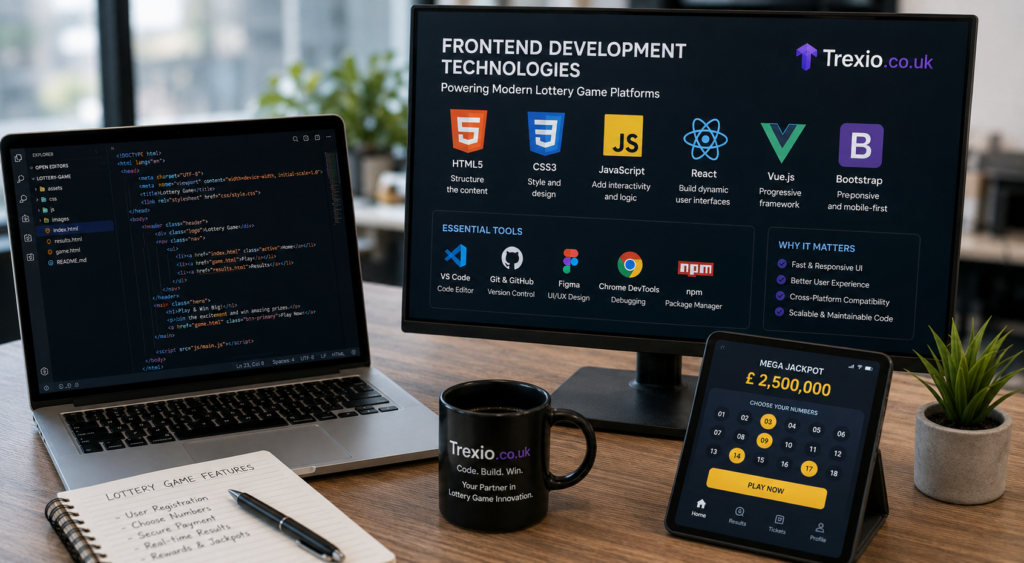
Frontend development determines how users interact with lottery applications across desktop and mobile devices. Modern interfaces prioritize speed, accessibility, responsiveness, and intuitive navigation to improve user satisfaction. Developers design dashboards that simplify ticket purchasing, account management, transaction history, and result tracking. Responsive layouts ensure consistent performance regardless of screen size or operating system. Interactive graphics, animations, and notifications enhance user engagement while maintaining fast loading speeds. Progressive Web App technologies further improve accessibility by allowing users to install lottery applications directly from browsers. Accessibility standards also ensure that users with disabilities can comfortably participate in lottery games. A well-designed frontend significantly contributes to the overall success of lottery game development platforms tools lotterygamedevelopers.
User Experience Design
An effective user experience reduces confusion while encouraging repeat participation. Clear navigation menus, readable typography, and logical workflows make applications easier to understand for both new and experienced players. Designers minimize unnecessary steps during ticket purchases to reduce abandonment rates. Visual consistency strengthens brand identity while improving usability. User-centered design also considers loading performance, accessibility, localization, and multilingual support. Continuous usability testing helps identify opportunities for interface improvements. Well-designed experiences build trust and increase long-term customer loyalty. User experience remains a critical competitive advantage within digital lottery platforms.
Backend Development Technologies
Backend systems power every core function of a lottery application, from ticket validation and random number generation to payment processing and reporting. Developers build scalable server architectures capable of supporting thousands or even millions of simultaneous users without compromising performance. Modern backend frameworks simplify API creation, database communication, authentication, and transaction management. Efficient caching mechanisms improve response times during peak traffic periods such as major jackpot announcements. Security protocols protect sensitive customer data while preventing unauthorized system access. Logging and monitoring tools help administrators quickly detect operational issues before they impact users. Automated backups improve disaster recovery capabilities and minimize downtime risks. Selecting reliable backend technologies is one of the most important decisions when building lottery game development platforms tools lotterygamedevelopers.
Database Technologies for Lottery Systems
Lottery applications generate enormous volumes of transactional data every day, including user accounts, purchased tickets, payment histories, game records, promotional campaigns, and analytics information. Database systems must deliver high availability, rapid query performance, and dependable backup capabilities to maintain operational stability. Developers typically optimize database architecture for both read-heavy and write-heavy workloads to ensure consistent responsiveness during peak activity. Data replication improves fault tolerance while reducing the risk of information loss. Strong encryption protects personally identifiable information and financial records from unauthorized access. Database indexing further improves search speed for reporting and customer support operations. Scalable storage solutions allow operators to accommodate continuous business growth without major infrastructure changes. Efficient database management forms another essential component of successful lottery game development platforms tools lotterygamedevelopers.
Cloud Infrastructure and Hosting Solutions
Cloud computing has become the preferred deployment model for modern lottery applications because it provides flexibility, scalability, and operational efficiency. Cloud platforms allow developers to increase computing resources automatically during periods of high demand and reduce capacity during quieter periods to optimize costs. Geographic redundancy improves service availability while supporting international audiences. Integrated monitoring services provide real-time insights into application performance, server health, and security events. Automated deployment pipelines accelerate software updates while reducing downtime. Disaster recovery planning becomes more reliable through distributed backups and infrastructure automation. Cloud-native architectures also simplify maintenance and future feature expansion. As lottery businesses continue growing globally, cloud infrastructure remains a cornerstone of lottery game development platforms tools lotterygamedevelopers.
API Integrations for Lottery Applications
Application Programming Interfaces (APIs) connect lottery platforms with external services that expand functionality without requiring developers to build every feature from scratch. APIs enable secure payment processing, identity verification, SMS notifications, email delivery, analytics, fraud detection, customer relationship management, and reporting systems. Well-designed integrations improve operational efficiency while ensuring consistent communication between multiple software components. Developers should prioritize secure authentication methods, rate limiting, encryption, and comprehensive documentation when implementing APIs. Reliable integration testing reduces compatibility issues and prevents service disruptions after updates. Modular API architecture also makes future expansion significantly easier as new technologies become available. Selecting dependable integrations contributes to a more stable, scalable, and feature-rich lottery ecosystem. Effective API management completes the technological foundation of professional lottery game development platforms tools lotterygamedevelopers.
Security and Compliance Considerations for Lottery Platforms
Security is one of the defining characteristics of successful lottery game development platforms tools lotterygamedevelopers because every transaction involves sensitive user information and financial data. Developers must implement multiple layers of protection instead of relying on a single security mechanism. End-to-end encryption safeguards communication between users and servers, while secure token management protects authentication sessions. Regular vulnerability assessments and penetration testing help identify weaknesses before attackers can exploit them. Compliance with regional gaming regulations is equally important because different jurisdictions have unique licensing, taxation, and responsible gaming requirements. Audit logs should record every critical system event, allowing operators to investigate suspicious activities and maintain transparency. Backup strategies and disaster recovery plans ensure business continuity even during unexpected infrastructure failures. By prioritizing security from the beginning of development, lottery businesses build trust, improve reliability, and create long-term value for players.
Responsible Gaming Features
Responsible gaming has become an essential requirement for modern lottery applications rather than an optional feature. Developers incorporate account limits, spending controls, cooling-off periods, and self-exclusion tools to encourage healthy participation. Age verification systems help prevent underage access while supporting legal compliance. Behavioral monitoring can identify unusual activity patterns that may require additional verification or intervention. Educational resources within the application also help players understand the odds, rules, and responsible gaming practices. Operators benefit from improved public trust when responsible gaming measures are clearly implemented. These features demonstrate that lottery game development platforms tools lotterygamedevelopers can support both commercial success and ethical operation. As regulations continue evolving, responsible gaming functionality will remain a key competitive advantage.
Artificial Intelligence in Lottery Game Development
Artificial intelligence is rapidly becoming an important component of lottery game development platforms tools lotterygamedevelopers by improving automation, customer support, analytics, and fraud detection. AI-powered systems analyze user behavior to identify suspicious transactions, helping operators reduce financial risks. Machine learning models also personalize promotions based on player preferences, increasing engagement without overwhelming users with irrelevant offers. Intelligent chatbots provide instant assistance for common questions, reducing support costs while improving customer satisfaction. Predictive analytics help operators understand participation trends and optimize marketing campaigns more effectively. AI also assists development teams by automating testing, identifying software bugs, and improving code quality. While AI should never influence random lottery outcomes, it can optimize nearly every operational process surrounding the platform. Organizations that adopt AI strategically often gain operational efficiency while delivering a better user experience.
AI Applications Beyond Automation
Beyond customer support and analytics, AI contributes to content personalization, multilingual assistance, and operational forecasting. Recommendation engines can suggest relevant games based on previous activity while maintaining responsible gaming guidelines. Image recognition technologies assist document verification during identity validation. AI-driven dashboards summarize business performance, enabling decision-makers to respond quickly to changing market conditions. Automated monitoring systems continuously analyze infrastructure performance and notify administrators about potential issues before they affect users. Voice-enabled interfaces may further improve accessibility in future lottery applications. These innovations illustrate how AI complements traditional development rather than replacing essential security and compliance practices. The future of lottery game development platforms tools lotterygamedevelopers will likely involve even greater collaboration between AI technologies and experienced software developers.
Mobile Lottery App Development Strategies
Mobile devices now account for a significant portion of online lottery participation, making mobile optimization an essential priority. Developers design interfaces that perform consistently across different screen sizes, operating systems, and hardware capabilities. Fast loading times improve user retention because players expect instant access to games and account information. Push notifications inform users about jackpot announcements, winning numbers, promotional campaigns, and account updates without becoming intrusive. Offline-friendly functionality can enhance the user experience by allowing ticket browsing even when internet connectivity is temporarily unavailable. Efficient battery usage and optimized network requests further improve application quality. Accessibility features ensure users with different abilities can comfortably interact with lottery services. Strong mobile strategies strengthen the overall effectiveness of lottery game development platforms tools lotterygamedevelopers in today’s competitive gaming market.
DevOps and Continuous Deployment for Lottery Platforms
Modern lottery software benefits significantly from DevOps practices that streamline development, testing, deployment, and maintenance. Continuous Integration and Continuous Deployment (CI/CD) pipelines automate software delivery while minimizing manual errors. Automated testing validates application functionality before updates reach production environments. Version control systems enable development teams to collaborate efficiently on large projects while maintaining complete change histories. Infrastructure as Code simplifies cloud resource management and ensures consistent deployment across multiple environments. Monitoring tools continuously evaluate application health, server performance, and security metrics. Rapid rollback capabilities reduce downtime if unexpected issues occur after software releases. These DevOps practices help lottery game development platforms tools lotterygamedevelopers maintain reliability while accelerating innovation.
Choosing the Right Development Platform
Selecting the appropriate platform depends on business objectives, technical requirements, budget, regulatory obligations, and future scalability plans. Organizations should evaluate available technologies based on long-term maintainability rather than only initial development costs. Flexible architectures allow developers to introduce new lottery formats without rebuilding the entire system. Vendor support, documentation quality, developer community activity, and integration capabilities should all influence platform selection. Businesses planning international expansion should prioritize multilingual support and localization features from the beginning. Performance benchmarks and independent security assessments also provide valuable insights during evaluation. Pilot projects help validate technology decisions before full-scale implementation. Careful planning ensures lottery game development platforms tools lotterygamedevelopers continue supporting business growth for years to come.
Platform Evaluation Checklist
| Evaluation Factor | Why It Matters | Priority |
|---|---|---|
| Scalability | Handles growing user traffic | High |
| Security | Protects financial and user data | Critical |
| API Support | Enables third-party integrations | High |
| Performance | Improves player experience | High |
| Compliance | Meets regional gaming laws | Critical |
| Cloud Compatibility | Supports flexible deployment | High |
| Maintenance | Reduces long-term costs | Medium |
| Documentation | Simplifies development | Medium |
Future Trends in Lottery Game Development

The lottery industry continues evolving as emerging technologies reshape player expectations and operational capabilities. Blockchain-based verification systems are being explored to improve transparency and strengthen public confidence in lottery operations. Cloud-native architectures will continue replacing traditional infrastructure because they provide greater flexibility and resilience. Artificial intelligence will further improve operational efficiency through predictive analytics, customer support, and automated monitoring. Cross-platform experiences will become increasingly seamless as users expect uninterrupted gameplay across multiple devices. Advanced cybersecurity technologies will remain a top investment as digital threats continue becoming more sophisticated. Enhanced personalization, responsible gaming innovations, and real-time analytics will further differentiate successful platforms from competitors. Businesses adopting forward-looking lottery game development platforms tools lotterygamedevelopers will be better positioned to adapt to changing market demands and technological advancements.
Best Practices
- Choose scalable architectures that support future business growth.
- Implement strong encryption for all sensitive user and payment data.
- Perform regular security audits and penetration testing.
- Design responsive interfaces for desktop, tablet, and mobile users.
- Use automated testing throughout the development lifecycle.
- Integrate trusted payment gateways with fraud prevention features.
- Maintain detailed audit logs for compliance and troubleshooting.
- Optimize application performance for high-traffic jackpot events.
- Follow responsible gaming regulations in every target market.
- Continuously monitor system performance and user feedback for improvements.
Common Mistakes
- Ignoring legal and regulatory requirements during planning.
- Selecting technology based only on short-term cost savings.
- Underestimating infrastructure requirements for peak traffic.
- Neglecting security updates after deployment.
- Poor database optimization that slows ticket processing.
- Failing to test integrations with payment providers.
- Overcomplicating the user interface with unnecessary features.
- Skipping disaster recovery planning and backup procedures.
- Ignoring accessibility standards for diverse user groups.
- Launching without comprehensive performance testing.
Pro Tips
- Build modular applications that allow features to be added independently.
- Automate repetitive testing to improve software quality.
- Monitor analytics to understand player behavior and optimize engagement.
- Prioritize cloud-native infrastructure for easier scalability.
- Invest in comprehensive documentation for future maintenance.
- Keep development frameworks and dependencies updated.
- Use monitoring dashboards to detect issues before users notice them.
- Design APIs with future integrations in mind.
- Balance innovation with regulatory compliance.
- Focus equally on security, usability, and long-term maintainability when selecting lottery game development platforms tools lotterygamedevelopers.
Conclusion
Building a successful lottery application requires far more than attractive graphics or basic ticket purchasing functionality. Modern lottery game development platforms tools lotterygamedevelopers combine secure infrastructure, scalable cloud technologies, intelligent APIs, responsive user interfaces, advanced analytics, and strict compliance measures into a unified ecosystem. Organizations that invest in reliable development platforms can deliver faster performance, stronger security, and better user experiences while reducing operational complexity. Careful technology selection, continuous testing, responsible gaming features, and proactive maintenance contribute directly to long-term business success. As artificial intelligence, cloud computing, and automation continue evolving, lottery platforms will become even more efficient and personalized. Developers who remain committed to industry best practices and emerging technologies will be well positioned to build innovative solutions that meet changing market expectations. By focusing on quality, transparency, and scalability, businesses can create lottery platforms that earn player trust and support sustainable growth for years to come.
Frequently Asked Questions
1. What are lottery game development platforms?
Lottery game development platforms are software frameworks and technologies used to build, manage, and maintain digital lottery applications with features like ticket sales, payment processing, security, and reporting.
2. Why are specialized tools important for lottery development?
Specialized tools simplify complex processes such as random number generation, payment integration, fraud prevention, compliance, and infrastructure management while improving development efficiency.
3. Which technologies are commonly used in lottery software?
Modern lottery applications typically use frontend frameworks, backend services, secure databases, cloud infrastructure, REST APIs, DevOps pipelines, and analytics platforms.
4. How important is cloud hosting for lottery applications?
Cloud hosting improves scalability, reliability, availability, disaster recovery, and performance, making it an ideal deployment model for growing lottery businesses.
5. Can lottery platforms support both web and mobile users?
Yes. Modern development platforms support responsive websites, Progressive Web Apps, Android applications, and iOS applications using shared backend services.
6. What security features should every lottery platform include?
Essential features include encryption, multi-factor authentication, secure payment processing, audit logging, fraud detection, regular backups, and continuous monitoring.
7. How does AI benefit lottery software?
AI assists with fraud detection, customer support, predictive analytics, automated testing, personalization, and operational monitoring while maintaining fair lottery operations.
8. What should businesses consider before selecting a development platform?
They should evaluate scalability, compliance, security, performance, integration capabilities, maintenance requirements, documentation quality, and long-term business goals.
9. Are lottery platforms customizable?
Yes. Most modern platforms provide modular architectures that allow developers to customize game types, payment methods, user interfaces, promotions, and administrative features.
10. How often should lottery software be updated?
Regular updates are recommended to improve security, maintain compliance, optimize performance, introduce new features, and address evolving user expectations.
Author Bio
Author: An experienced technology and gaming software writer specializing in online gaming infrastructure, cloud platforms, software architecture, cybersecurity, and digital transformation. With extensive research into lottery systems, development frameworks, and emerging technologies, the author creates practical, SEO-focused content that helps businesses and developers understand complex technical concepts while following Google’s EEAT and Helpful Content guidelines.