
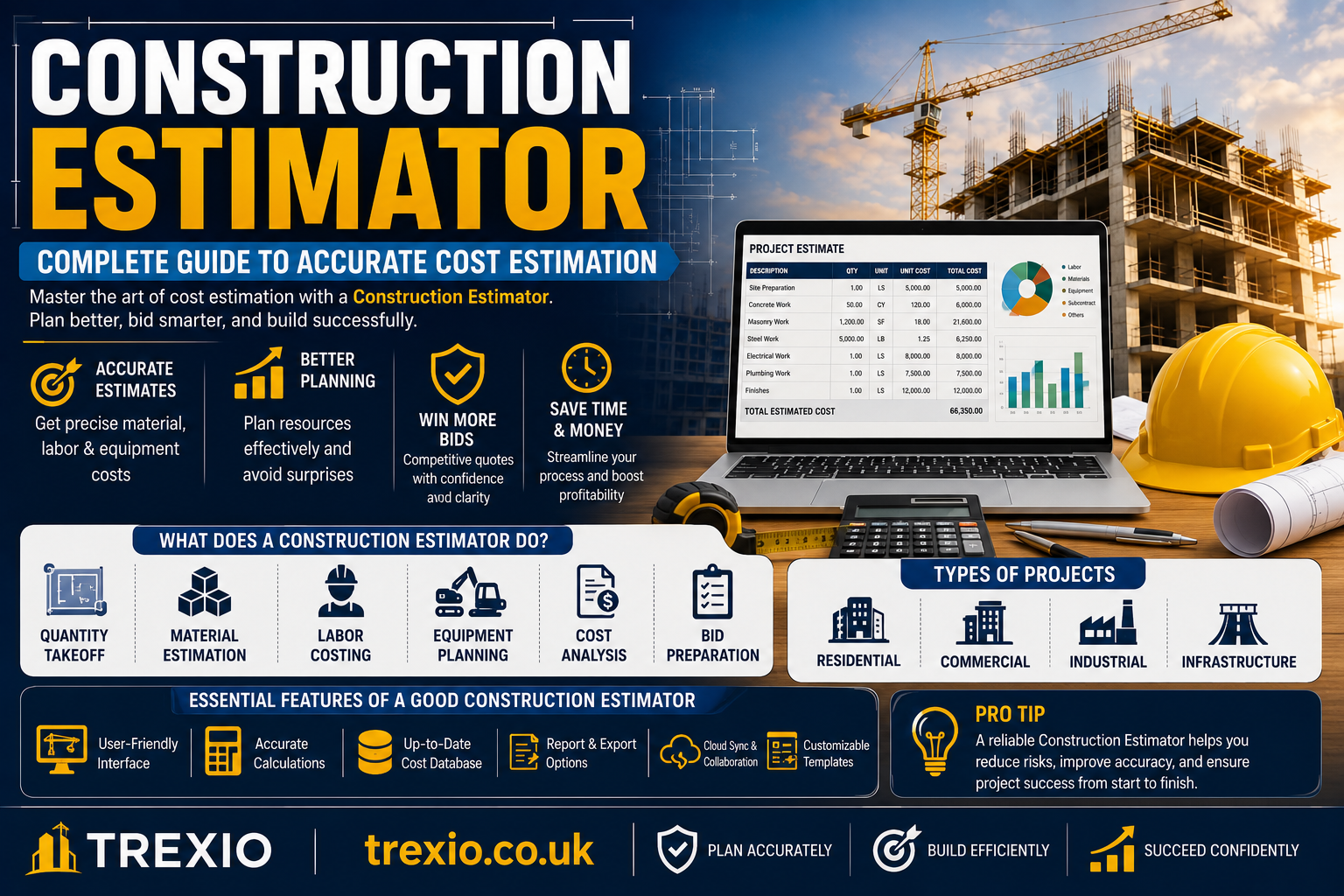
A construction estimator plays one of the most important roles in the building industry. Whether working on residential homes, commercial buildings, industrial facilities, or infrastructure projects, a construction estimator helps determine the expected costs before construction begins. Accurate estimates allow contractors, developers, and project owners to make informed decisions while reducing financial risks.
Today’s construction estimator relies on modern estimating software, digital takeoff tools, historical cost databases, and industry experience to prepare detailed project budgets. An experienced construction estimator evaluates labor, materials, equipment, subcontractor pricing, permits, overhead, and profit margins to produce reliable estimates that improve bidding success.
If you’re interested in becoming a construction estimator, hiring one, or choosing the best estimating software, this guide explains everything you need to know.
Quick Summary
- A construction estimator calculates project costs before construction starts.
- Accurate estimates reduce budget overruns and financial risks.
- Modern estimating software increases speed and accuracy.
- Every construction estimator must understand labor, materials, equipment, and scheduling.
- Digital takeoff tools simplify quantity calculations.
- Estimating skills are valuable for contractors, builders, architects, and project managers.
- The right software helps every construction estimator create competitive bids.
- Choosing the proper estimating solution depends on project size, budget, and workflow.
What Is a Construction Estimator?
A construction estimator is a professional responsible for forecasting the total cost of construction projects before work begins. Their estimates include direct costs like materials and labor, along with indirect expenses such as insurance, permits, equipment rentals, overhead, and contingency allowances.
The role of a construction estimator goes beyond simple calculations. They analyze architectural drawings, engineering specifications, supplier quotations, subcontractor bids, and market pricing trends to produce accurate cost projections.
Primary Responsibilities
- Reviewing blueprints
- Performing quantity takeoffs
- Calculating labor costs
- Estimating material requirements
- Comparing supplier prices
- Evaluating subcontractor bids
- Preparing bid proposals
- Monitoring project budgets
Why Accurate Construction Estimation Matters
Every successful construction project begins with a reliable estimate. An inaccurate estimate can lead to budget overruns, project delays, contract disputes, and reduced profitability.
A skilled construction estimator minimizes uncertainty by identifying potential expenses early. This allows contractors to submit competitive bids while maintaining healthy profit margins.
Benefits include:
- Better project planning
- Improved budgeting
- Reduced financial risks
- Higher bid success rates
- Better resource allocation
- Increased client confidence
Skills Every Construction Estimator Needs
Successful professionals combine technical knowledge with analytical thinking.
Important skills include:
Cost Analysis
Understanding labor productivity, equipment expenses, and material pricing helps a construction estimator produce realistic budgets.
Blueprint Reading
Reading architectural and structural drawings is essential for accurate quantity takeoffs.
Mathematics
Daily estimating involves measurements, unit conversions, percentages, and cost calculations.
Communication
Estimators regularly coordinate with contractors, architects, engineers, suppliers, and project owners.
Software Knowledge
Modern estimating software significantly improves efficiency and reduces manual errors.
Construction Estimation Process
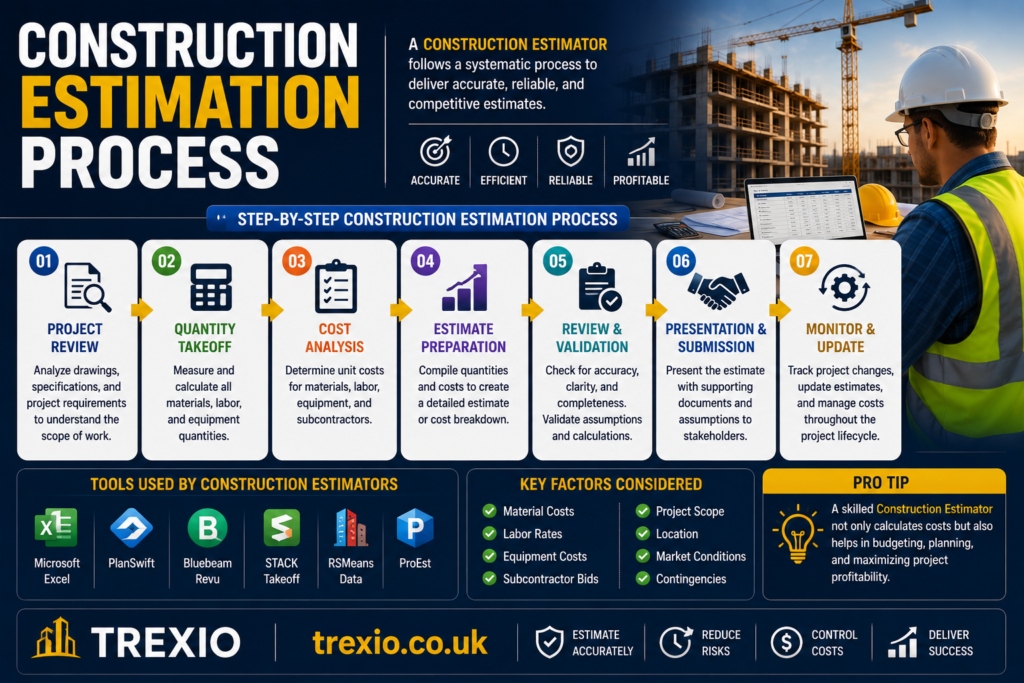
Although every company follows its own workflow, most estimating projects include these steps:
Review Project Documents
Study drawings, specifications, contracts, and design requirements.
Quantity Takeoff
Measure concrete, steel, lumber, drywall, roofing, flooring, and other materials.
Calculate Material Costs
Use supplier pricing and historical data to estimate procurement expenses.
Estimate Labor
Determine workforce requirements based on productivity rates.
Add Equipment Costs
Include machinery rentals, fuel, maintenance, and transportation.
Include Overhead and Profit
Finalize the estimate by adding indirect expenses and desired profit margins.
Best Construction Estimator Software
Comparison Table
| Software | Best For | Key Features | Platform | Pricing |
|---|---|---|---|---|
| ProEst | Large contractors | Cloud estimating, bid management, cost database, reporting | Web | Custom Quote |
| STACK | Digital takeoffs | Plan viewing, quantity takeoffs, collaboration, estimating tools | Web | Subscription |
| PlanSwift | Quantity takeoffs | Drag-and-drop measurements, material calculations, assemblies | Windows | Paid License |
| Buildertrend | Residential builders | Project management, estimating, scheduling, budgeting | Web & Mobile | Subscription |
| Sage Estimating | Enterprise construction | Advanced estimating, cost databases, reporting, integrations | Windows | Custom Pricing |
| Software | Best For | Key Features | Platform | Pricing |
|---|---|---|---|---|
| Autodesk Takeoff | BIM-based estimating | 2D & 3D quantity takeoffs, BIM integration, cloud collaboration | Web | Subscription |
| Bluebeam Revu | PDF markup and takeoffs | Measurement tools, document collaboration, customizable markups | Windows | Subscription |
| CostX | Professional estimators | Automated takeoffs, BIM support, cost planning, reporting | Windows | Custom Pricing |
| Buildxact | Small builders & remodelers | Estimating, quoting, scheduling, supplier integrations | Web & Mobile | Monthly Subscription |
| Trimble WinEst | Large commercial projects | Detailed estimating, historical cost database, reporting, ERP integration | Windows | Custom Pricing |
Feature Comparison Table
| Feature | ProEst | STACK | PlanSwift | Buildertrend | Sage Estimating | Autodesk Takeoff | Bluebeam Revu | CostX | Buildxact | Trimble WinEst |
|---|---|---|---|---|---|---|---|---|---|---|
| Digital Takeoffs | ✔ | ✔ | ✔ | Limited | ✔ | ✔ | ✔ | ✔ | ✔ | ✔ |
| Cloud Access | ✔ | ✔ | Limited | ✔ | Limited | ✔ | ✔ | Limited | ✔ | Limited |
| BIM Support | Limited | Limited | No | No | Limited | ✔ | Limited | ✔ | Limited | ✔ |
| Cost Database | ✔ | Limited | No | Limited | ✔ | Limited | No | ✔ | Limited | ✔ |
| Reporting | ✔ | ✔ | ✔ | ✔ | ✔ | ✔ | ✔ | ✔ | ✔ | ✔ |
| Collaboration | ✔ | ✔ | Limited | ✔ | ✔ | ✔ | ✔ | ✔ | ✔ | ✔ |
| Mobile Support | ✔ | ✔ | No | ✔ | Limited | ✔ | Limited | Limited | ✔ | Limited |
| Bid Management | ✔ | Limited | No | Limited | ✔ | No | No | Limited | Limited | ✔ |
Pricing Comparison Table
| Software | Free Trial | Starting Price | Best For |
|---|---|---|---|
| ProEst | Demo Available | Custom Quote | Enterprise Contractors |
| STACK | Yes | Subscription | General Contractors |
| PlanSwift | Limited Trial | One-Time/License Options | Independent Estimators |
| Buildertrend | Demo Available | Subscription | Home Builders |
| Sage Estimating | Demo | Custom Pricing | Large Businesses |
| Autodesk Takeoff | Trial Available | Subscription | BIM Projects |
| Bluebeam Revu | Trial Available | Subscription | Design & Estimating Teams |
| CostX | Demo | Custom Pricing | Professional Estimators |
| Buildxact | Free Trial | Monthly Subscription | Small Construction Companies |
| Trimble WinEst | Demo | Custom Pricing | Commercial Contractors |
Note: Prices and subscription plans may change over time. Check each vendor’s official website for the latest pricing.
How to Choose the Best Construction Estimator Software
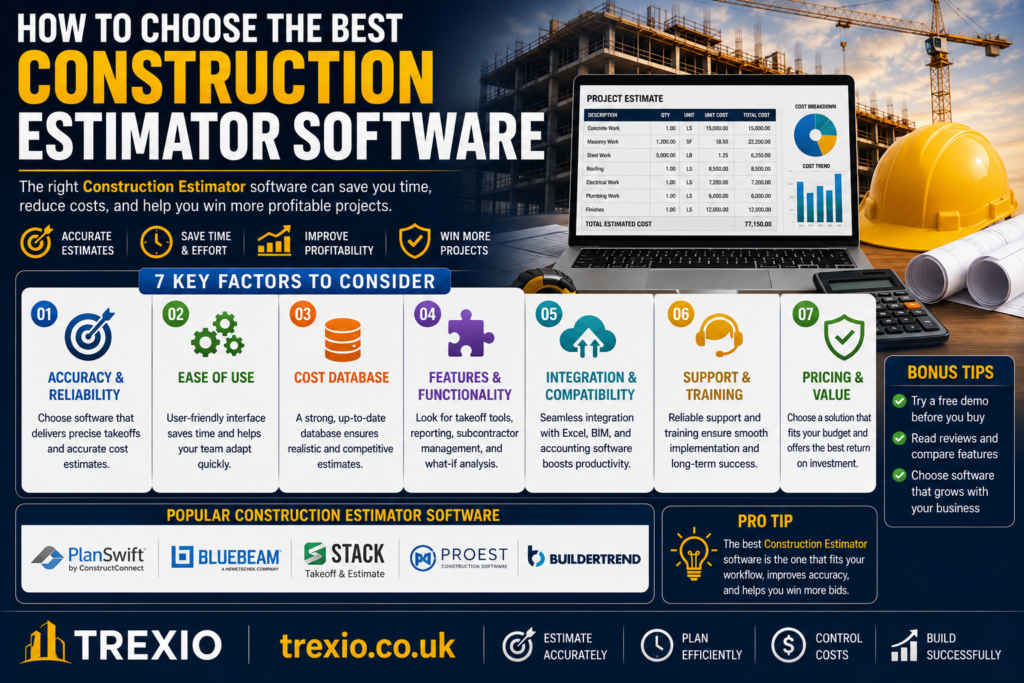
Selecting the right software depends on your company size, project complexity, and budget. Keep these factors in mind:
- Choose software that matches your project type (residential, commercial, or industrial).
- Look for digital takeoff capabilities to reduce manual calculations.
- Ensure it integrates with accounting, scheduling, or project management tools.
- Consider cloud-based solutions if your team works remotely.
- Compare subscription costs with the features provided.
- Check for BIM compatibility if you frequently work with 3D models.
- Evaluate reporting and collaboration features for team efficiency.
- Use free trials or demos before making a final decision.
Our Recommendation
For most contractors and estimating professionals, the best choice depends on business size:
- Best Overall: ProEst
- Best for Digital Takeoffs: STACK
- Best Value: PlanSwift
- Best for Residential Builders: Buildertrend
- Best Enterprise Solution: Sage Estimating
- Best BIM Workflow: Autodesk Takeoff
- Best PDF Measurement Tool: Bluebeam Revu
- Best Professional Cost Estimating: CostX
- Best for Small Businesses: Buildxact
- Best Commercial Estimating Platform: Trimble WinEst
If you’re just starting as a construction estimator, choose software that is easy to learn, supports accurate takeoffs, and fits your budget. As your projects grow, you can upgrade to more advanced platforms with BIM support and enterprise integrations.
Conclusion
A skilled construction estimator is essential for delivering successful construction projects on time and within budget. From analyzing blueprints and calculating material quantities to preparing competitive bids, the role combines technical expertise with financial planning. Modern estimating software further improves accuracy, reduces manual work, and streamlines collaboration across teams.
Whether you’re an aspiring construction estimator, an experienced contractor, or a construction business owner, investing in the right skills and software can improve project outcomes and profitability. By understanding your workflow, comparing available tools, and selecting a solution that matches your needs, you’ll be better equipped to create reliable estimates and win more projects.
Frequently Asked Questions (FAQs)
1. What does a construction estimator do?
A construction estimator calculates the expected cost of labor, materials, equipment, permits, and other expenses before a project begins.
2. Is a construction estimator a good career?
Yes. It offers strong demand, competitive salaries, and opportunities in residential, commercial, and industrial construction.
3. Which software is best for a beginner construction estimator?
PlanSwift and STACK are commonly chosen by beginners because of their user-friendly interfaces and efficient takeoff tools.
4. What qualifications are needed to become a construction estimator?
Many employers prefer a degree or diploma in construction management, engineering, quantity surveying, or a related field, along with practical estimating experience.
5. How accurate should a construction estimate be?
A professional estimate should be as accurate as possible using current pricing, detailed plans, and realistic productivity assumptions.
6. What is a quantity takeoff?
A quantity takeoff measures the materials and quantities required for a construction project, forming the basis of a cost estimate.
7. Can estimating software replace a construction estimator?
No. Software improves efficiency, but professional judgment, experience, and market knowledge remain essential for accurate estimates.
8. Why is estimating important in construction?
Accurate estimating helps control costs, improve planning, reduce financial risk, and increase the chances of winning profitable bids.
Quick Bio
About the Author
This guide was created for construction professionals, contractors, project managers, and anyone interested in becoming a construction estimator. It provides practical insights into estimating principles, software comparisons, and best practices to help readers make informed decisions and improve the accuracy of construction cost estimates.