
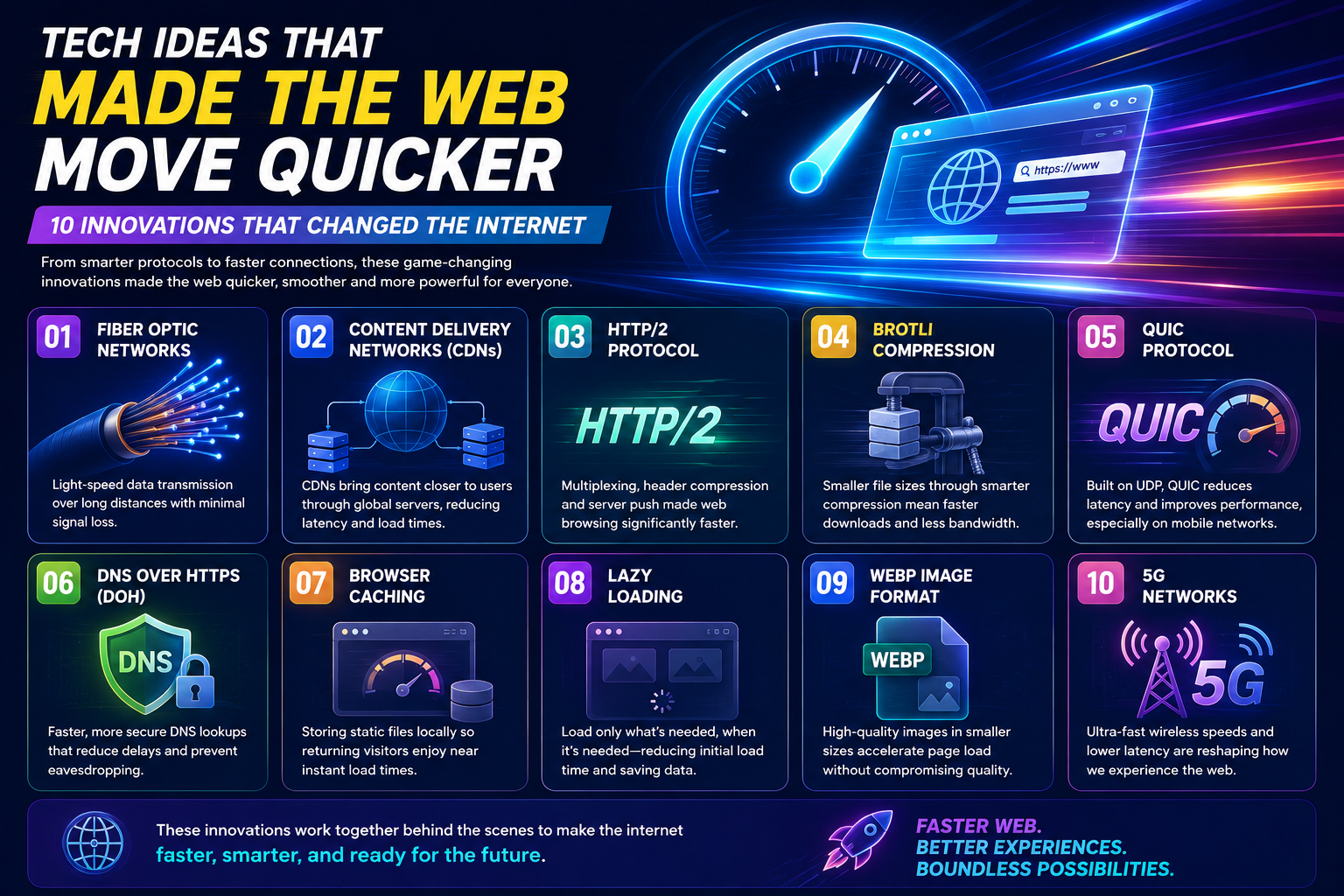
The internet we use today feels almost instant, but it wasn’t always that way. Early websites loaded slowly, videos buffered constantly, and online applications struggled to keep up with growing demand. Over the years, several tech ideas that made the web move quicker completely changed the browsing experience.
From content delivery networks and caching systems to modern web protocols, these innovations reduced loading times and improved reliability. Businesses, developers, and users all benefited from these tech ideas that made the web move quicker.
In this article, we’ll explore the most influential technologies and software platforms behind the faster internet we enjoy today. Understanding these tech ideas that made the web move quicker helps explain why modern websites feel dramatically faster than they did a decade ago.
Quick Summary
Here are the major tech ideas that made the web move quicker covered in this section:
- CDNs (Content Delivery Networks) – Deliver content from servers closer to users.
- Browser Caching – Store website assets locally for faster reloads.
- HTTP/2 – Send multiple requests through a single connection.
- Gzip & Brotli Compression – Reduce file sizes dramatically.
- Cloudflare – One of the most widely used performance and security platforms.
These innovations are among the most important tech ideas that made the web move quicker and helped create today’s high-speed internet experience.
Why These Tech Ideas Matter
When people search for tech ideas that made the web move quicker, they’re usually referring to technologies that reduced latency, improved data delivery, and optimized how browsers communicate with servers.
These tech ideas that made the web move quicker impacted:
- Website loading speed
- Video streaming quality
- Online gaming performance
- E-commerce conversions
- Mobile browsing experience
- Cloud applications
Top Software Behind Faster Web Performance
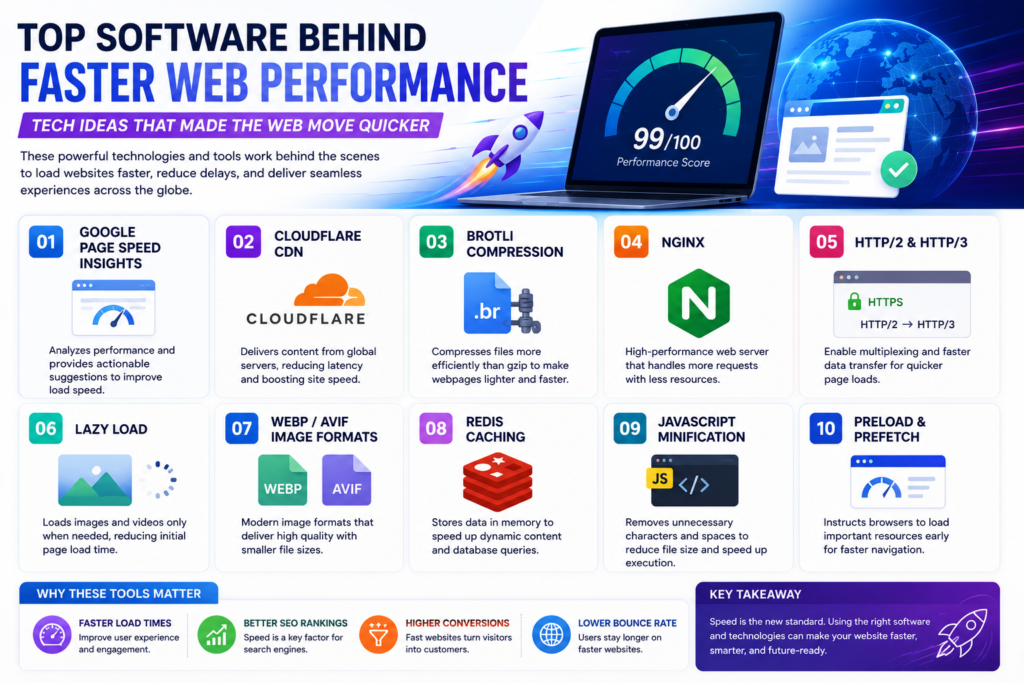
Below are five major platforms and technologies often associated with the tech ideas that made the web move quicker.
Comparison Table
Software
Main Contribution
Cloudflare
Cloudflare became famous for using a global CDN and smart caching to speed up websites. It represents one of the most successful tech ideas that made the web move quicker.
Akamai
Akamai pioneered large-scale content delivery networks, bringing website content closer to users worldwide. This was a major breakthrough among tech ideas that made the web move quicker.
NGINX
NGINX improved server performance by handling thousands of connections efficiently. Many modern websites rely on it as part of the tech ideas that made the web move quicker.
Google PageSpeed
Google PageSpeed introduced optimization techniques such as compression, caching, and image optimization. These recommendations became standard tech ideas that made the web move quicker.
Amazon CloudFront
Amazon CloudFront uses edge servers around the world to reduce latency and accelerate content delivery, making it another example of tech ideas that made the web move quicker.
How These Innovations Changed the Internet
Content Delivery Networks (CDNs)
CDNs are among the most important tech ideas that made the web move quicker. Instead of loading a website from one distant server, users receive content from a nearby location.
This reduces:
- Latency
- Server load
- Page load times
- Bandwidth costs
Browser Caching
Another of the tech ideas that made the web move quicker is browser caching. Images, CSS files, and JavaScript are stored locally so repeat visits load much faster.
HTTP/2
HTTP/2 introduced multiplexing, allowing multiple files to be transferred simultaneously through one connection. This innovation became a core part of the tech ideas that made the web move quicker.
Compression Technologies
Gzip and Brotli compression shrink website files before they’re sent to users. Smaller files mean faster downloads, making compression one of the simplest tech ideas that made the web move quicker.
| Software | Main Contribution |
|---|---|
| LiteSpeed Web Server | A high-performance web server that improves website speed through advanced caching, HTTP/3 support, and optimized resource handling. |
| Varnish Cache | An HTTP accelerator that stores frequently requested content in memory, reducing server load and speeding up page delivery. |
| Redis | An in-memory data store used for caching databases, sessions, and API responses to significantly reduce response times. |
| Fastly | An edge cloud platform that delivers content closer to users, reducing latency and improving website performance worldwide. |
| Bunny CDN | A lightweight and affordable content delivery network known for fast global delivery, image optimization, and edge caching. |
Feature Comparison Table
| Software | CDN | Caching | HTTP/3 | Compression | Security | Best For |
|---|---|---|---|---|---|---|
| Cloudflare | ✔ | ✔ | ✔ | ✔ | ✔ | All websites |
| Akamai | ✔ | ✔ | ✔ | ✔ | ✔ | Enterprise businesses |
| NGINX | ✖ | ✔ | ✔ | ✔ | Basic | High-traffic servers |
| Google PageSpeed | ✖ | Optimization | N/A | ✔ | ✖ | Performance optimization |
| Amazon CloudFront | ✔ | ✔ | ✔ | ✔ | ✔ | AWS users |
| LiteSpeed | ✖ | ✔ | ✔ | ✔ | Basic | WordPress hosting |
| Varnish Cache | ✖ | ✔ | ✖ | ✖ | ✖ | Dynamic websites |
| Redis | ✖ | Memory Cache | ✖ | ✖ | ✖ | Database acceleration |
| Fastly | ✔ | ✔ | ✔ | ✔ | ✔ | Large-scale applications |
| Bunny CDN | ✔ | ✔ | ✔ | ✔ | Basic | Small to medium businesses |
Pricing Comparison Table
| Software | Free Plan | Starting Price |
|---|---|---|
| Cloudflare | Yes | Free / Paid plans from around $20/month |
| Akamai | No | Custom enterprise pricing |
| NGINX | Open Source | Free / Enterprise pricing available |
| Google PageSpeed | Yes | Free |
| Amazon CloudFront | No | Pay-as-you-go |
| LiteSpeed | No | License-based pricing |
| Varnish Cache | Community Edition | Enterprise pricing available |
| Redis | Open Source | Free / Managed cloud pricing |
| Fastly | Trial Available | Usage-based pricing |
| Bunny CDN | No | Pay-as-you-go with low monthly costs |
How to Choose the Right Software

Selecting the right tool depends on your website’s size, traffic, and technical requirements.
Choose Cloudflare if:
- You need security and speed in one platform.
- You want an easy setup.
- You run a business website or blog.
Choose Akamai if:
- You manage enterprise-level traffic.
- You require a worldwide delivery network.
- Your organization needs advanced performance optimization.
Choose NGINX if:
- You manage your own servers.
- You need excellent web server performance.
- You host high-traffic websites.
Choose LiteSpeed if:
- Your website runs on WordPress.
- You want built-in caching.
- Your hosting provider supports LiteSpeed.
Choose Bunny CDN if:
- You need affordable global content delivery.
- You operate a small or medium-sized website.
- You want simple pricing.
Choose Fastly if:
- Your application serves users worldwide.
- You need edge computing capabilities.
- Your business depends on real-time content delivery.
Choose Redis or Varnish Cache if:
- Database performance is your bottleneck.
- You need ultra-fast caching.
- You manage dynamic applications.
Our Recommendation
If you’re looking for the best overall solution among the tech ideas that made the web move quicker, Cloudflare stands out as the top choice. It combines a global CDN, caching, compression, DDoS protection, and modern protocol support into a single platform that suits businesses of all sizes.
For enterprise organizations, Akamai remains a leading option thanks to its extensive global infrastructure. Developers managing their own servers often prefer NGINX or LiteSpeed for their performance and flexibility.
Small businesses and personal websites can benefit from Bunny CDN due to its affordability, while applications with heavy database usage should consider Redis and Varnish Cache to reduce response times.
Conclusion
The internet has evolved dramatically thanks to innovative tech ideas that made the web move quicker. Technologies such as content delivery networks, browser caching, HTTP/2, HTTP/3, compression algorithms, and advanced web servers have transformed the way websites perform.
The software discussed in this guide demonstrates how these innovations work together to reduce latency, improve reliability, and create a smoother browsing experience. Whether you’re a developer, business owner, or technology enthusiast, understanding these tech ideas that made the web move quicker can help you build faster, more efficient websites.
As the web continues to evolve with edge computing, AI-powered optimization, and newer networking protocols, these foundational technologies will remain essential to delivering a fast and responsive online experience.
Frequently Asked Questions (FAQs)
What are the biggest tech ideas that made the web move quicker?
Content Delivery Networks (CDNs), browser caching, HTTP/2, HTTP/3, Brotli compression, and edge computing are among the most significant innovations.
What is a CDN?
A Content Delivery Network stores copies of website content on servers around the world so users receive data from the nearest location.
Why is Cloudflare so popular?
Cloudflare combines security, caching, DNS services, and a global CDN into one platform, making websites faster and more secure.
Does caching really improve website speed?
Yes. Caching stores frequently accessed files so they don’t need to be downloaded again, reducing loading times significantly.
What is HTTP/3?
HTTP/3 is the latest version of the HTTP protocol. It uses the QUIC transport protocol to provide faster and more reliable connections.
Which software is best for WordPress?
LiteSpeed, Cloudflare, and NGINX are among the most popular performance solutions for WordPress websites.
Are these technologies useful for small businesses?
Absolutely. Even small websites benefit from CDNs, caching, compression, and optimized web servers because they improve user experience and search engine rankings.
Will faster websites help SEO?
Yes. Faster loading times improve user experience and are a positive ranking factor, making performance optimization an important part of modern SEO.
Quick Bio
About the Author
This article was created by a technology writer specializing in web performance, cloud computing, SEO, and digital infrastructure. The goal is to simplify complex technical concepts into practical guidance that helps developers, businesses, and website owners build faster, more reliable online experiences.